
.avif)
Thoughtful conversations with innovative leaders from across the political spectrum to get your fix of news, cutting-edge analysis and ideas.


There’s a critical mass of evidence pointing to the ways in which our politics and political system are broken. So the real question is: what can we do about it? Democracy Fix is a podcast hosted by Dr. Carah Ong Whaley from Issue One, a cross partisan organization working to fix our broken political system and build an inclusive democracy that works for everyone. Join us for thoughtful conversations with innovative leaders from across the political spectrum to get your fix of news, cutting-edge analysis and ideas that will inspire you to join the broader movement to fix democracy.
In this episode, hosts Carah Ong Whaley, Angelina Clapp, and Mia Minkin sit down with King County, WA Director of Elections Julie Wise for a deep dive into the county’s award-winning initiatives to ensure all voices are heard in elections. Known for her passionate advocacy for voter accessibility and election transparency, Wise discusses the critical role of trained, nonpartisan election administrators in preserving democracy.
She highlights the challenges faced by election officials across the country, including the need for consistent and reliable federal funding, the impact of the spread of false election information, and the rise in threats against election workers. Despite the challenges, Wisee’s dedication to increasing voter participation and improving election systems remains unwavering.
Whether you're a policy wonk or just curious about what goes on behind the scenes in our elections, this episode is packed with insights on how to build a more inclusive and transparent democratic process.
Tune in to hear about the inspiring work being done in King County, WA to strengthen the foundation of our democracy.
Episode links:
Minnesota Secretary of State Steve Simon joins Issue One’s Dr. Carah Ong Whaley and Liz Cassin to discuss the challenges posed by the spread of false election information and the importance of directing voters to credible sources. Recently, Grok, an AI chatbot operated by X (formerly known as Twitter), disseminated false information regarding ballot laws in nine states. In response, Sec. Simon and four other secretaries of state wrote a letter to Elon Musk, urging him to correct the misinformation. Sec. Simon highlights the broader challenges posed by AI models that often fail to provide accurate voting information and suggests a simple, proactive solution: directing users to accurate resources like CanIVote.org.
Our conversation also delves into the challenges posed by the spread of false information on social media. “I think social media companies have a really big and serious responsibility to the voters in this country,” Sec. Simon tells us. “They have an obligation to make sure that their users, all Americans, have accurate information.” Sec. Simon draws a distinction between platform-generated misinformation and user-generated content: “There are at least two ways that mis- and disinformation can come about. One is when users on a particular platform say the wrong thing, either unintentionally or intentionally. And while I can see that's tougher to police, it's not impossible to police. And when a particular post, maybe one that has a particularly large audience and penetration, is discovered, it's not an unreasonable request to reach out to these companies and ask them to do something about it.”
Minnesota has been at the forefront of legislative efforts to combat misinformation, including new laws that limit the use of deepfakes in campaigns. The state has also implemented laws to protect election workers from rising threats, harassment and intimidation that has resulted from the proliferation of false election information.
Links in this episode:
Despite a toxic information environment, election officials are stepping up to meet the moment and make elections more safe and secure in 2024. One of the leaders is Arizona Secretary of State Adrian Fontes, a member of Issue One’s Faces of Democracy campaign, who just won a Clearinghouse Award for Outstanding Innovation in Election Cybersecurity and Technology.
In this episode, Secretary Fontes talks about how election officials are preparing for the challenges posed by the spread of false information, generative artificial intelligence technologies, the need for reliable federal funding for elections, and why ordinary Americans should step up and serve as poll workers this election year.
Be sure to listen through to the end of our conversation to learn about a not-so-secret talent Secretary Fontes has, why “Ferris Bueller’s Day Off” is his favorite movie, and which historical figure he would most like to meet.
Links in this episode:


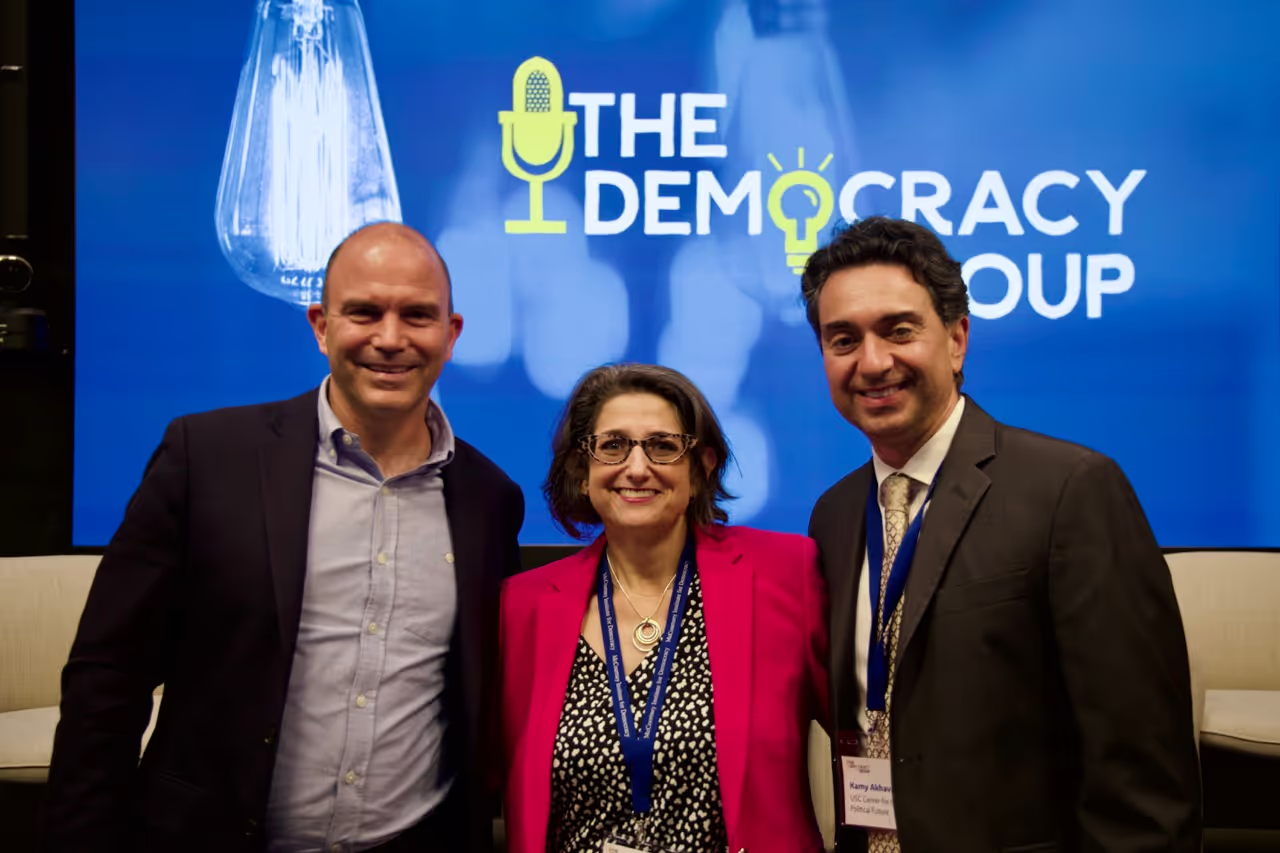
Ben Rhodes, Jessica Tarlov join our network convening.

We're excited to welcome the newest addition to The Democracy Group: New Faces of Democracy — a series of conversations with modern-day heroes and regular citizens from all walks of life who are using their talents and skills to transform the political landscape.

Faced with an increasing number of young Americans who are losing faith in U.S. democracy, a Democracy Journal article advocates for an innovative way to approach one of the pillars of a democratic society — civic education.

We welcome five students from around the country who are all about storytelling, civic engagement, and, most importantly, creating their own podcasts! These Gen Z leaders are ready to get to work!

The States United Democracy Center, recipients of the McCourtney Institute for Democracy's Brown Democracy Medal, recently surveyed nearly 8,000 Americans to gauge their attitudes about elections, voting and political violence.

We're excited to welcome the newest addition to The Democracy Group: Democracy Fix — a new podcast by Issue One that highlights how organizations and individuals across the country are working to fix our political system.
Engaging in civil discourse. Inspiring civic engagement. Exploring the future of our democracy.
Join our community and never miss your favorite episodes from the Democracy Group.
Subscribe to our Newsletter


.avif)



.avif)

.avif)





.avif)

