

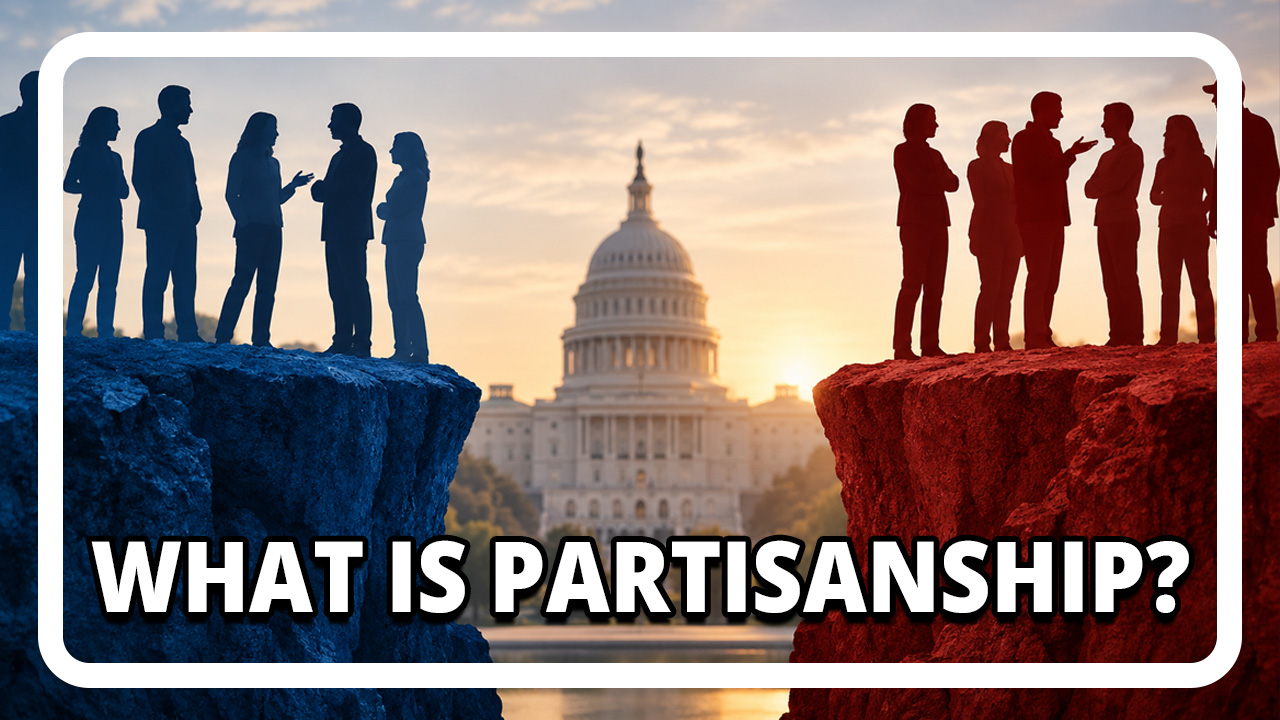
Political parties give voters a way to organize around shared goals, elect representatives, and influence what government does. Partisanship—the support of or alignment with a particular political party or candidate—is therefore a normal part of democratic politics. But what happens when supporting your side becomes less about advancing ideas and more about defeating theirs?
At its extreme, partisanship can turn politics into an us-versus-them contest. Political affiliation can become intertwined with our personal and social identities, disagreement can become moral judgment, and opponents can begin to look less like fellow citizens with different ideas and more like threats. When that happens, the consequences can extend beyond heated arguments at the dinner table. Hyperpartisanship can affect how we govern, how we participate in elections, how willing we are to compromise, and even whether we view the political system—and one another—as legitimate.
So why does partisanship have such a powerful hold on us? And can we remain politically engaged without treating politics like a war between opposing teams?
Drawing on expert conversations from podcasts across The Democracy Group, this article explores what partisanship is, how America's partisan divide developed, and the psychology that turns political affiliation into social identity. We'll examine affective polarization, negative partisanship, moralization, and the consequences that can follow when partisan conflict escalates. Most importantly, we'll look at ways to transcend destructive partisanship—from creating political pathways that cross party lines to cultivating more complex identities, approaching disagreement with curiosity, and learning how to seek the truth together.
Partisanship may divide us into teams. Understanding why we form those teams—and how we learn to live with the other one—is part of the work of democracy.
Subscribe to receive a biweekly collection of the hottest podcast episodes from the network, upcoming special events, expert features, and news from your favorite shows.
Subscribe to our NewsletterPartisan means supporting, advocating for, or aligning with a political party or candidate. It’s about promoting a party’s platform, elevating its representatives, or working to get them elected.
To understand why partisanship matters, it’s helpful to first understand what a political party is and what it seeks to accomplish. Julia Azari and James Wallner, hosts of Politics in Question, help define political parties.
Julia Azari:
“I think the broadly understood definition is that it's a coalition of people who seek office and who have some shared goal. And part of what breaks down is the shared goal. There's often disagreement about to what degree it is just about gaining office. Is it about shared ideological predispositions? Is it about a shared set of policy goals? And if so, how many of those goals need to be shared in order for a party to be, I guess, a party—to be a responsible party?”
James Wallner then adds an important distinction between a political party and other political organizations.
James Wallner:
“I would actually go a little bit more basic and contrast parties with, say, interest groups or advocacy groups. Political parties are designed to influence what government does from within government, whereas interest groups are designed to influence what government does from outside of government.”
“And not all parts of the party are within the government, obviously. But all of their activities are geared in some way toward nominating candidates, winning elections, taking office, and making policy within government. So that's really the distinction I see.”
If the goal of a political party is to influence government from within, then a partisan is someone who supports a party or candidate in pursuing that influence. All well and good. However, that support can sometimes become extreme, leading to what Lee Drutman, another host of Politics in Question, describes as hyperpartisanship.
Lee Drutman:
“I think the hyperpartisanship that people are concerned about is real. I think it's more about identity than it is about issues, and it's more about the fact that we have two parties that are roughly equally balanced, equally competitive for control of national institutions, and yet represent completely different geographies and completely different values.”
He describes those competing coalitions and then explains the psychological consequences:
“And we have those two parties competing really for the soul of America, and both sides fear that if the other side gets into power, they will be living in a country that they no longer recognize, that doesn't share their values.”
“And this narrow competition for power really is in conflict with our political institutions, which demand broad compromise. It drives us all crazy because it turbocharges the us-versus-them thinking that is inherent in the human brain.”
“And it is driving this increasing political escalation of constitutional hardball, of no-compromise politics in which both sides dig in harder and harder.”
“And what we're losing in this process is the shared sense of legitimacy and fairness on which our democracy depends. If we can't even agree on how to define the truth, if we are engaged in completely separate epistemological worlds, how do we agree on a fair process to resolve our disputes?”
Imagine you have an uncle who watches every Packers game and roots for his team no matter how well they're doing. He doesn't support them only when they're winning. Even when they're playing poorly, making bad decisions, or doing things he disagrees with, he still supports his team. Even if he secretly thinks another team is better, he'll root for the Packers every time.
There are people who approach politics similarly. They pick a team and want their side to win. In its more extreme forms, that can mean supporting their side even when they disagree with what it is doing or dismissing the other side even when it might have a point. Winning becomes especially important because winning determines who gets to hold office, make policy, and influence the direction of government.
That's partisanship.
Listen to the full episode on Politics in Question: Do Americans need more parties?
Although strong partisanship is often seen as a problem today, there was a time when political scientists worried about the opposite: America's two major parties seemed too similar, leaving voters without a clear choice between them.
Lilliana Mason, associate research professor of political science at Johns Hopkins University's SNF Agora Institute and Department of Political Science, explains how the modern concept of partisanship emerged from political science research during this period. Lee Drutman then explains how the parties gradually became more distinct, eventually causing some of their once-prominent ideological factions to disappear.
Lilliana Mason:
“Part of it is just an accident of history—the way that American political scientists developed the concept of partisanship. And honestly, the measure that we use today of partisanship all happened during research that was conducted during the 1950s.”
“During that period of time, there wasn't very strong partisanship. Eisenhower didn't even know which party he was going to run under when he ran for president. And people really didn't think of people in the other party as enemies.”
“There was actually so little distinction between the parties in the 1950s that the American Political Science Association put out a report saying, ‘It's really important that the parties become more distinct.’ People need very different cues coming from different parties. We need to know that they stand for different things.”
“And so it was during that period of time that the founders of political thought around American partisanship came up with their theories of partisanship.”
Listen to the full episode on Democracy Works: The roots of radical partisanship
Lee Drutman:
“I know a lot of people will say, ‘Well, haven't we always had two political parties?’ And, yeah, we have, but the political parties were these really broad, big-tent, catch-all parties that had incredible diversity within them.”
“And so there was incredible overlap in the two parties. And for a long time in American democracy, the complaint was not that the parties were too far apart, but that they were too similar, and voters didn't have a clear choice.”
Over the following decades, however, that began to change.
“There was a broad realignment that took about 50, 60 years, as the parties shifted and there was incredible nationalization of the party system.”
As that realignment took place, some of the ideological factions that once existed within both parties largely disappeared.
“And so conservative Democrats eventually went extinct. Liberal Republicans eventually went extinct.”
Listen to the full episode on Politics in Question: Do Americans need more parties?
Democracy—and the work of understanding and cooperating with people we disagree with—does not always come naturally to us. Peter Ditto, professor of psychological science at the University of California, Irvine, explains that some of the same human tendencies that draw us into groups can also make cooperation across political divides difficult.
Peter Ditto:
“Democracy is this incredible, wonderful human experiment, but it runs counter to almost all of our evolutionary tendencies, right?”
“I mean, we're built to sort of separate people—the us's and them's. We're very groupy, you know, by nature. That was our evolutionary niche.”
“And so it's easy to get people to separate and group up. It's much harder to get people to cooperate and behave nicely with people who don't look like you, who don't share your values in particular.”
“Real democracy is just kind of reaching across and being able to tolerate people who believe things that you just don't believe, and somehow vow to work together.”
“And that's really new. It's really hard, and it's really hard to maintain. You have to work to keep that up.”
Listen to the full episode on Outrage Overload: Political Sectarianism: The Role of Outrage Porn — Peter Ditto
Lilliana Mason explains that a two-party system can intensify us-versus-them competition by making electoral politics a zero-sum contest: when one party wins power, the other loses it. As our political affiliation becomes intertwined with our social identity, political victories and defeats can begin to feel personal, making us more emotionally invested in protecting the status of our group.
Lilliana Mason:
“The two-party system does make things more antagonistic because it turns politics into a zero-sum competition. When one party wins, the other party loses by definition, and so every election becomes this dire competition for status.”
Mason explains that understanding partisanship through the lens of social identity helps explain why political affiliation can produce such powerful emotional responses.
“We realized that we're using psychology that studies intergroup conflict and applying it to Democrats and Republicans. But we were missing a step because, in order to actually apply that theory, you first have to explain that being a Democrat or being a Republican is itself a social identity.”
“It's not a set of policy preferences. It's not a rational choice. It is a sense of psychological connectedness with other people who share that identity, and so we feel emotionally connected to the status of that social group.”
Mason and her colleagues spent years investigating whether partisan identity could explain political behavior independently of people's policy preferences.
“There had been a little bit of work kind of trying to make this point before, but what we did was basically to say, ‘How can we just throw all the data that we possibly can at this and really prove this part first?’”
“And so that was the paper that we ended up writing, and that took eight years, just really demonstrating that when people are participating in politics, all of their sense of themselves as a person in the world is wrapped up in the status of their party.”
That connection between political affiliation and personal identity can help explain why politics generates such strong emotions.
“And actually, they become active in politics, and they get emotional. They get angry and enthusiastic. All of these things that we think of as just, like, a normal part of politics—all that is driven by the identity part. It's not driven by the policy preferences part.”
This distinction is supported by Mason's published research, which found that partisan identity was more strongly associated with campaign involvement and emotional reactions to electoral victories and losses than strong positions on important policy issues.
Listen to the full episode on Democracy Works: The roots of radical partisanship
Partisan behavior is not necessarily limited to people who explicitly identify as Democrats or Republicans. Mason explains that some Americans who call themselves independents nevertheless consistently favor one of the two major parties.
Lilliana Mason:
“Basically, what they showed was that the people who call themselves independents often behave very much like partisans. They vote in every election. They always vote for the same party. They consume media that's consistent with their party preference.”
The distinction, she explains, may be less about whether they have political preferences and more about whether they want to participate in the conflict associated with partisan politics.
“But they really don't like conflict, and when they think about politics, they think of it as a sort of nasty sport that they want nothing to do with.”
“They don't want to participate in the fight, but they care a lot about what happens on the other end. They're just as sad when their party loses, and they're just as happy when their party wins.”
“They just don't want to participate in the nasty politics of the day-to-day political atmosphere of American politics.”
Listen to the full episode on The Great Battlefield: Partisan Identity and Political Violence with Lily Mason of SNF Agora Institute
In other words, rejecting a partisan label does not necessarily mean someone lacks partisan preferences or behaviors. Some self-described independents consistently lean toward one party while distancing themselves from the social identity or conflict associated with openly partisan politics. Research on political independents has similarly found an important distinction between how Americans identify themselves and how they behave politically.
Once politics becomes part of our social identity, how we perceive the other side becomes increasingly important. Mónica Guzmán, journalist and senior fellow for public practice at Braver Angels, explains that our perceptions of political opponents can become distorted and exaggerated, fueling suspicion and fear.
Mónica Guzmán:
“We would not be as divided if we had a clear view of how the other side felt, because what we see in the social science research when we ask people, ‘What do you think the other side believes?’ is alarming exaggerations. And those exaggerations justify our deep suspicion and fear.”
“A lot of our division is based on how we feel about each other and how we think the other side feels about us. And when that's exaggerated, it motivates behaviors that are actually not that justified.”
One way researchers describe this phenomenon is affective polarization: the tendency for partisans to feel positively toward their own political group and negatively toward the opposing group. Unlike ideological polarization, which concerns differences in political beliefs and policy preferences, affective polarization concerns how people feel about one another.
Mónica Guzmán:
“Affective polarization is the polarization that results from the feelings about each other, and if you look at the data, it's very disturbing. The amount to which one side really despises the other has increased, and the extent to which we're motivated by stopping the other side has just gotten bigger and bigger.”
“It does not track with what's called ideological polarization—the actual divisions and disagreements at the base of our policies and our ideas.”
Richard Davies:
“In other words, it's not that we're getting more right- or left-wing in our political views. It's that how we see the other has changed.”
Mónica Guzmán:
“Exactly. How we see the other has changed, and it is not in direct relationship to the actual disagreements that we hold.”
Guzmán explains that these perceptions can change when people have opportunities to interact directly with those on the other side.
“A lot of the time, Braver Angels hosts these incredible workshops that bring people together in certain structures so they can understand each other. And so many times, at the end of those workshops, people are asked, ‘So what did you take away from this?’ And people will say, ‘I had no idea that we weren't as divided as I thought.’ People on either side will say that.”
“But it's just that we don't give each other that many opportunities to actually engage with someone outside of these platforms where we do so much performance and signaling, to know the truth—which is that we really are not that divided. The anger and the rage that we see out there that defines our division doesn't actually exist that much on the one-to-one level.”
Listen to the full episode on How Do We Fix It?: Successful Conversations Across Difficult Divides. Mónica Guzmán
Peter Ditto explains that our perceptions of the other side can go beyond disagreement over the quality of its ideas or policies. Political disagreements can become moralized, transforming the other side from people who are simply wrong into people who are perceived as bad.
Peter Ditto:
“There's kind of two ways that politics works, in a rough sense. You could think of the classic way we think about it: You've got these two parties. They all have the same goal of trying to have an effective government. One party's got one kind of idea—liberal ideas. Another's got conservative ideas. But you're the noble opposition. I know you're trying to get to the same place, but your ideas are bad, right?”
“One idea is our ideas are better or worse. At worst, that gets you to, ‘You're stupid,’ right? It's more like you're misguided or maybe you're wrong, in the noblest sense. But it can get you to, ‘Those guys are stupid.’”
Ditto argues that political conflict can take on a different character when disagreements become moralized.
“That's not the way politics works these days, right? It feels like it's about morality. It's not that the other side is stupid. It's that the other side is evil. They're bad. It's not like we have different ideas about how to get to the same place. We want to get to different places, right? We have these totally different sort of moral goals about what to achieve with government, and it starts to feel a lot more like religion.”
“And so we got to this idea of sectarianism, right? It's like we have these two parties. It's like this fight in this civil religion, where each side feels like they have the founders' goals in mind: They really wanted this; they really wanted that.”
“And if you don't believe that, you're wrong. And if you start to talk about agreeing with the other side, well, you're an apostate. It's not just that you're wrong or misguided. It's like you're morally wrong. You're bad. You should be sanctioned somehow.”
“So liberals and conservatives, Democrats and Republicans, kind of feel more like Sunnis and Shias than they do political parties. And that's kind of the feeling that you get.”
“And that's really the problem—this kind of metastasized, moralized political environment, how much the two sides really dislike each other and really feel like the other side is taking the country on the wrong moral path.”
Recent research on affective polarization similarly identifies moralization, along with othering and aversion, as an important component of the phenomenon.
Listen to the full episode on Outrage Overload: Political Sectarianism: The Role of Outrage Porn — Peter Ditto
When political disagreements become moralized, people can begin to view their own side's positions as righteous while seeing the other side's positions as potentially catastrophic. Guzmán explains that this dynamic can produce fear—and that people may treat their own political fears as legitimate while dismissing the other side's.
Mónica Guzmán:
“One of the big problems right now across the political divide—the big assumption that people are making over and over again—is, ‘My side's fears are real. That side's fears are imagined.’ That's not true.”
“I've talked to plenty of people across the divide, really genuine, open conversations, and what I have seen that's in people's hearts tells me that is not true.”
“Something closer to the truth is that each side has a mix of fears that are grounded in very reasonable concerns backed up by what's going on, and they have fears that are grounded in hyperbole, exaggeration, and rhetoric that is not serving us.”
“So each side has to figure out the difference.”
Listen to the full episode on Making Peace Visible: In America, a braver way to talk about politics
This fear can contribute to another phenomenon known as negative partisanship. Rather than being motivated primarily by support for one's own party, negative partisanship involves political attitudes and behavior driven by opposition to, dislike of, or fear of the opposing party. Political scientists have commonly distinguished this from positive attachment to one's own party.
Political scientist Rachel Bitecofer describes the concept in terms of the threat people perceive when the opposing party holds political power.
Rachel Bitecofer:
“Negative partisanship refers to the feeling of threat and fear that you get when you're being subjected, especially, to the rule of the opposition party. So it's a very strong emotion, particularly when you're out of the presidency.”
Listen to the full episode on Future Hindsight: Employ Negative Partisanship: Rachel Bitecofer
If partisan identities become stronger, emotions run high, and political opponents increasingly view one another as threats, what happens to a democracy in which those same people are supposed to work together to govern?
The consequences can range from difficulties finding broadly acceptable solutions and distorted political incentives to disengagement, escalating hostility, and—in more extreme cases—support for political violence.
Christine Todd Whitman, national co-chair of the Forward Party, argues that when one party dominates government, policymakers can become more focused on solutions that appeal to their political base rather than considering a broader range of perspectives.
Christine Todd Whitman:
“It means you’re not getting the kind of governance that you deserve. When you see one-party rule, be it Republican or Democrat, it’s not healthy. I mean, as governor, I had a Republican House and Senate, and I would have much preferred to have had one of those two houses in the hands of the other party.”
“In fact, for some of the most controversial things I did, I did it with the Democrats. It’s just not healthy. You look across the country where you have one-party governance, and things aren’t the way people would want them to be in the cities, in the states where you have that. It’s not a healthy place.”
“It doesn’t give you the kind of options on solutions to problems because there will only be one way of looking at it—through that party’s prism, not through the lens of what’s good for everybody. But what’s going to really help my base? Because that’s what you care about, because that’s what keeps you in office.”
Listen to the full episode on The Context: One-Party Governance is Not Healthy Democracy
Partisanship can also shape the incentives built into elections themselves. Mark Gaber, senior director of redistricting at Campaign Legal Center, gives the example of partisan gerrymandering, in which electoral district boundaries are drawn to advantage a political party, incumbent, or candidate rather than neutrally represent voters.
Mark Gaber:
“There's racial gerrymandering, which is drawing district lines with a predominant view toward the racial makeup of the district. And then, setting aside race, there's also partisan gerrymandering. Partisan gerrymandering, as it sounds, is drawing district lines to benefit one political party over the other or one incumbent or politician over another.”
“Throughout American history, this has been an endemic problem of drawing district lines to thwart the will of the voters and instead create a situation where politicians could insulate themselves from accountability.”
“The problem ends up with unfair representation in our government and then, as a result of that, distorted policies that don't reflect the views of the voters.”
Listen to the full episode on Democracy Decoded: How Gerrymandering Undermines Fair Representation
Strong party divisions can also leave some voters feeling alienated from the party system altogether. Grace Rauh, executive director of Citizens Union, points to New York City's closed primary system as an example of how choosing not to affiliate with a political party can affect a voter's ability to participate in certain elections.
Grace Rauh:
“Right now, we have more than 1 million registered voters in New York City who have chosen to not be members of a political party. They don’t want to join the Democratic Party. They don’t want to be Republicans, and they do not have a voice in these really critical early primary elections.”
“We need to open up our closed partisan primary system to let that fastest-growing group of voters who have chosen not to be part of a party participate. They’re rejecting the party system. They probably have a lot of reasons for doing that, but we should be allowing them to participate in our early elections, which have been so consequential historically.”
Listen to the full episode on Good Government: Vote, Citizens Union is trying to get you to the Polls
The consequences can become more serious when each political group begins to view itself as an embattled minority fighting against a more powerful opponent. Bill Mattox, senior director of the J. Stanley Marshall Center for Education Freedom at the James Madison Institute, explains how people on different sides can simultaneously perceive themselves as politically or culturally disadvantaged.
Bill Mattox:
“Both sides today feel as though they are the embattled minority.”
“Liberals do so because they look at Washington and they say, ‘The Supreme Court, the House, the Senate, and the presidency are all in Republican, conservative hands,’ or whatever.”
“And then, similarly, conservatives look at Hollywood and academia and mass media and all the rest and say, ‘We're the embattled minority.’”
Liz Joyner, founder and president of The Village Square, explains what can happen when both sides enter political conflict with that perception of existential threat.
Liz Joyner:
“If you come into an interaction with the sense that this is existential for your group because you are so powerless, then it licenses you to behave in ways that make it so much worse.”
“And then, if you imagine how that looks to the other group—who feels that they are the powerless ones.”
“So this very powerful group is rising up in this very illiberal, aggressive behavior. It has a tendency to just push the vicious cycle faster and faster and faster in a really tragic way.”
In other words, one group's actions can reinforce the other group's perception that it is under threat, potentially creating a feedback loop in which each side views its own behavior as defensive and the other's as aggressive.
Listen to the full episode on Village Squarecast: Flying Pig Academy: Conservative 101 for Liberals and Liberal 101
At its most extreme, strong partisan identity can become associated with dehumanization, moral disengagement, and even support for political violence. Lilliana Mason describes this combination of attitudes as radical partisanship.
Lilliana Mason:
“The way that we are thinking about radical partisanship, first of all, is we ask people questions, but we have two main concepts.”
“The first is what we call moral disengagement, which is a set of attitudes that, usually in other places and contexts, are attitudes that precede mass violence. So they're basically vilification—people in the other party aren't just wrong about politics; they're downright evil—and dehumanization, where they shouldn't be treated like humans because they behave like animals.”
“Those are the types of attitudes that often precede mass violence because they allow people to harm members of another group without feeling morally bad, right? They don't have to worry about the consequences for themselves morally because they've already distanced themselves morally from this other group of people.”
The second component concerns people's willingness to accept political violence itself.
“And the second set of attitudes are actually violent attitudes. So, to what extent is it okay to engage in violence to achieve your political goals? Is it okay to threaten leaders from the other party? Is it okay to threaten regular people from the other party?”
“So those are the two main categories of what we're calling radical partisanship.”
Mason explains that her research identified two important predictors of these attitudes. The first was a person's general tendency toward aggression, independent of politics.
“One is just regular aggressiveness. So, unrelated to politics, people who say, when they answer a question like, ‘Have you ever been in a fight before? Do you get angry easily?’—those types of nonpolitical attitudes—people who are just aggressive tend to be more likely to endorse these morally disengaged and violent attitudes.”
But another consistent predictor was the strength of a person's psychological identification with a political party.
“The second thing that's a consistent predictor of these attitudes is just a really strong identification with a party. So we ask questions like, when you talk about your party, to what extent do you say ‘we’ rather than ‘they’? It's really about a psychological identification with the party.”
“And the people who feel really identified with their party are much more likely to either dehumanize or vilify and also to endorse violent action for political goals.”
Listen to the full episode on Democracy Works: The roots of radical partisanship
Partisanship does not have to inevitably lead to division. If some of the problems we've explored arise from sorting people into opposing camps, attaching our identities to those camps, and viewing the other side with suspicion, then bridging the partisan divide requires finding ways to interrupt those patterns.
Lee Drutman suggests starting with the political system itself. Rather than reinforcing a binary us-versus-them competition, he argues that political systems can introduce more complexity and create alternative ways for people to organize and cooperate.
Lee Drutman:
“You wanna set up a political system that challenges that us-versus-them way in which the human mind is prone to work, and you wanna have a system that sets up a bunch of alternative frameworks so that things become actually more complex and not so black and white.”
Listen to the full episode on Politics in Question: Do Americans need more parties?
Political action does not always have to occur strictly through one party or the other. Jon Grinspan, curator of political history at the Smithsonian's National Museum of American History, describes how reform movements have historically created what was called an “invisible third party” capable of building coalitions across partisan lines.
Jon Grinspan:
“More than change growing from one party or the other, you get this—what they called an invisible third party of reform—that isn't working solely through one party. It isn't just Democratic, isn't just Republican, but is able to build chunks and factions of each party and of voters to really make a difference."
Ballot initiatives can provide another avenue for political participation outside of candidate- and party-centered elections. Luke Mayville, co-founder of Reclaim Idaho, explains that voters may approach ballot initiatives differently because they do not necessarily categorize them in the same way they do political parties and candidates.
Luke Mayville:
“One of the great things about ballot initiatives that we found is people don't immediately place ballot initiatives in the same compartment in their mind that they place parties and candidates.”
“Our initiative campaigns, if we do our work, come across as just good-natured, well-intentioned civic enterprises. And that's been powerful for us.”
Listen to the full episode on When the People Decide: The invisible third party of reform
Changing political structures is one approach, but another involves how we think about our own identities.
Lilliana Mason explains that each of us has many social identities rather than just one, and those identities can shift in importance depending on the context.
Lilliana Mason:
“All of the research in identity, in social identity, had been about one identity. But, of course, we all have many, many, many identities, and they shift and change depending on the context, really.”
The important factor, however, isn't simply the number of identities we have. Mason points to psychologist Marilynn Brewer's research on social identity complexity—the extent to which our different group identities overlap with one another.
Lilliana Mason:
“What she was finding was that the people who had identities that were complex—meaning that not everybody from one of the groups is also in another group, as opposed to less complex identities...”
“What she found was that people who had more complex identities were more tolerant of outsiders. They were more kind of humanistic in their sense of the world.”
“It's not that they didn't identify with the group that they were in. It was that they were more open to people who were not in their group.”
Listen to the full episode on The Great Battlefield: Partisan Identity and Political Violence with Lily Mason of SNF Agora Institute
In other words, imagine that your political affiliation, religion, profession, neighborhood, hobbies, and social circle all divide people into essentially the same two groups. Nearly everyone who shares one identity with you also shares the others. Your world can easily become divided into a clear us and them.
But when those identities cross partisan boundaries—your political opponent is also your neighbor, coworker, fellow church member, teammate, or friend—the boundary between “us” and “them” becomes more complicated. Research on social identity complexity has found that people whose different group memberships overlap less tend to show greater tolerance toward out-groups.
We can also change how we interact with people across the partisan divide. Mónica Guzmán suggests beginning by separating understanding from agreement. Listening to someone, asking questions, or trying to understand how they arrived at their beliefs does not require endorsing those beliefs.
Mónica Guzmán:
“I think that that's one of the big myths about this. That's just not at all what happens. We conflate conversation and engagement with endorsement and agreement, as if we're that vulnerable, as if just hearing somebody out or engaging them is already agreeing or endorsing. And it's not.”
Instead, Guzmán recommends approaching political disagreement with curiosity. Her broader work on political division similarly emphasizes curiosity as a way of testing our assumptions about people across political divides rather than relying on what we imagine they believe.
Mónica Guzmán:
“Curiosity is a state of mind that you can turn on. You can willingly make yourself curious. It can help us see a different way and get us out of the win-lose mode or the attack-defense mode that gets us repeating these toxic cycles.”
Even the way we phrase a question can change the conversation. Rather than asking someone why they believe something, Guzmán suggests asking how they came to believe it.
“When you want to ask why people believe what they believe, instead ask how they came to believe what they believe. When you ask people how instead of why, you're asking for their story.”
“They take you on a tour instead of you putting them on trial. That's the thing you want to avoid.”
“As curious and wonderful as the question ‘why’ is, in contexts of distrust, it can often just get people's guard up and put you into that place where you're really just trying to defend yourselves at all costs, at which point you're not really focused on learning and understanding anymore.”
Listen to the full episode on How Do We Fix It?: Successful Conversations Across Difficult Divides. Mónica Guzmán
Finally, bridging partisan divides doesn't mean ignoring disagreements about facts. Instead, Guzmán suggests changing how we try to resolve those disagreements.
Much of our information consumption happens individually, which means we encounter facts, arguments, and sources without seeing how someone with a different perspective interprets the same information.
Mónica Guzmán:
“Mostly, the way people consume their information is alone—themselves and the screen, themselves and the screen. So the opportunity to check with somebody else or watch someone else's reaction to the same piece of information you're looking at is gone, right?”
Guzmán describes moments when she and her mother encounter factual disagreements and make a deliberate effort to investigate them together.
“So those moments where my mom and I have actually gotten to that point in a conversation where we realize we disagree on what's true, and then we're able to say, ‘Well, let's look it up,’ it's tough because there's that moment where I go, ‘Ugh, I don't wanna look it up. Like, what a waste of my time.’ And she'll kind of think the same thing.”
“We both have to get over that for ourselves to do it.”
Rather than each person retreating to their own sources and returning with evidence for their position, they search for answers together.
“But learning together, I think, would be—if I could wave a magic wand, I would have more and more of us look up information together because we would absorb it very differently.”
“When we come to a place where we don't agree on something, we do research together. We go and Google it together. We search for the answer, and then we say, ‘Oh, there you go.’”
“And usually we're both a little bit right and a little bit wrong.”
The goal isn't necessarily to reach agreement. It's to replace the instinct to defeat the other person with an effort to understand the other person and investigate the disagreement together. That allows people to remain political opponents on an issue without automatically treating one another as enemies.
Listen to the full episode on Making Peace Visible: In America, a braver way to talk about politics
Partisanship isn't inherently the enemy of democracy. Political parties give people a way to organize around shared values, advocate for policies, and choose between competing visions for government. You can be a Democrat, Republican, independent, or something else entirely—and care deeply about your political beliefs.
The problem begins when your party becomes more than something you support and starts determining who you trust, who you respect, and who you are willing to listen to. When politics becomes an us-versus-them battle, it becomes easier to exaggerate what the other side believes, dismiss their fears while validating our own, assume bad intentions, and treat compromise as surrender.
As an average citizen, you may not be able to change the party system or eliminate polarization across the country. But you can change how you participate in it.
Build relationships and identities that cross political lines. Seek out conversations with people who disagree with you rather than relying on your own side to tell you what they believe. Ask how someone came to a conclusion before assuming you know why. When you disagree about the facts, investigate them together. Pay attention to moments when you're judging an argument based on who said it rather than what was said. And remember that listening to someone isn't the same as agreeing with them.
None of this requires becoming less politically engaged, abandoning your values, or pretending that every disagreement has an easy middle ground. Some disagreements are real and consequential. Understanding another person's position may ultimately leave you just as opposed to it as you were before.
But democracy asks something harder than agreement. It asks people who fundamentally disagree to continue sharing a political system, accepting one another as legitimate participants in it, and finding ways to govern together.
You don't have to stop rooting for your team. You just have to remember that the people wearing the other jersey are citizens, too.
Subscribe to receive a biweekly collection of the hottest podcast episodes from the network, upcoming special events, expert features, and news from your favorite shows.
Subscribe to our NewsletterBrandon Stover is the Network Manager for The Democracy Group and a Digital Content Specialist at the McCourtney Institute for Democracy. He leads partnerships and collaborations across the podcast network, oversees educational content strategy, and produces written, audio, and video content while managing the network's digital marketing efforts. Before joining the McCourtney Institute for Democracy, Brandon founded and led a nonprofit organization dedicated to creating free educational content on global issues. He holds a master's degree in Architecture from Washington State University.
What is partisanship, and why does it divide us? Learn the psychology, consequences, and ways Americans can bridge the partisan divide.

What are the main types of government, and where does your country fall on the democracy-to-authoritarian spectrum? Learn the differences between democracy, republics, monarchies, oligarchies, anocracies, authoritarianism, and totalitarianism through expert insights from political scientists, historians, and democracy advocates featured across The Democracy Group podcast network.
Lindsey Cormack discussed civic education, common misconceptions about government and what to expect from her new podcast "Government That Doesn't Suck."

Engaging in civil discourse. Inspiring civic engagement. Exploring the future of our democracy.
Join our community and never miss your favorite episodes from the Democracy Group.
Subscribe to our Newsletter