

In simple terms, partisanship means picking a political team and supporting that side. A partisan tends to support a particular political party or its candidates and wants them to succeed. This is a normal part of politics, just as sports fans naturally root for their team. But partisanship can become a problem when loyalty to the team becomes more important than evaluating its actions fairly, or when people begin treating those on the other side as enemies rather than fellow citizens with different political views.
One simple way to understand partisanship is to think about sports.
Imagine you have an uncle who watches every Green Bay Packers game. He's a lifelong Packers fan. When the Packers are great, he roots for them. When they're terrible, he still roots for them. They might make bad decisions. He might disagree with the coach. Another team might objectively be playing better football.
It doesn't matter. When Sunday comes around, he's wearing green and gold and rooting for the Packers.
Why?
Because they're his team.
Partisanship can work similarly in politics. A person identifies with a political party, supports its candidates, and wants that party to win elections and gain political power. The original meaning is fairly straightforward: being partisan means supporting, advocating for, or aligning with a particular political party or candidate.
Just as supporting a football team isn't inherently bad, neither is supporting a political party. Political parties give people a way to organize around shared goals, elect representatives, and influence government. Having different parties also gives voters competing choices about how government should operate.
The sports analogy becomes particularly useful when we consider why partisanship can become so powerful.
Political scientist Lilliana Mason explains that political affiliation can function as a social identity. Being a Democrat or Republican isn't necessarily just a collection of opinions about taxes, healthcare, immigration, or other policies. People can develop a psychological connection with others who share their political identity.
That means politics can start to feel personal.
If your party wins, we won.
If your party loses, we lost.
And because the United States primarily has two major political parties, elections often operate like a zero-sum competition. One side's victory necessarily means the other side's defeat. Mason argues that this structure can make political competition particularly antagonistic because each election becomes a competition between two opposing groups for political power and status.
The problem isn't simply having a team. It is what happens when your team winning becomes more important than everything else.
Return to our Packers fan.
Imagine that a referee makes a questionable call benefiting Green Bay. If the same call benefited the opposing team, your uncle would be furious. But because it helped the Packers, he suddenly thinks the referee made the right decision.
Or perhaps another team makes a smart play. Instead of admitting it was a good play, he dismisses it simply because he dislikes the other team.
Something similar can happen in politics. People may defend behavior from their own party that they would criticize if the opposing party did it. They may dismiss an idea because it came from the other side rather than evaluating the idea itself. In more extreme forms, political competition becomes less about advancing policies and more about making sure the other team loses.
This connects to what researchers call affective polarization: feeling increasingly positive toward your political group and increasingly negative toward the opposing group. Those feelings do not necessarily correspond to how far apart people actually are on policy. Sometimes, how much people dislike the opposing group can exceed their actual political disagreements.
Partisanship simply means having a political team and supporting that team. A Democrat who consistently supports Democratic candidates is displaying partisanship, just as a Republican who consistently supports Republican candidates is.
That political loyalty isn't automatically harmful. Parties are an important way people organize and participate in democratic government.
The danger comes when politics becomes entirely about our team versus their team. When winning becomes more important than judging ideas fairly, compromising when necessary, or recognizing the legitimacy of political opponents, ordinary partisanship can become hyperpartisanship. Political opponents stop looking like people who happen to wear a different jersey and start looking like enemies.
Being a fan of your political team is one thing. Believing the other team shouldn't be allowed on the field is something very different.
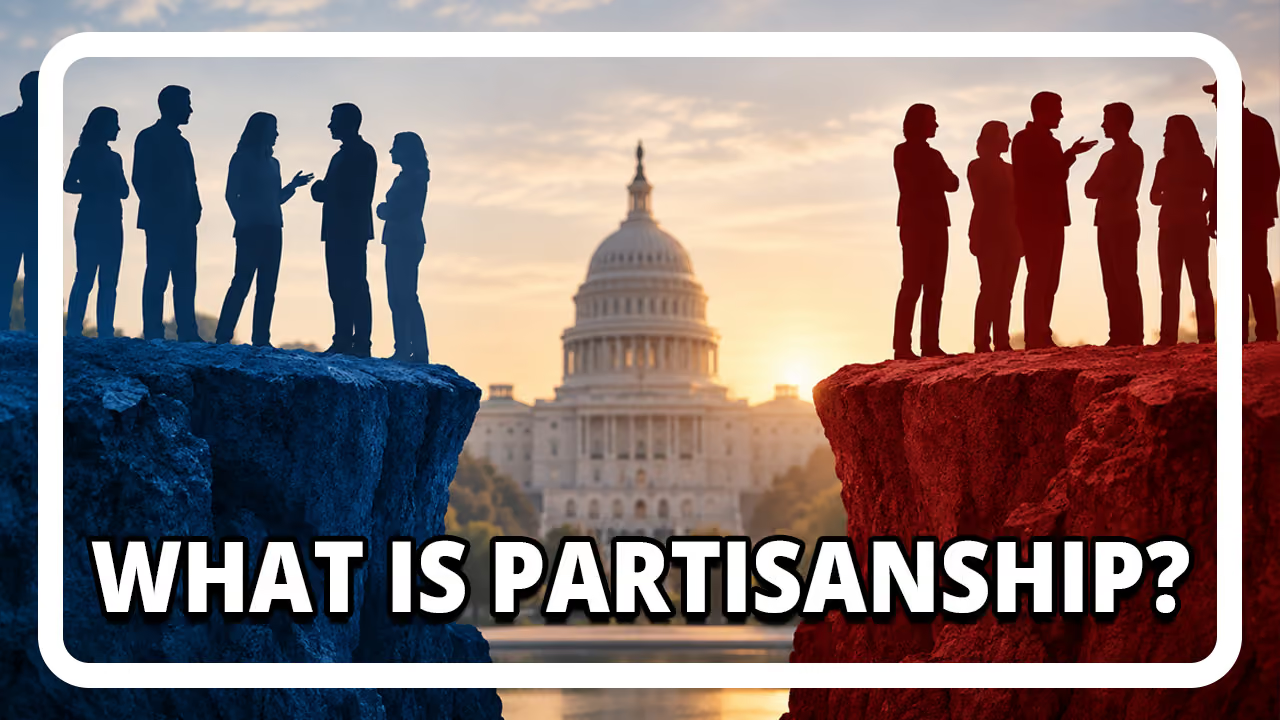
What is partisanship, and why does it divide us? Learn the psychology, consequences, and ways Americans can bridge the partisan divide.
Read PostSubscribe to receive a biweekly collection of the hottest podcast episodes from the network, upcoming special events, expert features and news from your favorite shows.
Subscribe to our NewsletterPartisanship means supporting, advocating for, or aligning with a particular political party or candidate. A partisan generally supports a party’s goals, promotes its platform or candidates, and wants that party to gain political power. Partisanship is a normal feature of democratic politics because political parties organize people around shared goals and compete to influence government. However, strong partisanship can become divisive when loyalty to a political party becomes part of a person’s social identity and politics turns into an “us versus them” competition.
Partisan means supporting or favoring a particular political party, candidate, or political side, while bipartisan means involving cooperation or agreement between two political parties. In the United States, bipartisan usually refers to Democrats and Republicans working together on legislation, policies, or other political goals. Partisanship is a normal part of democracy because parties compete to win elections and influence government, while bipartisanship occurs when members of competing parties find enough common ground to work toward a shared objective.
Partisan politics is not inherently good or bad. Some partisanship is a normal and useful part of democracy because political parties organize voters around shared goals, offer competing ideas for government, and give citizens meaningful choices in elections. Partisanship becomes harmful when loyalty to a political party becomes more important than evaluating ideas fairly, accepting legitimate election outcomes, compromising with opponents, or maintaining shared democratic rules. The problem, therefore, is less partisanship itself than hyperpartisanship—when ordinary political competition becomes an us-versus-them struggle in which defeating the opposing party takes priority over governing together.
Negative partisanship is when a person’s political behavior is driven more by dislike, fear, or opposition toward another political party than by support for their own. A negative partisan may vote for a candidate not because they particularly like that candidate, but because they strongly want to prevent the opposing party from winning. In this way, negative partisanship turns political competition from “I want my side to win” into “I need the other side to lose.” It can intensify polarization because political opponents increasingly come to be viewed as threats rather than simply people with different political preferences.
Brandon Stover is the Network Manager for The Democracy Group and a Digital Content Specialist at the McCourtney Institute for Democracy. He leads partnerships and collaborations across the podcast network, oversees educational content strategy, and produces written, audio, and video content while managing the network's digital marketing efforts. Before joining the McCourtney Institute for Democracy, Brandon founded and led a nonprofit organization dedicated to creating free educational content on global issues. He holds a master's degree in Architecture from Washington State University.
Engaging in civil discourse. Inspiring civic engagement. Exploring the future of our democracy.
Join our community and never miss your favorite episodes from the Democracy Group.
Subscribe to our Newsletter