

Partisan politics is not inherently good or bad. Some partisanship is a normal and useful part of democracy because political parties organize voters around shared goals, offer competing ideas for government, and give citizens meaningful choices in elections. Partisanship becomes harmful when loyalty to a political party becomes more important than evaluating ideas fairly, accepting legitimate election outcomes, compromising with opponents, or maintaining shared democratic rules. The problem, therefore, is less partisanship itself than hyperpartisanship—when ordinary political competition becomes an us-versus-them struggle in which defeating the opposing party takes priority over governing together.
Political parties exist, in part, to bring together people with shared goals, nominate candidates, win elections, and influence government from within. Partisanship is what happens when people support those parties and candidates in pursuing those goals.
That competition can serve an important democratic purpose.
Voters need meaningful choices. In fact, political scientist Lilliana Mason explains that American political scientists in the 1950s were concerned about the opposite problem: Democrats and Republicans were so similar that voters did not always have clear alternatives. The American Political Science Association argued at the time that parties needed to become more distinct so voters could understand what each stood for.
Partisanship can therefore help organize political disagreement. One party might propose one approach to solving a problem while another proposes something different. Voters can compare those alternatives, choose representatives, and hold the governing party accountable.
Political disagreement isn't necessarily a flaw in democracy. It's part of how democracy works.
The problem begins when supporting a party changes from "I think my side has better ideas" to "my side must win at all costs."
Lee Drutman describes this more extreme form as hyperpartisanship. America's two major parties compete closely for control of national institutions while increasingly representing different values and constituencies. According to Drutman, this can intensify the human tendency toward us-versus-them thinking and encourage no-compromise politics.
The distinction is similar to being a sports fan.
Imagine your uncle is a die-hard Green Bay Packers fan. There's nothing inherently wrong with wanting the Packers to win. Competition is the entire point of the game.
But imagine that his loyalty becomes so strong that he thinks every call benefiting the Packers is fair and every call against them is corrupt. He refuses to acknowledge when another team plays well. Eventually, winning matters more to him than whether the game itself is played fairly.
That's where the analogy becomes useful for politics.
Healthy partisan competition requires both sides to care not only about winning but also about maintaining the democratic system in which that competition occurs.
Partisanship can become especially powerful because political affiliation isn't always just about policy.
Mason's research examines partisanship as a social identity. People can develop a psychological connection to fellow Democrats or Republicans, making the success or failure of their political group feel personally significant. In a two-party system, where one party's electoral victory necessarily means the other's defeat, elections can become competitions for the status of the group itself.
That can contribute to affective polarization, where people increasingly like members of their own political group and dislike members of the opposing group. Importantly, those feelings do not always correspond to the actual size of their policy disagreements.
Politics can then shift from debating ideas to judging people.
Instead of thinking, They're wrong, people can begin thinking, They're bad.
When partisan identity becomes extreme, it can affect how people govern and how they view their political opponents.
The Democracy Group's interviews highlight several potential consequences. Policymakers may focus more heavily on satisfying their political base rather than considering a broader range of solutions. Partisan incentives can influence processes such as redistricting. People may become less willing to compromise, and opposing groups can enter a cycle in which each views its own behavior as defensive and the other's as threatening.
At the most extreme end, Mason's research on radical partisanship examines attitudes involving vilification, dehumanization, and support for political violence. Strong psychological identification with a political party was one predictor associated with those attitudes in her research.
Partisan politics can be healthy when it gives voters meaningful choices, organizes competing political ideas, and encourages participation. It becomes unhealthy when political identity and defeating the other side become more important than fair democratic competition, compromise, and recognizing political opponents as legitimate fellow citizens.
Democracy does not require everyone to agree. It actually depends on people being able to disagree.
The challenge is learning how to root for your team without deciding that the other team should no longer be allowed to play.
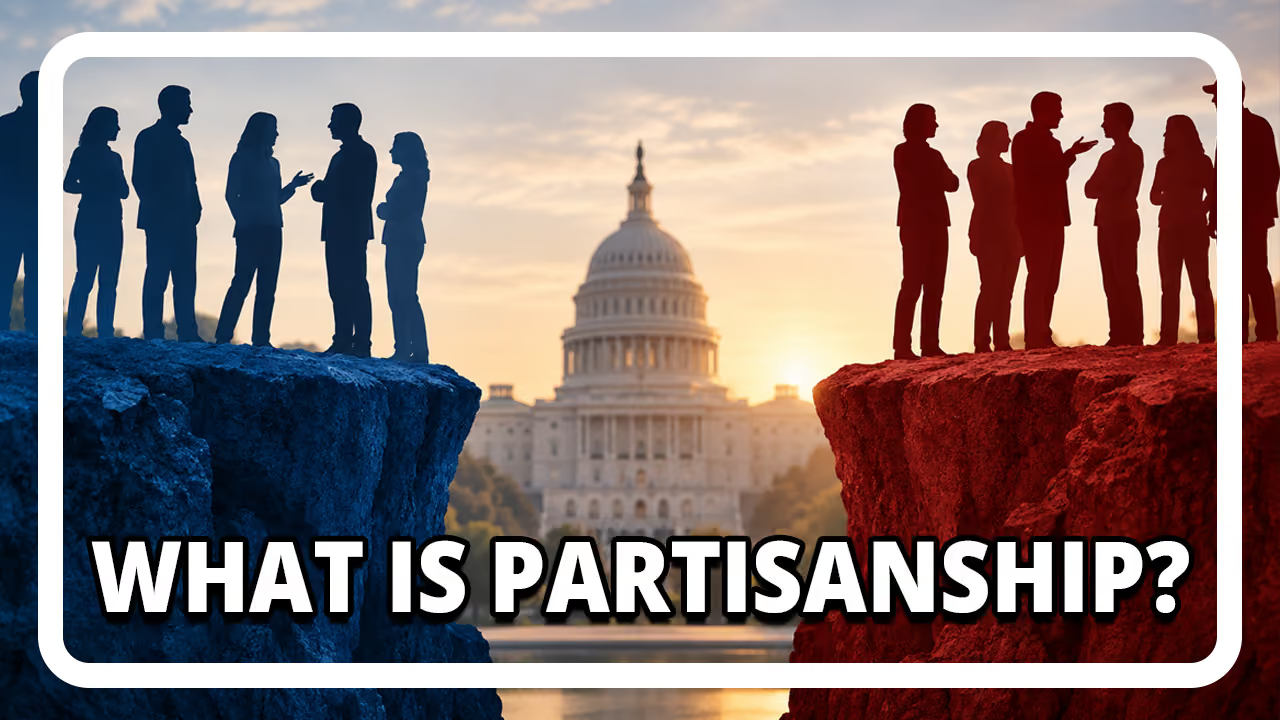
What is partisanship, and why does it divide us? Learn the psychology, consequences, and ways Americans can bridge the partisan divide.
Read PostSubscribe to receive a biweekly collection of the hottest podcast episodes from the network, upcoming special events, expert features and news from your favorite shows.
Subscribe to our NewsletterPartisanship means supporting, advocating for, or aligning with a particular political party or candidate. A partisan generally supports a party’s goals, promotes its platform or candidates, and wants that party to gain political power. Partisanship is a normal feature of democratic politics because political parties organize people around shared goals and compete to influence government. However, strong partisanship can become divisive when loyalty to a political party becomes part of a person’s social identity and politics turns into an “us versus them” competition.
In simple terms, partisanship means picking a political team and supporting that side. A partisan tends to support a particular political party or its candidates and wants them to succeed. This is a normal part of politics, just as sports fans naturally root for their team. But partisanship can become a problem when loyalty to the team becomes more important than evaluating its actions fairly, or when people begin treating those on the other side as enemies rather than fellow citizens with different political views.
Partisan means supporting or favoring a particular political party, candidate, or political side, while bipartisan means involving cooperation or agreement between two political parties. In the United States, bipartisan usually refers to Democrats and Republicans working together on legislation, policies, or other political goals. Partisanship is a normal part of democracy because parties compete to win elections and influence government, while bipartisanship occurs when members of competing parties find enough common ground to work toward a shared objective.
Negative partisanship is when a person’s political behavior is driven more by dislike, fear, or opposition toward another political party than by support for their own. A negative partisan may vote for a candidate not because they particularly like that candidate, but because they strongly want to prevent the opposing party from winning. In this way, negative partisanship turns political competition from “I want my side to win” into “I need the other side to lose.” It can intensify polarization because political opponents increasingly come to be viewed as threats rather than simply people with different political preferences.
Brandon Stover is the Network Manager for The Democracy Group and a Digital Content Specialist at the McCourtney Institute for Democracy. He leads partnerships and collaborations across the podcast network, oversees educational content strategy, and produces written, audio, and video content while managing the network's digital marketing efforts. Before joining the McCourtney Institute for Democracy, Brandon founded and led a nonprofit organization dedicated to creating free educational content on global issues. He holds a master's degree in Architecture from Washington State University.
Engaging in civil discourse. Inspiring civic engagement. Exploring the future of our democracy.
Join our community and never miss your favorite episodes from the Democracy Group.
Subscribe to our Newsletter