

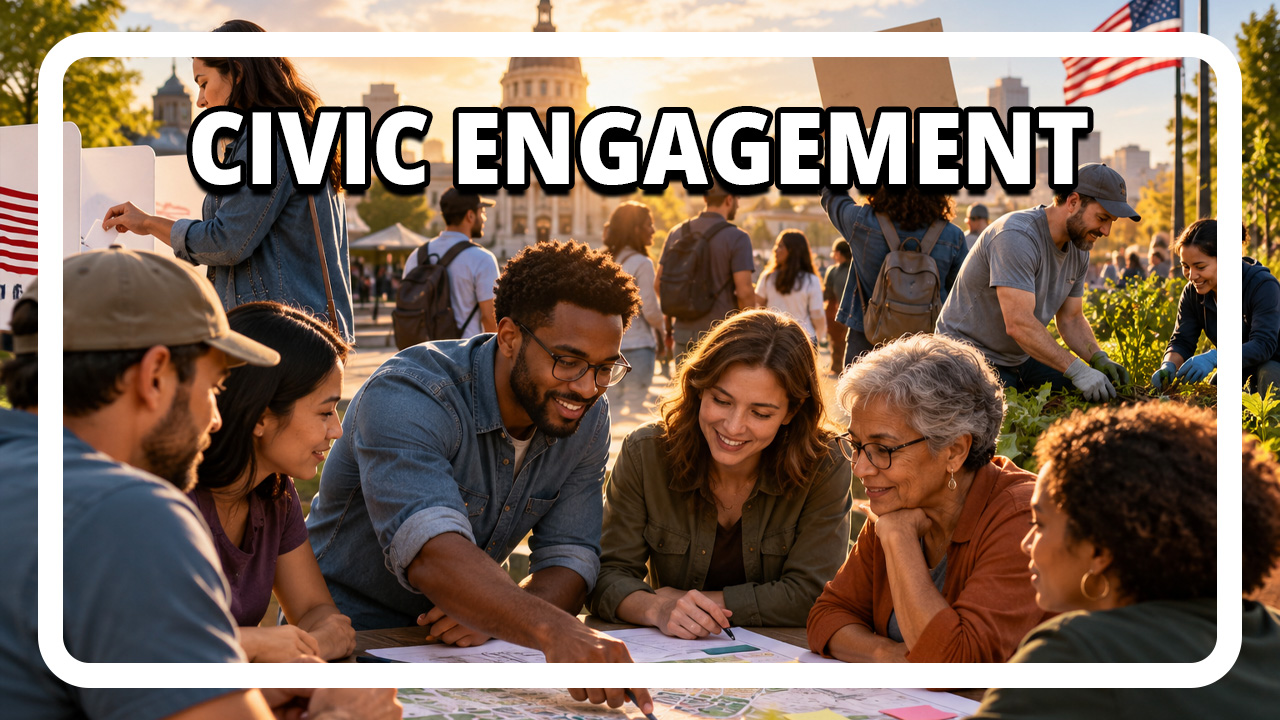
Democracy doesn't begin and end at the ballot box. It lives in our neighborhoods, schools, workplaces, and communities. Every day, decisions are made that shape our lives, from how public money is spent to which roads get repaired and what policies govern our communities. The question is whether we choose to have a voice in those decisions.
Civic engagement is the act of participating in activities that improve your community, influence public decisions, and contribute to the democratic process. It includes traditional political activities like voting, contacting elected officials, and supporting candidates, but it also extends to volunteering, joining community organizations, participating in local government, organizing neighbors, and helping solve shared problems.
Yet many Americans feel disconnected from the political process. They may believe their individual actions won't make a difference, feel overwhelmed by national politics, or simply not know where to begin. But civic engagement doesn't require political expertise, substantial financial resources, or a position of power. Sometimes, meaningful change begins with a conversation among neighbors who recognize a problem and decide to do something about it.
So why does civic engagement matter, and what can an ordinary citizen actually do to make a difference?
Drawing on insights from political scientists, democracy advocates, community organizers, and civic leaders featured across the podcasts in The Democracy Group, this article explores why civic participation is essential to a functioning democracy and why voting alone isn't enough.
More importantly, we'll examine practical ways you can become civically engaged, from understanding how your local government works and participating in public budgeting to supporting ballot initiatives, practicing mutual aid, and organizing with others to create lasting change.
Because democracy isn't just something we inherit or observe. It's something we practice, strengthen, and shape together.
Subscribe to receive a biweekly collection of the hottest podcast episodes from the network, upcoming special events, expert features, and news from your favorite shows.
Subscribe to our NewsletterFor those who aren't already civically engaged, a common question is: Why does it even matter? Jenna Spinelle, creator of When the People Decide, captures one of the central challenges facing civic engagement: people often believe their participation won't make a difference.
Jenna Spinelle:
“Yes, there are people who abuse the power voters give them. Yes, there’s a lot of dysfunction in government.
And I’ve also seen everyday people break through that dysfunction to actually push for change in their communities. And when they do, they find a sense of power that can break through those feelings of hopelessness and cynicism.
I see that cynicism come up again and again when it comes to money. I think it’s what my family is referring to when they say politicians are crooks or imply that government is wasting money.
But what if residents of a city could sit on a committee with city staff to actually help them decide how to spend city dollars? Could that increase the public’s trust in government and dispel some of that cynicism?”
Listen to the full episode on When the People Decide: Putting money and power in the people’s hands
What many people fail to realize is just how much politics influences our everyday lives. Lindsay Cormack, associate professor of political science at Stevens Institute of Technology, explains that everything from roads and zoning to drinking water and infrastructure is shaped by political decisions, whether citizens participate or not.
Lindsay Cormack:
“Politics influences so many parts of our lives. There's virtually nothing that isn't touched by politics. The criteria by which your roads get fixed—that's a political decision. The zoning that happens in your neighborhoods and communities—those are political decisions. The water that you drink, the pipes that are used in your cities—those are political decisions.
Everything really touches politics, and I teach at a school where very few students actually major in political science. Most of them are engineers. And so when I do projects in some of my classes, I'll say, ‘Pick whatever it is that interests you, and let's go find how it's involved in politics.’
And I think that's something where eventually they come around and they're like, ‘Oh, you're right. Politics is going to happen to us whether we like it or not, so we might as well understand it.’
And something else that I like to think about is that no one likes playing a game when they don't understand the rules. And so if politics is going to happen to all of us, whether we like it or not, we might as well understand those rules so we can play the game a little bit better.”
Listen to the full episode on The Politics Guys: How To Raise a Citizen
When people think about civic engagement, voting is often the first thing that comes to mind. Rightfully so, as it's one of the most fundamental ways citizens participate in a democratic system. Cormack emphasizes the importance of voting, arguing that teaching young people how to register to vote is a crucial first step toward civic participation.
Lindsay Cormack:
“Voting is easy for me. Voting is number one in the sense that you really can't participate in our democratic system until you learn how to register to vote.
And so parents should help their kids learn to register to vote, and they need to tell them that when they move, that doesn't go with them. Because that's something I found in college where I'm taking students—we have a little thing called Ducks to the Polls where we take our students to the polls.
We don't care how they vote. We just take them there so they can vote, and then we go out for ice cream at Ben & Jerry's afterward.
And something that I find is I'll have students who come to vote and then they're like, ‘Oh, well, I registered, but it'll be in another county.’ And so they'll have to cast a provisional ballot, which is kind of a pain, and it doesn't feel good for your first time.
And so parents have that responsibility to say, ‘Here's how you can get this piece done,’ because without voting, your connections to democracy are just really limited.”
Listen to the full episode on The Politics Guys: How To Raise a Citizen
But is voting what democracy is really about? Angela Glover Blackwell, attorney and civil rights advocate, believes democracy is about much more than casting a ballot. Voting is just one mechanism for achieving a much greater outcome: human flourishing.
Angela Glover Blackwell:
“As I started studying democracy and reading about democracy and talking to people about democracy, it was clear that ‘of the people, by the people, and for the people’ is a big, bold idea. And it’s all the people.
It’s for the people’s flourishing. It’s of the people because you can’t know what the people need if it’s not coming from them. It’s by the people because it is a system of self-governance. It is self-governing for all of the people. It is self-governance for human flourishing.
What democracy really is, is radically inclusive. Everybody is radically inclusive and mutually accountable. Democracy in service of human flourishing so that society will thrive and everyone can have a good life. The good life is up to you. Society thriving will happen because we have invested in the people who make a society.
This notion of a mutually accountable democracy in service of human flourishing feels like what the framers hoped for. They knew that they were falling short. They knew that they were being duplicitous as they were putting the rules together, but this notion is a good notion. We’ve never lived into it. The democracy that we have is not the democracy that we need.
We have the capacity to continue to strive for a more perfect union. We need to lift up what the goal is. Democracy is not voting.
Voting is a way to be mutually accountable. Democracy is not just about having representatives, but representation is a way to strive toward radical inclusiveness. If we all can’t be in the room, let’s make sure that our representatives are at least in the room.
All of those things are mechanisms for an outcome. What is the outcome? Human flourishing.”
Listen to the full episode on Care More Be Better: Co-Governance for Human Flourishing: Angela Glover Blackwell on Reimagining Democracy
Rather than viewing democracy solely through the lens of periodic elections, citizens must recognize the importance of ongoing, everyday civic participation. Michael Zakaras, director of Ashoka US, argues that strengthening democracy begins with creating opportunities for people from all walks of life to contribute to their communities.
Michael Zakaras:
“That's a good question. I think of a healthy civil society and a healthy democracy as two sides of the same coin.
They're in a very close symbiotic relationship with one another. You look around the world at places where civil society, what Ashoka refers to as the citizen sector, is stymied, and it's often where dictators and autocrats are in control, right?
Ashoka thinks of democracy as more than just free elections and robust institutions.
I think there is this cultural piece to it, a kind of daily, weekly practice of building this muscle.
When people have opportunities to feel a sense of agency and feel powerful, again, often at the local level, sometimes as a young person, like, ‘There was this thing that wasn't working at my school, and I did something about it,’ that feeds this inclination to do more.
And I think those are the kinds of people who are more likely to vote, are more likely to participate in local elections, and are more likely to engage in civic groups because it becomes part of their identity.
So in some ways, I think that voting and the traditional markers that we look at in terms of healthy democracy are an outgrowth, an outflow of people who are civically engaged more broadly.”
Listen to the full episode on Future Hindsight: Everyone a Changemaker: Michael Zakaras
Let’s explore several ways everyday citizens can become civically engaged beyond voting and make a meaningful difference in their communities.
This is precisely the advice offered by Peter Levine, one of America's leading scholars and practitioners of civic engagement. Levine identifies two actionable responsibilities: participate in the civic organizations and activities that already exist, and help create additional opportunities for others to get involved.
Peter Levine:
“One thing is to realize the moral, spiritual, and pragmatic advantages of actually being part of the civic life that exists. And to treat it as if we live in a wasteland with nothing going on is itself a mistake, because lots of good stuff is going on.
And the second claim is that when you are well enough positioned to do so, you should be trying to expand the opportunities for people to participate in our society.
And that doesn't mean participate in government, although that's good. But it means participate in the texture of our society, which takes place in lots of different forums.”
Listen to the full episode on Democracy Works: Finding the "we" in civic engagement
The first place to start is by looking beyond presidential elections and participating in primaries, state elections, and local elections. Historically, these elections have had much lower voter turnout, yet their impact on your everyday life can be substantial. Lindsay Cormack explains why understanding these elections and the different levels of government is essential.
Lindsay Cormack:
“When I talk about primaries versus general elections, this is because when we look at which elections tend to be those competitive ones that matter in terms of whether you're going to pick a winner or a loser, increasingly, in many different parts of the United States, that happens at the primary.
[...]
But a lot of people do not learn about primary elections in the course of high school. Instead, they'll usually only learn about one election, and that's the presidential election, which is unlike any other election that we have for any other position in the United States.
So talking about those differences, I think, is very important because that's where the action is in a lot of places.
This third bit on federalism is something that gets at what I mean when I talk about humanizing politics, which is that the local level and the state level do so much, but we tend to focus on the federal level.
And as you know, federalism is just sort of what the conversations are, the overlapping and individual powers that these different levels have, and how they enact policies on those levels.
[...]
And so understanding those pieces is also about civic know-how. It's where to go when something's wrong. Who do you call? That's something that you have to fold into this understanding of federalism.”
Listen to the full episode on The Politics Guys: How To Raise a Citizen
However, Megan Gulla, director of partnerships and public engagement at CivicLex, recognizes that many people face a significant hurdle when trying to get involved: they simply don't know how their local government works or where to begin.
Megan Gulla:
“I realized that the easiest way and the most effective way to make change is through city government and local government, and getting to know those processes and getting involved with them.
And then I realized, at the same time, that a lot of people don't know anything about local government. They don't know how to contact their representatives or how to get involved in those processes.”
Listen to the full episode on How Do We Fix It?: Why Voting Isn't Enough. CivicLex: Richard Young, Megan Gulla
Michael Zakaras offers a practical solution: start with an issue you personally care about. By getting involved, you'll naturally begin learning about the people, organizations, and processes through which you can create change in your community.
Michael Zakaras:
“Start at the local level, right?
It can be very easy for people to feel overwhelmed by the bigness and the direness of the national headlines, and yet so much of what affects our lives at a daily level happens at the local level.
And so finding a place to plug in.
And for whatever issue you care about, there's someone, if not multiple people, out there who are doing something meaningful about it and who are creating that basic community for you as an individual to step in and feel supported and feel effective.
I have seen a wonderful example of this with my own mother, who's 80 and here in Burlington, Vermont, who's become very engaged with the organization Third Act, which creates this community and, again, the structure for people who are retired and who have all kinds of relevant professional skills to plug into the climate movement.
And that combination of both the desire to have a purpose and to contribute, including skills that are highly relevant to this moment, with the basic structure to help people show up and not just feel alone in the work, is really a beautiful thing to watch.
And within just a few months, she was involved in helping craft policy legislation and presenting ideas to the state legislature in Vermont. And we're talking about this particular wood-burning power plant here in Burlington and how to phase it out. It's just really meaningful work.
And that's my advice, is that somewhere in your local community, there are many organizations that have that structure that are just waiting for you to show up and say, ‘How can I be helpful?’”
Listen to the full episode on Future Hindsight: Everyone a Changemaker: Michael Zakaras
As you begin exploring your community, you'll inevitably encounter problems that need solving. Rather than reinventing the wheel, look for organizations, groups, or initiatives already working to address those issues and consider getting involved.
If you can't find existing solutions in your community, look to other communities for inspiration. Max Stier, president and CEO of the Partnership for Public Service, suggests that identifying successful approaches elsewhere can be a powerful way to drive change.
Max Stier:
“So they need to speak up, and my advice would be, don't just flag the problem. Try to provide some ideas about what the solution might be.
And part of finding the solution would be to find someplace where it's better. It's one thing that doesn't happen enough in government. Someplace, somewhere, is doing whatever you're concerned about in a better way. Helping find that and raising it up is a way of improving it for everybody.”
Listen to the full episode on Good Government: The Voice of Public Service Meets the Partnership for Public Service
One mechanism you might encounter is participatory budgeting (PB). Rather than merely expressing their opinions, residents help develop proposals, learn how their government operates, and vote on how public resources should be allocated. Hollie Russon Gilman, political scientist at Columbia University, explains how participatory budgeting works.
Hollie Russon Gilman:
“Typically, there are neighborhood assemblies where people come and aggregate their ideas. So they say, ‘I would like to fund this, I would like to fund that,’ and they're sort of hyperlocal, based in people's communities.
Then, from that, people are signing up to become budget delegates, which is my favorite part of the process because you get to really see how the sausage is made. You're signing up, you're working intensively with your counterparts inside government to understand, on a given proposal, how you could make it viable. What would it actually take?
And then that's a huge learning opportunity. You're learning what's federal, what's city, what's in, what's out. And the way that PB is structured is that there are certain limitations and structures.
[...]
And then those proposals get turned back to a wider group of residents for a vote. And one of the things that's really great about participatory budgeting is that it's more inclusive than traditional elections. So noncitizens, young people—we're seeing some places where people as young as 11 or 12 are eligible to vote.”
What's important is distinguishing symbolic public engagement from meaningful democratic participation. Citizens need more than opportunities to express their opinions; they need ways to influence the outcomes of public decisions.
Jenna Spinelle emphasizes this distinction, drawing on Gilman's research to explain why participatory budgeting must give residents genuine decision-making power rather than simply inviting them to share their thoughts.
Jenna Spinelle:
“One thing she says is crucial to this kind of program being successful, like Andrew's program in Durham, is making sure the citizens who participate actually get to have real power in the process. Meaning, it's an opportunity to do more than just speak during public comment at a city council meeting.
Public engagement can often be set up to be merely performative, where city leaders ask to hear from residents but then make the crucial decisions themselves, with their colleagues or staff, and not with the folks who stood up to voice their preference.
Hollie says city leaders wanting to implement a PB program need to be ready not only to listen to their residents but also to give them decision-making power, especially when, as a city leader, you're trying to engage with communities your city has historically marginalized.”
Hollie Russon Gilman:
“And so if you're thinking about, for example, what more equitable policy may look like in a community, it's going to be a tough conversation. You're going to talk about historic injustices, maybe talking about racism in your community.
And I think having those spaces where people can come together helps us build our civic muscles, but they have to be tied to action, and they have to be tied to consequences.”
Listen to the full episode on When the People Decide: Putting money and power in the people’s hands
Even if participatory budgeting doesn't exist in your community, there are still ways to get involved in decisions about public spending. Megan Gulla describes how CivicLex helps residents understand their city's budget, learn how decisions are made, and connect directly with the officials responsible for allocating public funds.
Megan Gulla:
“One of our main projects is our budget guide and our budget workshops that we do.
In a typical year, not in a COVID year, we would get the city budget as it's being worked on by the council.
We would get the draft of it and put our budget guide together, then put that online.
And then we would invite community members in to talk about the budget, to learn how it's created by the city council, to learn what's in it, and then we talk about how to get involved in that process and who to talk to.
And in those meetings, we also try to have council members. We had the chair of the Budget, Finance, and Economic Development Committee in the meetings with us, too, so people had a chance to speak directly to the people who are part of that process.”
Listen to the full episode on How Do We Fix It?: Why Voting Isn't Enough. CivicLex: Richard Young, Megan Gulla
Another avenue for civic engagement is pursuing democratic reforms through ballot initiatives. Simone Leeper speaks with Erin Chlopak, senior director at the Campaign Legal Center, and Ellen Chaffee of the “BadAss Grandmas” about how everyday citizens can make their voices heard and create meaningful political change.
Erin Chlopak provides the context:
“So the grandmas, they saw particularly the influence of oil and gas, where it seemed like they had control over government. And they were really frustrated and came together, sort of informally, and decided that they wanted to take matters into their own hands.”
Ellen Chaffee explains how their movement began:
“We started having coffee with friends who had their own sad stories. And so we had many enjoyable grievance discussions, wallowing in our misery.
And finally, one day somebody said, ‘Have you seen what they're doing in South Dakota? They have a ballot initiative.’
We suddenly realized that we might have recourse. We might be able to design an initiative that the people could vote on to right some of the wrongs we were complaining about.
Well, that galvanized us, and we met every week over the course of almost a year and talked about what we thought needed to happen.”
Simone Leeper explains the democratic mechanism they used:
“Ballot initiatives are one way that citizens can try to bring about change in their state. Not every state allows for them, and the rules can vary, but it essentially works like this:
A group of citizens can come together to put a question on the ballot that asks the citizens of that state to vote directly on whether to adopt a new law or procedure.
Getting that question on the ballot can sometimes be quite challenging and often involves gathering a large number of signatures.”
Ellen Chaffee continues:
“We were very fortunate. At that time, RepresentUs was looking around the country to see where there might be places they could support.
So we formed an absolutely fantastic partnership with them and other organizations they introduced us to.
And through that work, we brought to the people of North Dakota an initiated measure that has since become Article 14 of the state constitution.
It has three major parts. The first part is campaign finance transparency, the second part deals with a variety of conflict-of-interest issues, and the third part created the ethics commission.”
Their story demonstrates how grassroots movements can begin with informal conversations among neighbors and grow into successful political reform efforts. What started as a group of frustrated citizens sharing their concerns over coffee eventually became a coordinated movement that helped change their state's constitution.
Listen to the full episode on Democracy Decoded: Dark Money Trickles Down
Getting involved in your community doesn't always require formal political organizations or government programs. Sometimes, civic engagement can be as simple as neighbors helping neighbors through mutual aid.
Angela Glover Blackwell highlights several approaches to community participation, from civic assemblies and participatory budgeting to everyday acts of mutual support. She emphasizes how these practices can strengthen relationships, encourage collective problem-solving, and help communities respond to shared challenges.
Angela Glover Blackwell:
“One of the tools I’ve been working on in Oakland, California, is creating a civic assembly in which people are randomly selected from the community to be able to come together and spend multiple days and weeks deliberating through a process that is completely inclusive of everybody’s voice and is used to put forward a solution.
That’s something we don’t do very often. We leave the problem-solving to the professionals and then critique them, as opposed to bringing ordinary people together to be able to look at what they need. When they learn together, we’ll see a lot better solutions coming forward.
We need other tools like that and participatory budgeting, where people get together and think about what we want our budget to do.
I also think that mutual aid is something that builds community. We’ve seen remarkable examples of mutual aid around the threats to people who are recent immigrants when ICE agents have been flooding communities.
What we saw in Los Angeles and Minneapolis was mutual aid. People coming and saying to their neighbors, ‘How can I help you get your kids to school? Can I shop for you since you’re not comfortable going out to shop? I will go to the streets for you.’
Many people who went to the streets had never been in a demonstration before, but they did it out of the spirit of mutual aid, not so much protest.
These kinds of things are some of the tools and habits that we’re going to need as we get comfortable knowing that what happens to you happens to me.
We have to be in a relationship with each other. I’ll be able to help you, and you’ll be able to help me. We’ll be able to play together and learn together and do the things that people do together in community.”
Listen to the full episode on Care More Be Better: Co-Governance for Human Flourishing: Angela Glover Blackwell on Reimagining Democracy
Another way to become civically engaged is to help spread the message of political candidates you support. Sharing their content, engaging with their campaigns, and encouraging others to learn about them can help candidates make the most of their limited campaign resources.
Michele Hornish, executive director of Every State Blue, explains several ways everyday citizens can support political campaigns without spending money.
Michele Hornish:
“Yeah, I mean, I think we're in a really difficult moment right now where we have both national political fatigue, I'd say, but also a lot of economic insecurity, and people are really worried.
And so it's hard for folks to know, where do you invest whatever resources you do have in the most efficient and effective way? How do you get the most bang for your buck, in other words?
So it's always helpful to share things, to like, to comment. I think you mentioned earlier in this live that hitting the heart button helps the algorithm. People don't realize just how helpful that is.
So anytime you see something from a candidate that you want to support, like it, share it, make sure that you engage with it, and leave a comment because it really does train the social media algorithm to share that with more people. So that's a free way for you to help those candidates.
Another thing that you might not know is voting on day one, or as soon thereafter as you can, actually gives more resources to your local Democrats because it means they can go deeper down the voter rolls.
So you're taking yourself automatically off the to-do list for the campaign. They no longer have to worry about contacting you. That's actually really, really helpful.”
Freedom Over Fascism: Everywhere is Everywhere: Building Power in the Deepest Roughest Reddist States ft Michele Hornish
Of course, before sharing political content, it's important to evaluate the credibility of the information to avoid unintentionally spreading misinformation. Corey Nathan, host of Talkin' Politics & Religion Without Killin' Each Other, emphasizes the importance of media literacy and evaluating individual journalists based on their reporting practices rather than simply the outlets they work for.
Corey Nathan:
“What I'm trying to do in terms of practicing discernment in my news consumption is ask: Is this outlet or this individual journalist committed to solid journalistic principles?
Are they committed to doing good reporting, to checking their sources, to getting extra sources?
Are they committed to correcting their errors and reporting those errors when they make them?
Are they committed to doing the work of good journalism?
And we'll talk more about what those principles are in coming episodes.
[...]
And you might be surprised where you find them. Again, if you lean left, you might be surprised that there are actually good reporters in outlets like Newsmax. Yeah, Newsmax, like Breitbart and the Daily Mail.
There are good reporters there, individual reporters.
Now, I'm not going to sit here and start selling subscriptions to the Daily Mail or to Newsmax, but I'm here to tell you there are good reporters there.
There are editorial decisions in terms of what stories they're pursuing.
But if there's somebody who's doing really good work from a journalistic standpoint, I want to read them where they're at.
I want to be exposed to stories that might not show up in The New York Times.
So I'm less about The New York Times, The Washington Post, or the LA Times. I'm more about individual writers and thinkers, and you can find them in a lot of different places, including The New York Times, including Breitbart, believe it or not.
So that's what I'm doing to practice discernment when it comes to consuming news and analysis.”
Listen to the full episode on Talkin‘ Politics & Religion Without Killin‘ Each Other: How Pro-Democracy Patriots Can Persist in an Anti-Democratic Time
When in doubt, bring people together and figure out what you can accomplish collectively. Civic engagement doesn't always require an established organization, a detailed plan, or extensive resources. Sometimes, it begins with a simple invitation to people who share your concerns.
Alex Kramer, co-founder and executive director of Knock for Democracy, explains how he brought people together to turn their shared concerns into collective action.
Alex Kramer:
“And so I simply sent out an email to everyone I knew in New York at the time and said, ‘I've talked to a few dozen folks in the last week since this election who are scared and confused and don't know where to turn next or how to best direct their energy.’
And I said, ‘Come to my apartment. I don't know. We don't know, but together, hopefully we can figure something out.’
And I started having weekly meetings in my little studio apartment in Brooklyn. We'd pack in 50 or so people, and we would just talk about what we'd been hearing, places where we recognized that there were opportunities for taking action.
And we brought everyone together and started taking action steps together. We went to protests. We organized small-scale canvassing trips. We found avenues online where our collective voice could be greater than any of our individual voices.”
Listen to the full episode on New Faces of Democracy: Knock for Democracy
However, simply bringing people together isn't always enough. Samuel Ely Bagg, assistant professor of political science at the University of South Carolina, argues that the structure of civic participation matters just as much as participation itself.
Without adequate organization, resources, and collective power, ordinary citizens may struggle to influence decisions when competing against well-funded interest groups.
Samuel Ely Bagg:
“So I do think that democracy is better when more people participate. I'll go ahead and say that upfront.
I don't think that fundamental idea is wrong. But I think that the issue I have, just to foreground it, is that I think participation has to be the right kind of participation in order to be effective for democracy.
And I think that the thing I'm critical of in terms of the participatory turn is the blanket acceptance of participation in many forms, and in particular, the forms that I see as less helpful than others.
[...]
And I think the impulse behind all of these things is very understandable and positive. The idea is that people should be involved in the policies that are affecting them, right?
But what happens, and here's where we come to the point about what the participation looks like: How is it integrated into the process?
And for me, I think when you put ordinary people in these contexts of participation on their own, and there are still vested interests that are better organized and have a lot more resources, a lot more wealth, and they're opposing them.
So their opponents, or the other people involved, are these really well-organized, well-resourced organizations, people, and interest groups.
You put ordinary people in those situations, and they're just not going to be able to really fight for the kind of public interests that we hope they would because they're going to be influenced or outmatched by these interest groups that have all the organization and power.
So even though they're participating, and it maybe looks like they're participating in an effective way and gives a kind of democratic sheen to the outcomes, it's still going to reflect the interests of the groups and organizations that are determining the outcomes anyway.”
Listen to the full episode on Politics in Question: Do we need to redefine democracy?
Bagg takes this argument further, suggesting that effective civic participation should focus less on giving individuals a direct role in every decision and more on building organizations capable of representing their interests.
Samuel Ely Bagg:
“Representative democracy in the case of the original fuel tax as it was passed, direct democracy as it was represented by the Yellow Vests and as a kind of institution that they had demanded in order to solve these problems, and deliberative democracy in the case of Macron.
And I think that each has certain interesting things to say, certain contributions, and foregrounds certain institutions that are important.
But I think that all of them have, I would say, the wrong idea ultimately about what democracy is fundamentally about.
And so, therefore, they're always going to fall short because they're always thinking about democracy basically in terms of a decision-making process that we all should get a say in somehow.
I just think that doesn't reflect what democracy really is about in the modern world, in these states of millions of people that have to make millions of kinds of decisions.
We're never going to have a decision-making process that's fundamentally equal in all respects for everybody.
We're going to have bargains worked out between organized interest groups. That's always how it's going to be.
And so the question of democracy has to be: How are those interest groups organized, and how well do they reflect the underlying interests of society?
How well are different groups in society represented by the organized interests that are ultimately working out bargains?
And so for me, if you think about what's the role of participation, the role of participation has to be working toward better organization of groups whose interests are not as well reflected in that balance of power, that bargaining between interest groups that's going to determine outcomes in any democratic system.
And if you're trying to incorporate people directly into decision-making processes, they're always going to be outmatched or overbalanced.
So what participation needs to be directed at instead is building the sort of power that would enable their interests to be represented more equally in that contest for power between organized groups.
And that's why I'm a fan of devoting energy to building unions, building parties, and building movements that are organized and can participate in that kind of process, in that behind-the-scenes conflict between organized interests, rather than putting our energy into these kinds of direct methods of participation.”
Listen to the full episode on Politics in Question: Do we need to redefine democracy?
Democracy isn't a spectator sport. It's something we create and sustain through our everyday actions, relationships, and participation in our communities.
As the experts throughout this article have demonstrated, civic engagement doesn't require you to become a political expert, run for office, or dedicate your life to activism. It simply requires recognizing that you have a role to play in shaping the community and society you live in.
And you can start right now.
You don't have to do everything. Choose one action and take the first step.
As we've seen, meaningful civic engagement can begin with something as simple as sharing information, attending a meeting, or having coffee with a few frustrated neighbors. Those small actions can build relationships, create collective power, and eventually lead to changes that extend far beyond any one individual.
Voting remains an essential part of democracy, but the work of self-government doesn't stop when the polls close. It continues in the decisions we influence, the problems we solve, and the communities we build together.
The question isn't whether you have enough power to make a difference. It's what you can do with the power you already have.
Subscribe to receive a biweekly collection of the hottest podcast episodes from the network, upcoming special events, expert features, and news from your favorite shows.
Subscribe to our NewsletterBrandon Stover is the Network Manager for The Democracy Group and a Digital Content Specialist at the McCourtney Institute for Democracy. He leads partnerships and collaborations across the podcast network, oversees educational content strategy, and produces written, audio, and video content while managing the network's digital marketing efforts. Before joining the McCourtney Institute for Democracy, Brandon founded and led a nonprofit organization dedicated to creating free educational content on global issues. He holds a master's degree in Architecture from Washington State University.
What is civic engagement, and how can you get involved? Discover why it matters and practical ways to strengthen democracy beyond voting.
Corinna Bellizzi talks about making the move from business leader to podcaster and how she think about the democracy in the context of social impact
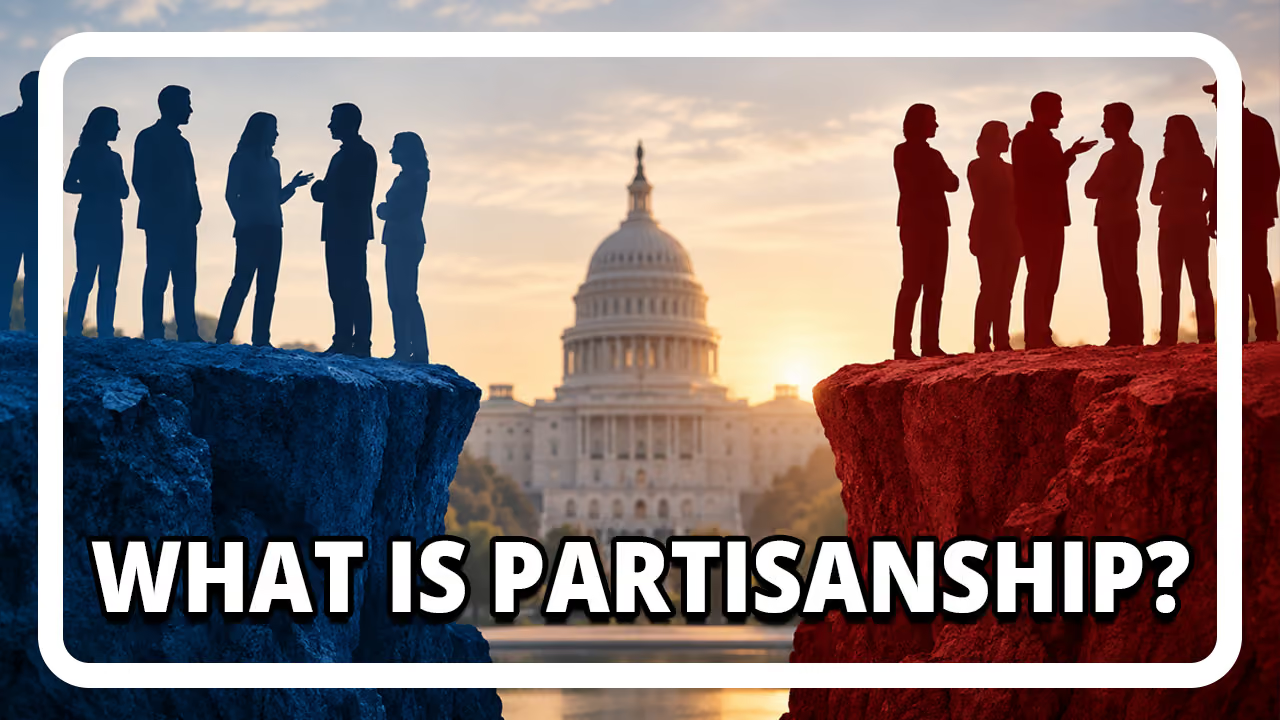
What is partisanship, and why does it divide us? Learn the psychology, consequences, and ways Americans can bridge the partisan divide.
Engaging in civil discourse. Inspiring civic engagement. Exploring the future of our democracy.
Join our community and never miss your favorite episodes from the Democracy Group.
Subscribe to our Newsletter