

Partisanship means supporting, advocating for, or aligning with a particular political party or candidate. A partisan generally supports a party’s goals, promotes its platform or candidates, and wants that party to gain political power. Partisanship is a normal feature of democratic politics because political parties organize people around shared goals and compete to influence government. However, strong partisanship can become divisive when loyalty to a political party becomes part of a person’s social identity and politics turns into an “us versus them” competition.
At its simplest, being partisan means taking the side of a political party or candidate. Political parties are coalitions of people attempting to gain office and influence what government does from within government. Their activities revolve around nominating candidates, winning elections, taking office, and shaping public policy. A partisan is someone who supports a party or its candidates in pursuing those goals.
Partisanship itself is not necessarily a bad thing. Political parties give voters a way to organize around shared political goals, distinguish between competing visions for government, and elect representatives who can turn those preferences into public policy. In fact, there was a period in American history when political scientists worried that the two major parties were not different enough. During the 1950s, the parties contained substantial ideological overlap, making it more difficult for voters to identify a clear choice between them.
Over the following decades, however, the parties became more distinct. Political coalitions realigned, and groups such as conservative Democrats and liberal Republicans became much less prominent. As the parties increasingly represented different political, geographic, and cultural coalitions, partisan differences became clearer.
Partisanship becomes more complicated when supporting a political party is no longer simply about preferring its policies.
Political scientist Lilliana Mason describes partisan affiliation as a form of social identity. From this perspective, identifying as a Democrat or Republican can create a psychological connection with other members of that group. As a result, people can become emotionally invested in whether their political group succeeds or fails, independent of their opinions about individual policies.
This can be intensified by a two-party system because elections create a zero-sum competition: when one party wins political power, the other loses it. Political victories can therefore feel like victories for a person's group, while political defeats can feel personal.
People do not even have to formally identify with a political party to behave in partisan ways. Some self-described independents consistently vote for the same party, consume media that aligns with that party, and experience similar emotional reactions when that party wins or loses. In other words, rejecting a partisan label does not necessarily mean someone lacks partisan preferences.
The more serious problem occurs when ordinary political loyalty develops into hyperpartisanship, where political competition increasingly becomes an us-versus-them struggle.
One manifestation is affective polarization: feeling positively toward members of your own political group while feeling negatively toward the opposing group. This differs from ideological polarization. People may disagree over policies, but affective polarization describes how they feel about the people on the other side. Those feelings can become stronger than the actual differences between their political beliefs.
Partisanship can also become negative partisanship, in which political behavior is motivated less by enthusiasm for your own party and more by dislike, fear, or opposition toward the other party. Instead of voting because you strongly support your candidate, for example, you may vote primarily because you believe preventing the opposing candidate from winning is essential.
At its most extreme, partisan disagreement can become moralized. Political opponents are no longer viewed simply as fellow citizens who have different ideas about how government should work. Instead, they may be perceived as immoral, dangerous, or threatening to the country itself. This can make compromise feel less like a normal part of democratic governance and more like surrendering to an enemy.
Partisanship therefore exists on a spectrum. At a basic level, it simply means supporting a political party or candidate and is a normal part of democratic competition. Political parties need supporters to organize voters, contest elections, and translate political goals into government action.
But when partisan loyalty becomes deeply connected to personal identity, fear, and hostility toward political opponents, it can make democratic cooperation more difficult. Political disagreements become conflicts between groups rather than debates between competing ideas.
The challenge for a democracy is not necessarily eliminating partisanship. Instead, it is maintaining political disagreement without allowing party affiliation to determine how we judge the legitimacy, morality, or humanity of our fellow citizens.
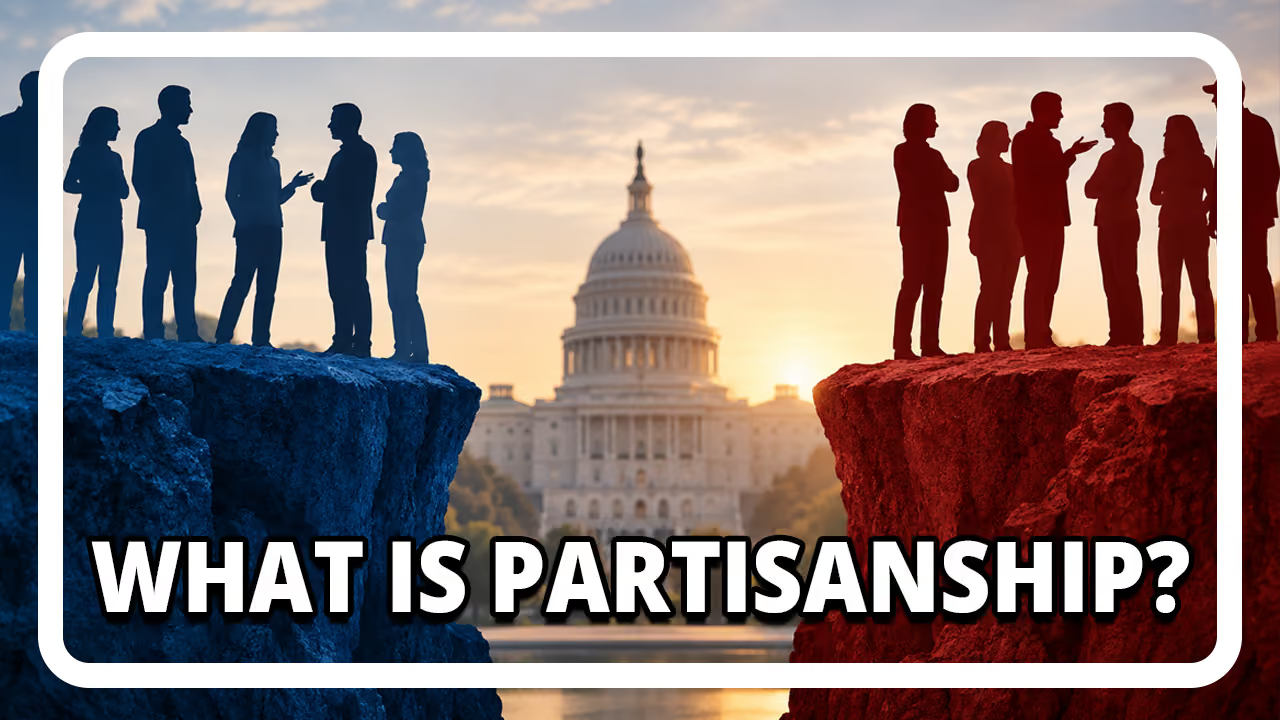
What is partisanship, and why does it divide us? Learn the psychology, consequences, and ways Americans can bridge the partisan divide.
Read PostSubscribe to receive a biweekly collection of the hottest podcast episodes from the network, upcoming special events, expert features and news from your favorite shows.
Subscribe to our NewsletterPartisan means supporting or favoring a particular political party, candidate, or political side, while bipartisan means involving cooperation or agreement between two political parties. In the United States, bipartisan usually refers to Democrats and Republicans working together on legislation, policies, or other political goals. Partisanship is a normal part of democracy because parties compete to win elections and influence government, while bipartisanship occurs when members of competing parties find enough common ground to work toward a shared objective.
In simple terms, partisanship means picking a political team and supporting that side. A partisan tends to support a particular political party or its candidates and wants them to succeed. This is a normal part of politics, just as sports fans naturally root for their team. But partisanship can become a problem when loyalty to the team becomes more important than evaluating its actions fairly, or when people begin treating those on the other side as enemies rather than fellow citizens with different political views.
Partisan politics is not inherently good or bad. Some partisanship is a normal and useful part of democracy because political parties organize voters around shared goals, offer competing ideas for government, and give citizens meaningful choices in elections. Partisanship becomes harmful when loyalty to a political party becomes more important than evaluating ideas fairly, accepting legitimate election outcomes, compromising with opponents, or maintaining shared democratic rules. The problem, therefore, is less partisanship itself than hyperpartisanship—when ordinary political competition becomes an us-versus-them struggle in which defeating the opposing party takes priority over governing together.
Negative partisanship is when a person’s political behavior is driven more by dislike, fear, or opposition toward another political party than by support for their own. A negative partisan may vote for a candidate not because they particularly like that candidate, but because they strongly want to prevent the opposing party from winning. In this way, negative partisanship turns political competition from “I want my side to win” into “I need the other side to lose.” It can intensify polarization because political opponents increasingly come to be viewed as threats rather than simply people with different political preferences.
Brandon Stover is the Network Manager for The Democracy Group and a Digital Content Specialist at the McCourtney Institute for Democracy. He leads partnerships and collaborations across the podcast network, oversees educational content strategy, and produces written, audio, and video content while managing the network's digital marketing efforts. Before joining the McCourtney Institute for Democracy, Brandon founded and led a nonprofit organization dedicated to creating free educational content on global issues. He holds a master's degree in Architecture from Washington State University.
Engaging in civil discourse. Inspiring civic engagement. Exploring the future of our democracy.
Join our community and never miss your favorite episodes from the Democracy Group.
Subscribe to our Newsletter