

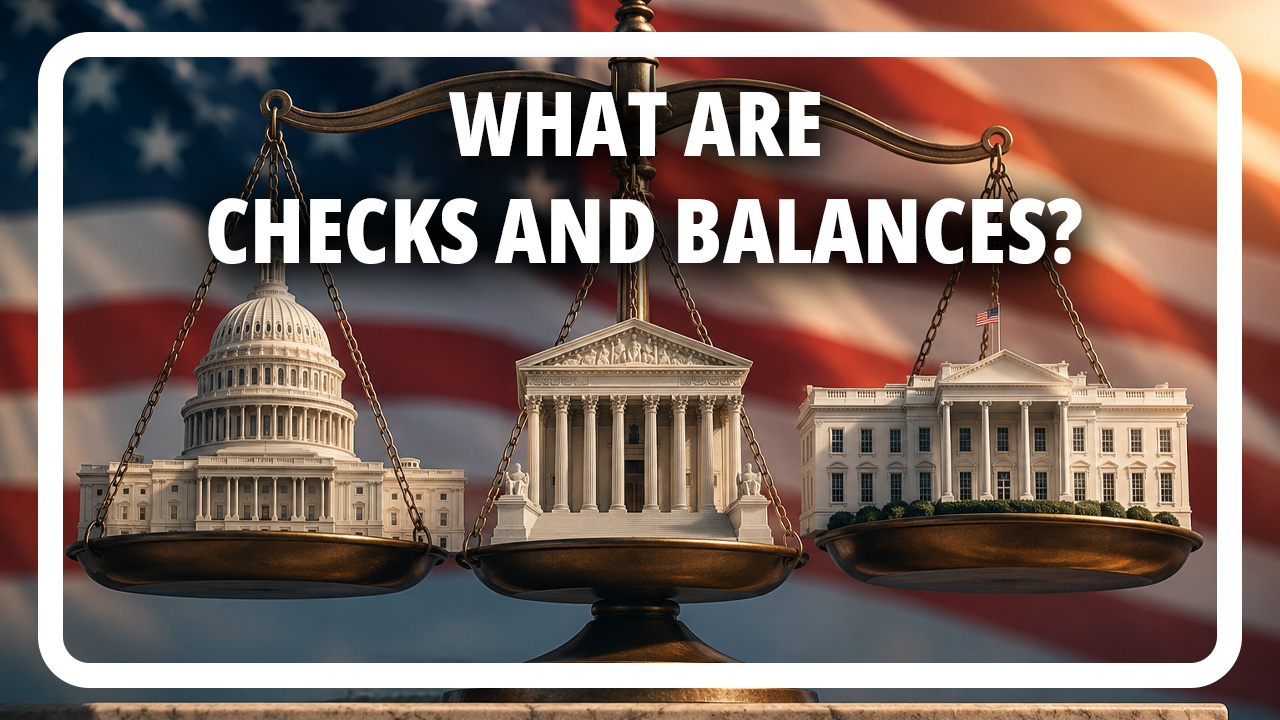
The American system of government was designed around a simple but profound idea: no person, institution, or branch of government should be trusted with unchecked power.
To prevent the concentration of authority, the Constitution created a system of checks and balances—a structure in which the legislative, executive, and judicial branches each have distinct powers and responsibilities, along with the ability to limit the actions of the others. The goal is not efficiency. It is accountability. By dividing power among competing institutions, the system is designed to prevent abuse, protect individual liberty, and ensure that the government remains responsive to the people.
But what happens when those checks begin to weaken? What happens when Congress fails to exercise oversight, when presidents push the boundaries of executive authority, or when courts accumulate increasing influence with limited accountability? Can a constitutional system designed to prevent tyranny still function when the institutions responsible for checking one another stop doing so?
To explore these questions, we turned to experts from across The Democracy Group podcast network. Throughout this article, you'll hear insights from constitutional scholars, historians, legal experts, former elected officials, ethics advocates, and democracy reformers who have spent years studying the American system of government.
Together, they explain how checks and balances are supposed to work, how each branch of government can constrain the others, where many believe the system is falling short today, and what reforms could strengthen democratic accountability in the future.
Understanding checks and balances isn't just a civics lesson. It's essential to understanding how power operates in America—and what citizens can do when the institutions designed to restrain that power begin to falter.
Subscribe to receive a biweekly collection of the hottest podcast episodes from the network, upcoming special events, expert features, and news from your favorite shows.
Subscribe to our NewsletterChecks and balances refers to a system in which the different branches of government have specific powers that allow them to limit or override the actions of the other branches. Its primary purpose is to ensure that no single individual or institution can accumulate excessive power or act unilaterally without oversight.
Adav Noti, Executive Director at Campaign Legal Center, explains why these formal checks and balances are in place.
Adav Noti:
“The founders of our country anticipated that there would come times when there might be people in charge of Congress or people elected president of the United States who would want to take on more power and more control over the country than the Constitution gives them.
And so, from the beginning, the system was designed with what we call checks and balances so that no one person or entity in government can take on more power than the Constitution allots them. For example, if a president tries to take over the role of making laws for the country—which is a role given to Congress—both Congress and the courts have the power and ability to stop the president from doing that. The same is true if one of the other branches tries to exceed its constitutional authority.
Each branch has the power and ability, through the constitutional process, to keep the other branches in their proper place, so to speak.”
Listen to the full episode on Democracy Decoded: How Democracy Is Impacted by the Expansion of Presidential Power
The United States' system also includes informal checks and balances in the form of ethical norms. Kedric Payne leads the ethics program at Campaign Legal Center, where he works to strengthen ethics laws and hold public officials accountable at the federal, state, and local levels. He explains how these informal checks function.
Kedric Payne:
“One of the key principles of our democracy is that we have checks and balances that ensure the different branches of government stay within the limits of the authority they should have. The current breakdown of ethics norms challenges that because we don't just have formal checks and balances—we also have informal checks and balances. Ethics norms are part of those informal checks.
It is expected that a president will follow certain ethical traditions so they can avoid the political and public pressure that could distract them from achieving their agenda. But we are currently in a situation where the president has no problem dealing with the ethics scandals that arise from financial interests tied to official acts, and is still able to push through a political agenda.
When a person is able to do both—to have ethics scandals and legislative success—then you have no check, no balance, and a deterioration of our democracy.”
Listen to the full episode on Democracy Decoded: How Corruption and Abuses of Power Threaten Democracy
Some might believe that checks and balances create too much bureaucratic red tape. Political scientist Kevin Smith explains that this is a feature, not a bug, of the system.
Kevin Smith:
“One of the things I think a lot of people don't realize is that federal executive branch agencies—in fact, any public bureaucracy—are not designed to be efficient. The whole of the United States government is not designed to be efficient. And I'll say that again: it is not designed to be efficient.
It was very deliberately designed that way. What the government is designed to be is responsive. It's designed to treat people as equals before the law. This is why you have all that red tape, process, and bureaucracy. A lot of it exists to ensure equality of treatment.”
Listen to the full episode on Outrage Overload: The Imperial Presidency
Without these checks and balances, the system can slide toward state capture and corruption. Simone Leeper, host of Democracy Decoded, discusses this concern with Jodi Vittori, Professor of Practice and Co-Chair of the Global Politics and Security Program at Georgetown University's School of Foreign Service. Former U.S. Representative Charlie Dent argues that the traditional system of checks and balances is increasingly being overtaken by partisan loyalty.
Simone Leeper:
“Here's Georgetown professor Jodi Vittori. She is concerned about the possibility that the United States could slide into a kleptocracy, which is essentially government by thieves. The mechanism for this is what's called state capture, when corrupt officials bend government institutions toward their own private gain. It sometimes happens in democracies.”
Jodi Vittori:
“In a state capture situation, you need impunity. To maintain that impunity, you need to stay in government. So you're going to start manipulating the governing system itself to make sure you remain in power, because you don't want to go to jail.
You're going to both enable illegal activity and take what was illegal—or should be illegal—and legalize it for your own benefit and for the benefit of your friends. In a large economy like the United States or China, you can have massive corruption scandals, but the average person may not feel the effects.
In a situation of state capture, however, corruption has become so widespread that the average person can't miss it anymore.”
Listen to the full episode on Democracy Decoded: How Corruption and Abuses of Power Threaten Democracy
Charlie Dent:
“I believe that, in many respects, we no longer have a system of separation of powers, but rather a system of separation of parties. Whichever party controls the presidency seems to view its obligation as protecting the president rather than defending institutional interests.
It flies in the face of what Madison intended, and it's been a significant problem. In many respects, they're behaving as if they're operating in a parliamentary system rather than the system of separation of powers and checks and balances that we have.”
Listen to the full episode on Democracy Works: Congressional oversight and making America pragmatic again
The United States federal government is divided into three co-equal branches to ensure a separation of powers:
This structure establishes a system of checks and balances. Each branch has enough power to perform its responsibilities, but not enough power to govern alone. Each also has specific powers to limit the actions of the others, ensuring that no single branch becomes too powerful.
The Legislative Branch makes the laws and serves as a check on both the Executive and Judicial branches.
Checks on the President and Executive Branch
Checks on the Judicial Branch
Ken Katkin, a professor of law at Northern Kentucky University, explains the structure of Congress described in Article I of the Constitution and how it supports American democracy.
Ken Katkin:
“Congress consists of a Senate and a House of Representatives. The concept of bicameralism is introduced right here in Article I, Section 1.
Now, Section 1 doesn't tell us the significance of that, but by giving us this bicameral legislature, the Constitution sets up a legislative process that is intentionally difficult. A bill cannot become law unless two separate bodies independently agree to pass the same legislation.
In principle, that makes it twice as hard to put something on the path to becoming law as it would be if it only had to pass one body.”
Article I, Section 2, which creates the House of Representatives, is really the home of democracy in our Constitution. It's the most democratic portion of the Constitution.
Article I, Section 3 is the counterweight to that. It's where anti-democratic features exist. It's a wedge against pure democracy. Everything about it is designed to make sure that the people can't completely control Congress.
The reason for that is that, in the framers' vision, no bill should become law unless it is both popular and wise. They believed the House was there to make sure legislation was popular—that it reflected what the people wanted.
The Senate, meanwhile, was intended to ensure that legislation was wise. Because of its institutional independence, the Senate could act as a cooling chamber. If the public demanded that the government do something foolish, the Senate would not have to immediately respond to that pressure. Instead, it could slow the process down and make sure nothing happened rashly, even if it was something many people wanted.”
Listen to the full episode on The Politics Guys: The U.S. Constitution Preamble and Article I Sections 1, 2 and 3
Hosts of Politics in Question, Lee Drutman and James Wallner, further explain why Congress was designed this way: to create a place where disagreement, conflict, negotiation, and compromise can take place.
Lee Drutman:
“What you're saying—and I think this is important—is that Congress is actually doing its job when there is disagreement and conflict. That's the purpose of a legislature: to provide a forum where different perspectives can confront one another. It's a way in which we see representation happening.
So it's not just about solving public problems, although that's certainly part of it. It's also about how we solve public problems. That is a crucial feature of a healthy legislature.”
James Wallner:
“I love talking about the idea of Congress as a factory. When you adopt that view—which I think is pervasive in society today—you begin to focus primarily on problems, solutions, and outcomes.
Members become workers on a production line, assembling a product according to a blueprint designed elsewhere. Politics becomes the application of expertise rather than the adjudication of disagreement.
But Congress—and politics more broadly—is, to borrow a phrase from Derrida, where you go to negotiate the non-negotiable.
In a society where every citizen is both a ruler and the ruled, you need a place where people can come together to make collective decisions. Congress is that place. It's where you're represented by the people you vote for. It's where lawmaking occurs. It's where individuals participate in the work of self-government.
Increasingly, however, we see lawmakers stepping away from that responsibility. Rather than resolving disagreements through negotiation, bargaining, and compromise, they're deferring those decisions to the executive branch and the judiciary.”
Listen to the full episode on Politics in Question: Why can't Congress do its job?
Kevin Smith returns to explain the various responsibilities Congress holds and the powers it possesses. Then, Charlie Dent provides an insider's perspective on the role of Congress and the importance of oversight.
Kevin Smith:
“Our system is supposed to be centered around the legislature. That's the way the Constitution was written.
The direction some of these movements are pushing us toward is much closer to what you might call an imperial presidency, where everything revolves around the president. But in our constitutional system, Congress is supposed to make the laws, and the president is supposed to enforce them.
Congress creates the agencies. Congress appropriates money and resources to those agencies. Yet there seems to be a growing expectation that the people who designed this system got it wrong—that what we really need is power concentrated in the executive branch, with far more unfettered control over personnel and the direction of government agencies.
Congress has enormous power over agencies—literally the power to create them, destroy them, and determine how much money they receive. Congress, and I'm far from the only person who has pointed this out, has largely abdicated that responsibility.
Oversight is messy. It's a grind. It's a chore. It's not sexy, and it doesn't give members much they can put on Instagram.
Even now, you're seeing it. Congress is essentially sitting back and saying, ‘Yeah, Elon and his crew over there are really raising a ruckus, aren't they?’ That's Congress saying, ‘We're not doing our job, so I guess somebody else will do it.’
To defend members of Congress, I don't think the incentive structure rewards becoming a great watchdog of executive agencies or a deeply knowledgeable lawmaker. It's hard to build a career by becoming an expert in a policy area and dedicating yourself to writing effective laws.
If you're focused on reelection and short-term political incentives, that approach often doesn't make much sense. What gets rewarded today is being seen as part of the right team by a particular voting base.
And you don't signal that you're on the right team by serving on an oversight committee and devoting a significant portion of your working life to oversight activities.”
Listen to the full episode on Outrage Overload: The Imperial Presidency
Charlie Dent:
“In many respects, oversight is one of Congress's most important responsibilities, and it's carried out every day.
When I served on the Homeland Security Committee, we spent a great deal of time examining what the department was doing. At that point, it was still a relatively new department, and there were significant growing pains, so we exercised a great deal of oversight.
Much of that work wasn't particularly glamorous or exciting, but it was necessary. Today, however, it often seems that oversight is more about getting your name on television than doing the hard, mundane work of analyzing what government departments are doing and how they're spending taxpayer money.”
Listen to the full episode on Democracy Works: Congressional oversight and making America pragmatic again
Unfortunately, some critics argue that Congress has not only abdicated portions of its oversight responsibilities, but that some members have also become vulnerable to conflicts of interest. Kedric Payne of Campaign Legal Center explains:
Kedric Payne:
“When you look at the legislative branch, we see conflicts of interest involving members of Congress who own and trade stocks that are directly tied to decisions they are making as lawmakers who regulate and oversee these industries.”
Listen to the full episode on Democracy Decoded: How Corruption and Abuses of Power Threaten Democracy
The second branch of government is the Executive Branch, which enforces the law and serves as a check on both the Legislative and Judicial branches.
Checks on Congress and the Legislative Branch
Checks on the Judicial Branch
Rick Perlstein, an American historian, writer, and journalist, and Douglas Brinkley, the Katherine Tsanoff Brown Chair in Humanities and Professor of History at Rice University, help us understand presidential power through executive orders.
Rick Perlstein:
“The people who founded the country, and especially the people who devised and promoted the Constitution, were deeply concerned that the executive branch not become too powerful.
Not only was the nation founded by overthrowing a king, but even the word they chose for the chief executive—president—simply means someone who presides over a meeting.
Even in the language they chose, they demonstrated their distrust of concentrated authority and their fear that a single person might be able to make decisions affecting the population without meaningful review.”
Douglas Brinkley:
“We were trying to create a system that was not a monarchy—an executive branch that had considerable leeway in what would become foreign affairs, but one that existed alongside Congress and, of course, the judiciary.
If you look at the period from 1800 onward, you don't see many executive orders. They're not mentioned in the Constitution.
What you really see is Abraham Lincoln. During wartime, Lincoln not only suspended habeas corpus, but he also issued the Emancipation Proclamation, which you could informally call executive order number one. And what a significant example it is of presidential power.”
Listen to the full episode on Democracy Decoded: How Democracy Is Impacted by the Expansion of Presidential Power
Next, Simone Leeper and Juan Proaño, Chief Executive Officer of the League of United Latin American Citizens (LULAC), discuss concerns about the growth of presidential power and what they believe that could mean for American democracy.
Simone Leeper:
“Protesting is protected speech under the First Amendment, but Trump declared that these protests constituted a ‘danger of rebellion’ and responded with soldiers.
In effect, he argued that what he viewed as an emergency granted him extraordinary powers.
In the months following this flashpoint in Los Angeles, we've seen what many critics view as a troubling trend of the Trump administration deploying the military in domestic affairs, including most notably in Washington, D.C.”
Juan Proaño:
“For us, there's a real concern that democracy is at stake—that there is a rise of authoritarianism in this country and that, without legal protections, we will be at a significant disadvantage.
The fact that this administration also has the benefit of a Supreme Court that Trump has largely been able to reshape through his appointments is a serious concern.”
Simone Leeper:
“The question keeps arising: Can the Trump administration do that?
Can the president allow Elon Musk unrestricted access to hundreds of millions of Americans' most sensitive government data? Can he fire the leaders of independent government agencies at will? Can he revoke FEMA aid from communities hit by natural disasters? Can he unilaterally impose tariffs? Can he cancel scientific research grants and student loan programs? Can he dismantle the Department of Education? Can he end birthright citizenship with the stroke of a pen? Can he use the Department of Justice to silence political opponents and quash dissent?
Amid all of these questions, one thing is clear: the Trump administration is testing the legal constraints of the presidency through an array of actions that courts, Congress, and the public have rarely confronted before.”
Listen to the full episode on Democracy Decoded: How Democracy Is Impacted by the Expansion of Presidential Power
Kedric Payne returns to outline what he sees as corruption within the executive branch and efforts by President Trump to consolidate power.
Kedric Payne:
“The average person has to care about corruption at the highest levels because, sooner or later, that corruption will trickle down to the state and local levels.
If the tone set at the top is that ethics is not a priority and public officials can focus on personal profit rather than public service, the public will lose trust in government, and our democracy will be gradually eroded by that improper conduct.
When it comes to fighting corruption in government, particularly within the executive branch, there are a number of mechanisms that were put in place following Watergate. Trump has directly attacked many of those enforcement mechanisms.
First, he targeted the inspectors general. He also removed the head of the Office of Government Ethics and the head of the Office of Special Counsel.
Trump has challenged the parts of government that were specifically designed to combat corruption.”
Listen to the full episode on Democracy Decoded: How Corruption and Abuses of Power Threaten Democracy
The third branch of government is the Judicial Branch, which interprets the law and the Constitution and serves as a check on both the Legislative and Executive branches.
Checks on Congress and the Legislative Branch
Checks on the President and Executive Branch
A famous example is the Supreme Court case United States v. Nixon, in which the Court required President Richard Nixon to release evidence during the Watergate investigation.
Leah Litman, professor of law at the University of Michigan and a former Supreme Court clerk, discusses with Simone Leeper how the power of the courts has grown and provides examples of that influence.
Simone Leeper:
“The U.S. Supreme Court holds immense power as the head of one of the three co-equal branches of government.
In recent years, however, the Court has issued a series of decisions that some critics argue have undermined rules supporting American democracy and reversed decades of precedent established by previous courts.
Unlike members of the other two branches of government, Supreme Court justices are not elected to fixed terms. Instead, they are appointed for life after being nominated by the president and confirmed by Congress. After that, there are relatively few mechanisms for accountability when concerns arise.
Leah Litman wants more Americans to understand that the Supreme Court can overturn laws passed by Congress, whose members are elected directly by the American people.”
Leah Litman:
“The Supreme Court has become so far removed from the people and so unconstrained by Congress, the media, and the public that it's important for people to reason backward.
Ask yourself: What's an issue I care about? Then try to figure out what role the Supreme Court has played in that area.
I think that would be an illuminating exercise because it would help people see just how powerful the Supreme Court really is.”
Simone Leeper:
“In 2010, the Supreme Court's 5–4 decision in Citizens United struck down portions of the McCain-Feingold Act, allowing corporations to spend money more freely to influence elections.
The Court followed its 5–4 decision in Shelby County v. Holder with another major voting-rights decision eight years later. In Brnovich v. Democratic National Committee, decided in 2021, the Court ruled that Arizona voting laws that, in practice, made voting more difficult for many nonwhite voters did not violate the Voting Rights Act.
In effect, the 6–3 decision made it more difficult to use the Voting Rights Act to challenge election laws as discriminatory.
Then, in June 2025, the Supreme Court issued its decision in Trump v. CASA, a ruling that many legal observers argue significantly expanded presidential power.”
Leah Litman:
“We need a Supreme Court that issues decisions that uphold American democracy rather than undermine it.
In recent years, however, the Court's decisions on voting rights, partisan gerrymandering, and campaign finance have, in my view, damaged voting rights, American democracy, and the legitimacy of the Supreme Court itself.
At this point, it has become clear that Congress must step up. It has the constitutional authority to correct many—though not all—of what I view as the Court's most egregious anti-democratic rulings.
When people are asked whether they trust the Supreme Court, the answer should be a swift and easy yes.
To get there, however, we clearly have work to do, and serious, consistent, and substantial legislative action may be one of the few remedies we have left.”
Listen to the full episode on Democracy Decoded: How the U.S. Supreme Court Is Drastically Reshaping American Democracy
What kinds of problems can this growing power create? Chris Kang, co-founder and chief counsel of Demand Justice, argues that it can erode the legitimacy of the courts themselves.
Chris Kang:
“I do think there is a legitimacy crisis, but I actually see that as a symptom of a larger problem rather than the problem itself.
When you think about the branches of government, the courts rely on trust and legitimacy. Alexander Hamilton famously observed that the executive branch has the sword, Congress has the power of the purse, and the judiciary relies on public confidence.
When that trust is lost, the entire third branch of government begins to break down.
But I think that's reflective of a larger issue: our judiciary has become too powerful and too unbalanced.
The judiciary continues to accumulate power, taking authority away from both the president and Congress to address the nation's problems. In my view, that process has increasingly moved beyond the normal checks and balances that are supposed to constrain it.”
Listen to the full episode on Future Hindsight: Reform the Courts!: Chris Kang
Once again, Kedric Payne and Chris Kang describe what they view as ethical concerns within the U.S. Supreme Court and how those concerns can erode public trust in the system of checks and balances.
Kedric Payne:
“We are also seeing potential conflicts of interest within the U.S. Supreme Court.
Over the past several years, multiple ethics scandals have emerged involving members of the Court receiving gifts and other benefits from wealthy individuals and special interests. In some cases, those individuals or organizations are directly or indirectly connected to parties that appear before the Court.
First, you would expect members of the Court to be well aware of ethics rules and to avoid even the appearance of violating them.
Second, when there is a potential violation, you would expect there to be an investigation and for the public to be presented with the facts so they can determine whether wrongdoing occurred.
Instead, what we've seen is a Court that does not appear committed to fully clarifying the public record and helping the American people understand whether these alleged violations occurred.”
Listen to the full episode on Democracy Decoded: How Corruption and Abuses of Power Threaten Democracy
Chris Kang:
“One of the challenges with the Supreme Court is that we don't tend to think of it as another political branch of government. As a result, we often don't think of it as being subject to the same kinds of lobbying efforts and pressures that we associate with Congress or the White House.
What I believe this story reveals is that some conservatives have sought to influence the Supreme Court in ways that resemble the lobbying strategies used to influence members of Congress.
A whistleblower came forward claiming to have been involved in building an infrastructure that recruited wealthy ultra-conservative religious activists and donors. According to those allegations, these donors contributed money to the Supreme Court Historical Society, which allowed them to attend events and interact with justices.
From there, they could develop personal relationships by inviting justices to dinners, vacations, and other social engagements.
The purpose, according to the whistleblower, was to help justices understand the depth of support that existed for more conservative rulings and to encourage decisions that would move away from established precedent.”
Listen to the full episode on Future Hindsight: Reform the Courts!: Chris Kang
So far, we've seen how the three branches of government are supposed to function and what happens when checks and balances weaken, allowing power to accumulate in a single branch. Now let's turn our attention to how these systems can be strengthened to create more effective and accountable governance.
Kevin Kosar and Adav Noti offer recommendations for encouraging Congress to exercise the powers granted to it by the Constitution and more effectively check the other branches of government.
Kevin Kosar:
“What do you understand your job to be as a member of Congress? What is your duty as a constitutional actor?
That's something we're all going to have to spend a lot of time thinking about.
We're going to have to keep reminding Congress of its constitutional duties and the role it plays in our system of separated powers.
Beyond simply reminding lawmakers of those responsibilities, we also need to figure out how to align incentives so that members of Congress feel motivated to act as constitutional actors.”
Listen to the full episode on Politics in Question: Why can't Congress do its job?
Adav Noti:
“There are two things Congress needs to do to truly fulfill its role in the system of checks and balances.
First, Congress needs to reassert its authority as a co-equal and independent branch of government. For a couple of hundred years, that status was largely unquestioned.
Congress needs to say, ‘We're elected separately. We have our own powers that do not derive from—and are completely separate from—the president's powers. We're going to exercise those powers and not simply serve as a secondary institution to the presidency.’
The second thing Congress needs to do is strengthen the legal framework surrounding government and elections to make it harder for future leaders to concentrate power.
In his view, reforms should help ensure that future administrations cannot as easily exercise the kinds of authority that critics argue the current administration has attempted to wield.”
Listen to the full episode on Democracy Decoded: How Democracy Is Impacted by the Expansion of Presidential Power
Adav Noti and Kedric Payne explain how legal safeguards, public accountability, and civic engagement can help deter executive overreach.
Adav Noti:
“The whole reason this country exists is because we rebelled against authoritarian rule.
So when we see a presidential administration that appears determined to govern by fiat and unconcerned with whether its actions are consistent with the law or the Constitution, it requires us to reassert those founding ideals—the bedrock principles of what it means to be American and what it means to have an American system of government.
So far, I believe the effort to resist this attempted authoritarianism has been succeeding.
There are two primary tracks in that effort that Campaign Legal Center and our allies are pursuing.
One is directly confronting what we view as illegal actions through litigation. That includes lawsuits challenging executive orders on elections, portions of the administration's actions regarding birthright citizenship, and actions affecting how the federal government operates.
Litigation is a critical strategy because it allows the judiciary to provide oversight of executive actions.
The second track involves strengthening the legal framework governing our institutions and elections.
We need to strengthen election systems, ethics rules, and appointment processes so that it becomes more difficult for future officeholders to abuse positions of power or entrench themselves and their allies within government.”
Listen to the full episode on Democracy Decoded: How Democracy Is Impacted by the Expansion of Presidential Power
Kedric Payne:
“One thing that can be done is for the public to place more pressure on the president.
Historically, presidents have often tried to avoid the distraction of scandals involving their financial interests because those controversies could interfere with their policy goals and political agenda.
President Trump has not faced the same political incentives.
If the public applies pressure through elected representatives and other public officials, then a president may face greater political consequences for profiting from the office and be less likely to engage in that behavior.”
Listen to the full episode on Democracy Decoded: How Corruption and Abuses of Power Threaten Democracy
Chris Kang outlines several reforms that he believes could increase accountability, strengthen ethics rules, and rebalance the Supreme Court.
Chris Kang:
“The Supreme Court of the United States is the only court in the country that does not have a binding and enforceable code of ethics.
The theory, perhaps, is that because they're Supreme Court justices, they're above reproach. They don't need a code of ethics because, of course, they're ethical.
I think that mentality—placing justices on a pedestal—is corrosive.
Instead of accountability, you can end up with ethical problems at the highest levels.
This is an area where Congress could step in through investigations to better understand what happened, how it happened, and what ethical concerns may be involved.
Congress also has the authority to require the Supreme Court to adopt a binding code of ethics, and I believe that should happen immediately.
More broadly, citizens should encourage members of Congress to recognize that they have tools available to address these issues.
I also believe Supreme Court expansion is one potential way to reform the Court and restore balance.
Because the Court has consisted of nine justices for as long as most Americans can remember, many people assume that number is fixed in the Constitution. It isn't.
Congress has changed the size of the Supreme Court seven times in the past. It has the authority to do so again.
In my view, helping elected leaders understand that the Court presents serious challenges—and encouraging them to take action—will be essential to creating meaningful change.”
Listen to the full episode on Future Hindsight: Reform the Courts!: Chris Kang
The Constitution created three branches of government, but it also assumes the existence of a fourth force that keeps the entire system functioning: an engaged citizenry.
As the experts throughout this article have explained, checks and balances are not automatic. Congress must be willing to exercise oversight. Presidents must respect constitutional limits. Courts must maintain public trust and legitimacy. When any branch accumulates too much power or fails to perform its responsibilities, the system begins to weaken.
The good news is that ordinary citizens are not powerless observers.
You strengthen checks and balances when you stay informed about how the government works. You strengthen them when you pay attention to the actions of elected officials rather than just their rhetoric. You strengthen them when you contact your representatives, attend public meetings, support ethical governance, participate in elections, and hold leaders accountable regardless of political party.
Most importantly, you strengthen checks and balances when you resist the temptation to excuse abuses of power simply because they come from leaders you support. The system only works when principles matter more than personalities.
The founders understood that no constitution, law, or institution could protect democracy on its own. A government of separated powers requires citizens who are willing to defend those principles when they are tested.
Checks and balances are not merely a feature of the American government. They are a responsibility shared by every American. The future strength of the system depends not only on what Congress, the President, or the courts choose to do—but on what we choose to do as citizens.
Checks and balances are a system of government in which different branches have powers that allow them to limit or oversee one another, helping prevent any single person or institution from accumulating excessive authority. In the United States, this system operates through three co-equal branches: the legislative branch, which makes laws; the executive branch, which carries out and enforces laws; and the judicial branch, which interprets laws and the Constitution. Each branch has enough authority to fulfill its responsibilities but also possesses specific powers that can check the actions of the others. These formal constitutional safeguards are reinforced by informal checks, including ethical norms and expectations that public officials respect the limits of their offices.
The judicial branch is one of the three co-equal branches of the U.S. federal government and plays a central role in the system of checks and balances by interpreting laws and the Constitution. Federal courts can check the legislative branch by declaring laws unconstitutional through judicial review, and they can check the executive branch by ruling that executive actions, regulations, or executive orders are unlawful or unconstitutional and by requiring executive officials to follow the law. At the same time, the judiciary is itself checked by the other branches: the president nominates federal judges and Supreme Court justices, while the Senate confirms them; Congress can create lower federal courts, impeach federal judges, revise legislation in response to court decisions, and propose constitutional amendments that can overturn certain constitutional interpretations.
The legislative branch, made up of the U.S. House of Representatives and Senate, plays a central role in the system of checks and balances by making laws and overseeing the other branches of the federal government. Congress can check the executive branch by controlling government spending, overriding presidential vetoes, confirming certain presidential appointments, ratifying treaties, investigating executive actions, and using the impeachment process. It can check the judicial branch by creating lower federal courts, confirming federal judges and Supreme Court justices, impeaching federal judges, revising laws in response to court decisions, and proposing constitutional amendments that can overturn certain judicial interpretations. At the same time, Congress is checked by the president's veto power and by the courts' ability to declare laws unconstitutional.
The executive branch, headed by the president, carries out and enforces federal laws while participating in the U.S. system of checks and balances. The president can check the legislative branch by vetoing bills passed by Congress and can check the judicial branch by nominating federal judges and Supreme Court justices and exercising clemency powers, including pardons and commutations for federal crimes. At the same time, executive power is limited by Congress, which controls federal spending, can override presidential vetoes, confirms many presidential appointments, conducts oversight, and can use the impeachment process. Federal courts provide another check by reviewing executive actions and ruling them unlawful or unconstitutional.
Subscribe to receive a biweekly collection of the hottest podcast episodes from the network, upcoming special events, expert features, and news from your favorite shows.
Subscribe to our NewsletterBrandon Stover is the Network Manager for The Democracy Group and a Digital Content Specialist at the McCourtney Institute for Democracy. He leads partnerships and collaborations across the podcast network, oversees educational content strategy, and produces written, audio, and video content while managing the network's digital marketing efforts. Before joining the McCourtney Institute for Democracy, Brandon founded and led a nonprofit organization dedicated to creating free educational content on global issues. He holds a master's degree in Architecture from Washington State University.
What is partisanship, and why does it divide us? Learn the psychology, consequences, and ways Americans can bridge the partisan divide.

What are the main types of government, and where does your country fall on the democracy-to-authoritarian spectrum? Learn the differences between democracy, republics, monarchies, oligarchies, anocracies, authoritarianism, and totalitarianism through expert insights from political scientists, historians, and democracy advocates featured across The Democracy Group podcast network.
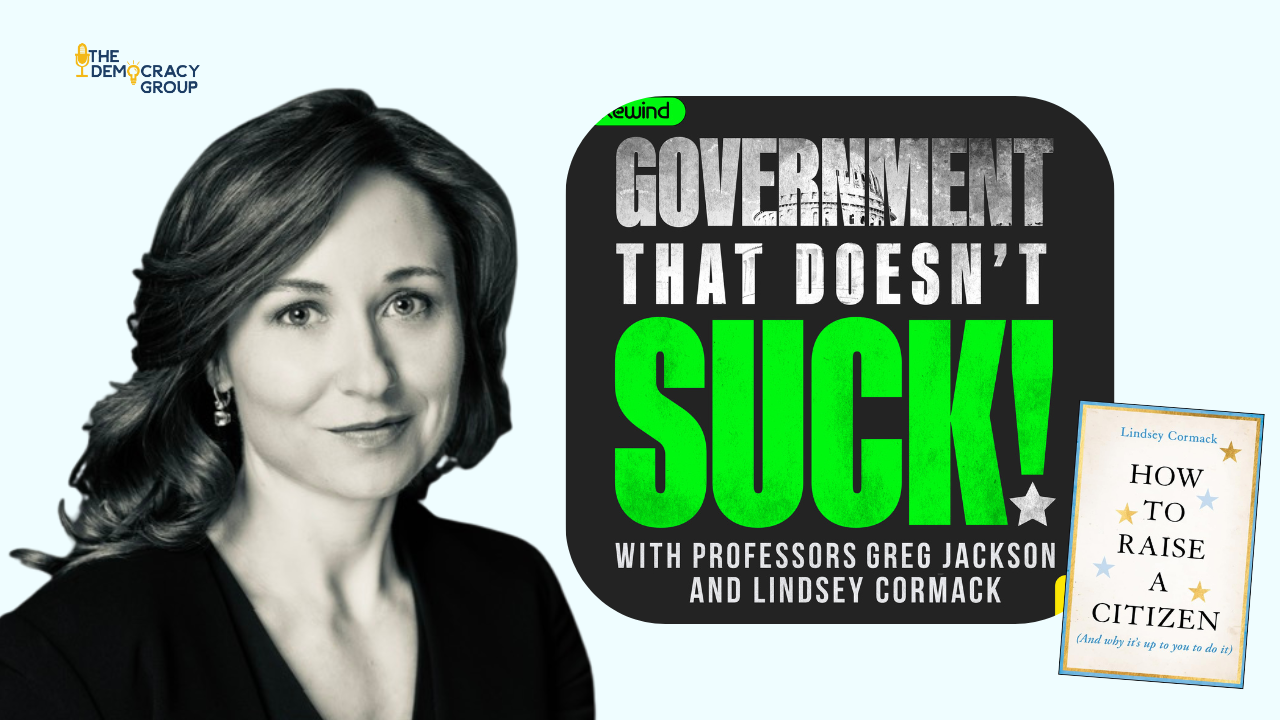
Lindsey Cormack discussed civic education, common misconceptions about government and what to expect from her new podcast "Government That Doesn't Suck."

Engaging in civil discourse. Inspiring civic engagement. Exploring the future of our democracy.
Join our community and never miss your favorite episodes from the Democracy Group.
Subscribe to our Newsletter