

Civic engagement is important because it gives people a voice in decisions that affect their lives, helps communities solve shared problems, and strengthens democracy by making government more responsive and accountable. Through activities such as voting, volunteering, contacting elected officials, and participating in local organizations, citizens can influence public policies and improve their communities. Civic engagement also builds relationships, encourages cooperation, and helps people develop the knowledge and confidence to participate in democratic life. Without meaningful public participation, government decisions risk becoming disconnected from the needs and priorities of the people they serve.
Government decisions affect nearly every aspect of our daily lives, from the roads we drive on to the quality of our drinking water and the schools our children attend.
Lindsay Cormack, an associate professor of political science at Stevens Institute of Technology, emphasizes that these decisions are shaped by government, even when people don't realize it.
Civic engagement gives citizens opportunities to influence those decisions rather than simply accepting their outcomes.
For example, attending a city council meeting allows residents to express their opinions about local development. Contacting elected officials can help representatives understand their constituents' concerns. Voting gives citizens a role in choosing who makes decisions on their behalf.
The more opportunities people have to participate, the more opportunities they have to make their priorities heard.
In a representative democracy, elected officials are supposed to serve the public. But elections alone aren't always enough to ensure that government remains responsive to citizens' needs.
Civic engagement provides ongoing opportunities for public oversight.
Citizens can attend public hearings, investigate government decisions, organize advocacy campaigns, and demand explanations from elected officials.
Max Stier, president and CEO of the Partnership for Public Service, encourages citizens to look for examples of government working effectively and identify how successful approaches might be applied elsewhere.
Rather than focusing exclusively on what government does wrong, citizens can help improve public institutions by identifying practical solutions.
This kind of participation encourages transparency, accountability, and better governance.
Not every community challenge requires action from the federal government. Many problems can be addressed through local organizations, neighborhood groups, and cooperation between residents.
Peter Levine, a scholar of civic engagement, recommends joining existing civic activities and organizations rather than assuming that meaningful participation requires creating something entirely new.
For example, residents concerned about neighborhood safety might organize a community association. People interested in improving education might volunteer with local schools or participate in school board discussions.
These activities allow individuals to combine their knowledge, skills, and resources to accomplish things they might struggle to achieve alone.
Civic engagement is therefore about more than influencing government. It's also about people working together to improve their communities.
Healthy communities depend on relationships between people who share common spaces, institutions, and responsibilities.
Civic engagement creates opportunities to build those relationships.
When people volunteer, participate in community organizations, or collaborate on local projects, they interact with neighbors they might otherwise never meet.
Michael Zakaras, director of Ashoka US, emphasizes the importance of a strong civil society in which people actively participate in shaping their communities.
These experiences can build trust, strengthen social networks, and encourage cooperation across differences.
They can also help people recognize that they have shared interests, even when they disagree about politics.
Some forms of civic engagement go beyond expressing opinions and allow citizens to directly influence government decisions.
One example is participatory budgeting, a process through which residents help decide how a portion of public money should be spent.
Political scientist Hollie Russon Gilman explains that participatory budgeting can give everyday people meaningful influence over public resources while helping them better understand government.
Citizens might propose improvements to parks, sidewalks, libraries, or other community facilities and participate in selecting which projects receive funding.
Another example is ballot initiatives, which allow voters in certain states to propose or approve laws directly.
These mechanisms demonstrate that democratic participation doesn't have to be limited to choosing representatives every few years.
Many people feel frustrated with politics or believe their participation won't make a difference.
Jenna Spinelle, creator of When the People Decide, highlights stories of everyday citizens who have overcome obstacles to create meaningful political change.
These examples illustrate how civic engagement can help people develop a sense of agency.
Rather than feeling powerless in the face of political dysfunction, individuals can discover opportunities to make tangible improvements.
Even small victories, such as improving a neighborhood park or influencing a local policy, can demonstrate that collective action matters.
Ultimately, democracy requires more than elections and government institutions. It requires people who are willing to participate in public life.
Angela Glover Blackwell, a civil rights advocate and attorney, describes democracy as a process of collective self-governance aimed at creating the conditions for people to flourish.
From this perspective, civic engagement is one of the primary ways citizens turn democratic ideals into everyday action.
You don't need to change the entire country to make a difference. Start by identifying an issue that matters to you, finding people already working on it, and taking one meaningful step to get involved.
When people participate in shaping their communities, they help make democracy more representative, responsive, and capable of addressing shared challenges.
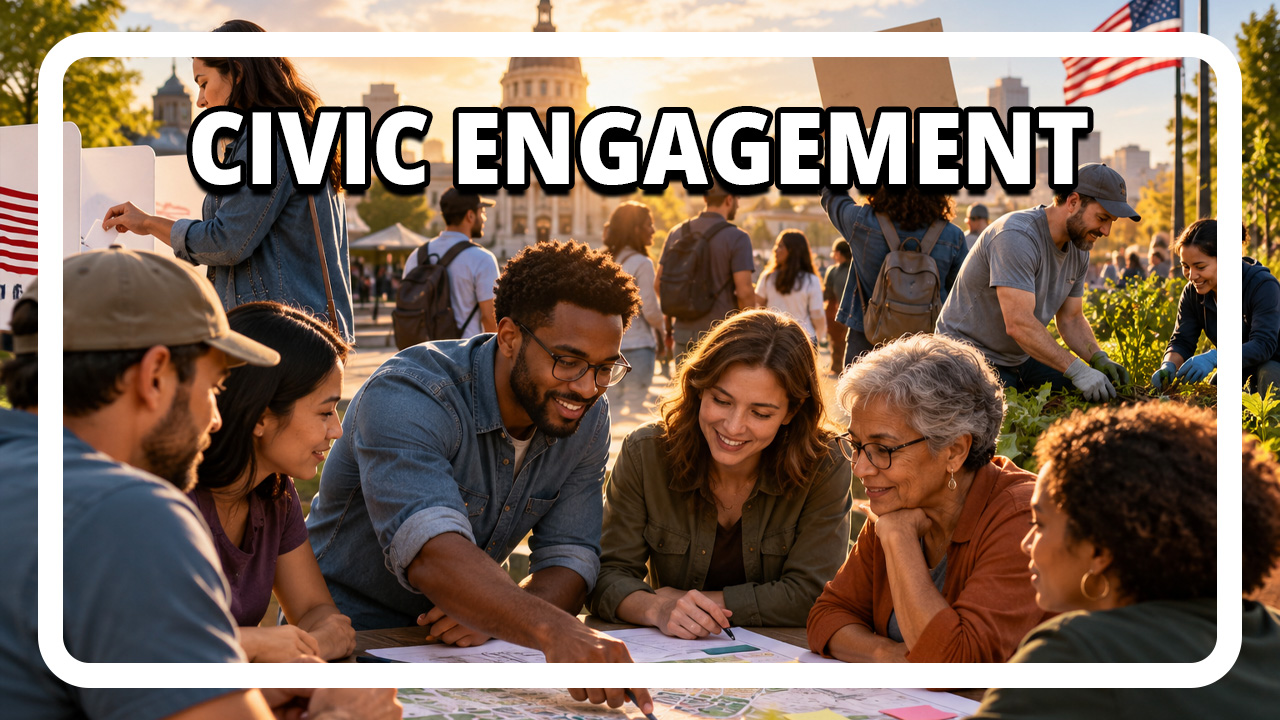
What is civic engagement, and how can you get involved? Discover why it matters and practical ways to strengthen democracy beyond voting.
Read PostSubscribe to receive a biweekly collection of the hottest podcast episodes from the network, upcoming special events, expert features and news from your favorite shows.
Subscribe to our NewsletterCivic engagement is the act of participating in activities that improve your community, influence public decisions, or contribute to the democratic process. It includes political activities such as voting, contacting elected officials, supporting candidates, and attending public meetings, as well as community activities like volunteering, joining local organizations, organizing neighbors, and helping solve shared problems. Civic engagement allows everyday people to have a voice in decisions that affect their lives and contribute to the well-being of their communities. It is an essential part of democracy because it gives citizens opportunities to participate in shaping society beyond simply voting in elections.
Civic engagement includes any activity through which people participate in public life, improve their communities, influence government decisions, or help solve shared problems. Common examples of civic engagement include voting, volunteering, contacting elected officials, attending public meetings, supporting political campaigns, joining community organizations, participating in protests, and organizing neighborhood initiatives. Civic engagement can be political, such as advocating for legislation, or nonpolitical, such as coordinating a community cleanup or mutual aid effort. The defining characteristic is active participation in improving or shaping the community and society around you.
Civic engagement is important in democracy because it allows citizens to participate in governing their communities, influence public policies, and hold elected officials accountable. Democracy depends on more than voting in elections; it requires people to remain involved in public decisions, advocate for their interests, and work together to solve shared problems. Through activities such as voting, volunteering, contacting representatives, attending public meetings, and organizing community initiatives, citizens help ensure that government reflects the needs and priorities of the people it serves. Without meaningful civic engagement, democratic institutions can become less responsive, less accountable, and increasingly disconnected from the public.
Brandon Stover is the Network Manager for The Democracy Group and a Digital Content Specialist at the McCourtney Institute for Democracy. He leads partnerships and collaborations across the podcast network, oversees educational content strategy, and produces written, audio, and video content while managing the network's digital marketing efforts. Before joining the McCourtney Institute for Democracy, Brandon founded and led a nonprofit organization dedicated to creating free educational content on global issues. He holds a master's degree in Architecture from Washington State University.
Engaging in civil discourse. Inspiring civic engagement. Exploring the future of our democracy.
Join our community and never miss your favorite episodes from the Democracy Group.
Subscribe to our Newsletter