

Civic engagement is the act of participating in activities that improve your community, influence public decisions, or contribute to the democratic process. It includes political activities such as voting, contacting elected officials, supporting candidates, and attending public meetings, as well as community activities like volunteering, joining local organizations, organizing neighbors, and helping solve shared problems. Civic engagement allows everyday people to have a voice in decisions that affect their lives and contribute to the well-being of their communities. It is an essential part of democracy because it gives citizens opportunities to participate in shaping society beyond simply voting in elections.
Civic engagement can take many forms, ranging from simple individual actions to organized community efforts.
Some common examples include:
Civic engagement doesn't necessarily require involvement in formal politics. Even organizing a neighborhood cleanup or helping coordinate mutual aid can be forms of civic participation.
Civic engagement matters because political decisions influence nearly every aspect of our daily lives, whether we participate in making them or not.
Lindsay Cormack, associate professor of political science at Stevens Institute of Technology, explains that decisions about roads, zoning, drinking water, and public infrastructure are all shaped by government.
Understanding how these decisions are made gives people opportunities to influence them.
Civic engagement can also help counter feelings of political hopelessness.
Jenna Spinelle, creator of When the People Decide, describes how everyday citizens have overcome government dysfunction to create meaningful change in their communities. Participating in those efforts can help people develop a sense of agency and confidence in their ability to make a difference.
Rather than viewing government as something that simply happens to us, civic engagement allows us to participate in shaping its decisions.
Yes. Although voting is one of the most fundamental forms of civic participation, civic engagement extends far beyond elections.
Angela Glover Blackwell, a civil rights advocate and attorney, argues that democracy is ultimately about collective self-governance and creating the conditions for people to flourish.
From this perspective, elections and political representation are mechanisms through which people pursue broader democratic goals.
Michael Zakaras, director of Ashoka US, similarly argues that a healthy democracy depends on a strong civil society in which people regularly participate in their communities.
This might involve joining a neighborhood association, organizing a community project, volunteering with a nonprofit, or helping others participate in public life.
Voting gives citizens a voice in choosing their representatives, but civic engagement provides ongoing opportunities to influence their communities between elections.
Getting involved doesn't require political expertise, substantial financial resources, or a position of authority.
Peter Levine, a leading scholar of civic engagement, recommends starting by participating in existing civic organizations and activities. When possible, he also encourages people to expand opportunities for others to participate.
One practical approach is to identify an issue you care about and find organizations already working on it.
For example, if you're concerned about housing affordability, you might attend a city council meeting, join a local housing organization, or learn how zoning decisions are made.
Another opportunity is participatory budgeting, a process in which residents help propose and select projects funded through public resources.
Political scientist Hollie Russon Gilman explains that participatory budgeting can give residents meaningful decision-making power while helping them understand how government works.
Citizens can also pursue change through ballot initiatives where state laws allow them. One example discussed in The Democracy Group's podcasts is the North Dakota group known as the BadAss Grandmas, whose grassroots organizing helped establish new ethics and campaign finance provisions in the state's constitution.
Civic engagement doesn't have to begin with a major political campaign or an ambitious plan to change the country.
Sometimes, it starts with a conversation between neighbors who recognize a shared problem and decide to do something about it.
The simplest way to become civically engaged is to find something in your community that matters to you and take one meaningful step toward improving it.
Whether that's voting in a local election, attending a public meeting, volunteering, or organizing with others, civic engagement is how ordinary people help shape the communities and democratic institutions that affect their lives.
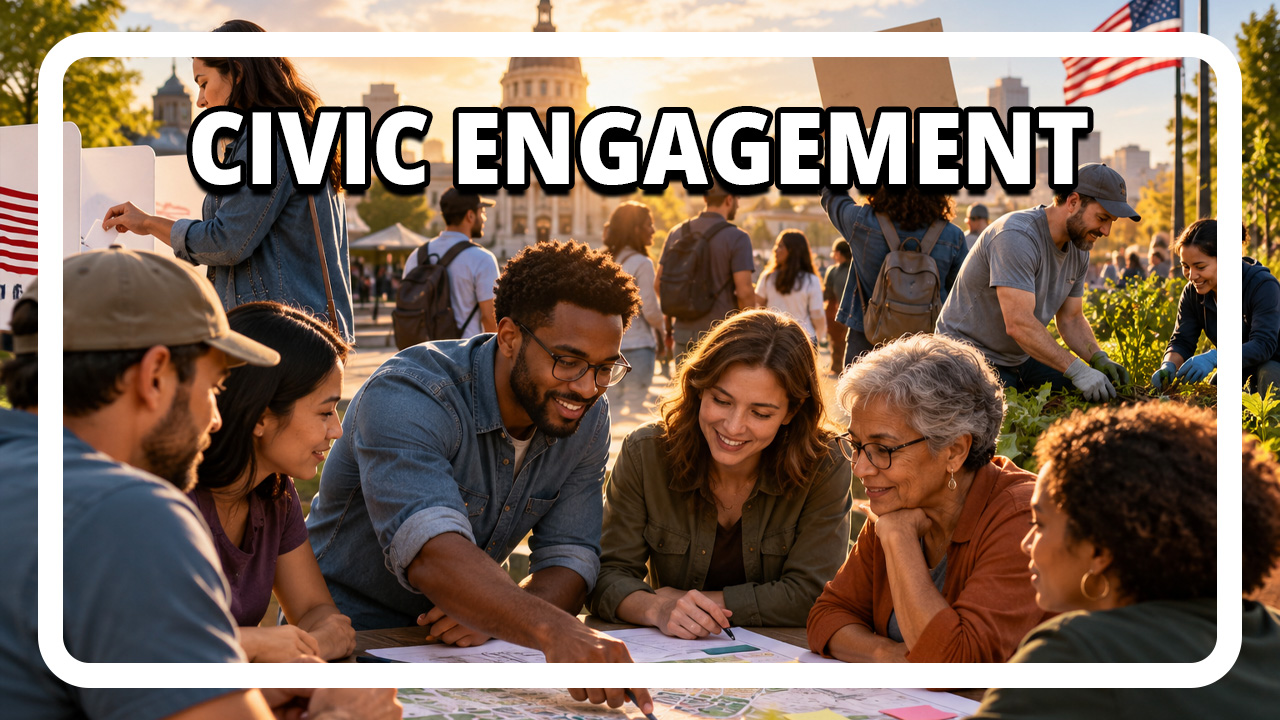
What is civic engagement, and how can you get involved? Discover why it matters and practical ways to strengthen democracy beyond voting.
Read PostSubscribe to receive a biweekly collection of the hottest podcast episodes from the network, upcoming special events, expert features and news from your favorite shows.
Subscribe to our NewsletterCivic engagement is important because it gives people a voice in decisions that affect their lives, helps communities solve shared problems, and strengthens democracy by making government more responsive and accountable. Through activities such as voting, volunteering, contacting elected officials, and participating in local organizations, citizens can influence public policies and improve their communities. Civic engagement also builds relationships, encourages cooperation, and helps people develop the knowledge and confidence to participate in democratic life. Without meaningful public participation, government decisions risk becoming disconnected from the needs and priorities of the people they serve.
Civic engagement is important in democracy because it allows citizens to participate in governing their communities, influence public policies, and hold elected officials accountable. Democracy depends on more than voting in elections; it requires people to remain involved in public decisions, advocate for their interests, and work together to solve shared problems. Through activities such as voting, volunteering, contacting representatives, attending public meetings, and organizing community initiatives, citizens help ensure that government reflects the needs and priorities of the people it serves. Without meaningful civic engagement, democratic institutions can become less responsive, less accountable, and increasingly disconnected from the public.
Civic engagement includes any activity through which people participate in public life, improve their communities, influence government decisions, or help solve shared problems. Common examples of civic engagement include voting, volunteering, contacting elected officials, attending public meetings, supporting political campaigns, joining community organizations, participating in protests, and organizing neighborhood initiatives. Civic engagement can be political, such as advocating for legislation, or nonpolitical, such as coordinating a community cleanup or mutual aid effort. The defining characteristic is active participation in improving or shaping the community and society around you.
Brandon Stover is the Network Manager for The Democracy Group and a Digital Content Specialist at the McCourtney Institute for Democracy. He leads partnerships and collaborations across the podcast network, oversees educational content strategy, and produces written, audio, and video content while managing the network's digital marketing efforts. Before joining the McCourtney Institute for Democracy, Brandon founded and led a nonprofit organization dedicated to creating free educational content on global issues. He holds a master's degree in Architecture from Washington State University.
Engaging in civil discourse. Inspiring civic engagement. Exploring the future of our democracy.
Join our community and never miss your favorite episodes from the Democracy Group.
Subscribe to our Newsletter