

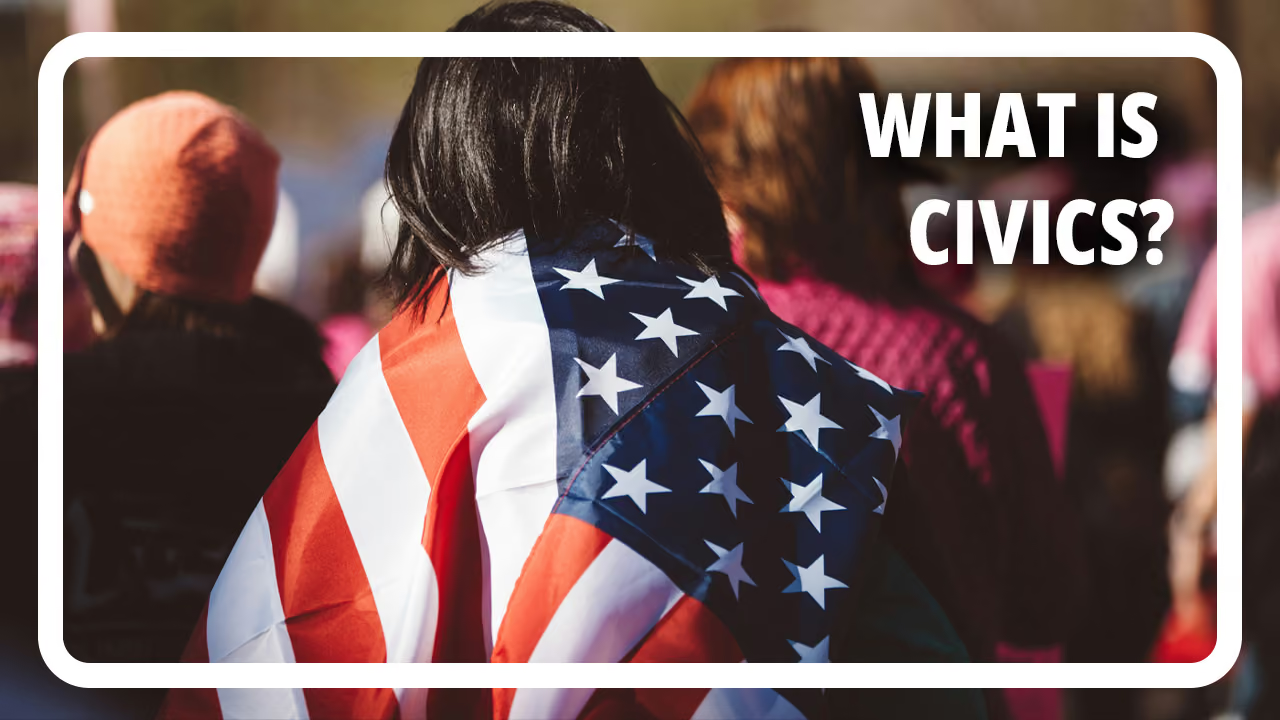
Civics is the study of the rights, duties, and responsibilities of citizens within a society. It focuses on how government functions and how individuals participate in the democratic process.
In other words, civics is about how we—the people being governed—help decide how we are governed.
Democracy does not run on autopilot. It depends on citizens who understand the system they live in and who are willing to engage with it. Yet today, many people feel disconnected from politics, unsure how the government works, or convinced that their participation doesn’t matter. Without civic understanding, frustration grows, trust erodes, and the very institutions meant to represent the public begin to feel distant and unresponsive.
That’s why civics matters.
Civics helps citizens understand their rights so they can protect them. It teaches how government decisions are made and how those decisions affect everyday life—from the schools our children attend to the safety of our food, water, and elections. Most importantly, civics empowers people to move beyond passive observation and become active participants in shaping their communities and their country.
At its core, civics comes down to three principles that are easy to say, but far more difficult to practice:
Throughout this article, you’ll hear from civic leaders, educators, and public servants who explain why these three steps matter—and how each of us can put them into practice. From understanding our obligations as citizens, to taking meaningful action in our communities, to rebuilding trust and respectful dialogue in a divided society, civics offers a roadmap for how democracy can continue to work.
But ultimately, the responsibility rests with us. As citizens, we each face a choice: to remain passive observers of government—or to actively participate in shaping the future of our democracy.
Related: If you teach political science, our free syllabus guide curates the best democracy podcasts on topics just like this—ready to assign.
Subscribe to receive a biweekly collection of the hottest podcast episodes from the network, upcoming special events, expert features, and news from your favorite shows.
Subscribe to our NewsletterOur first step is to understand the society we live in and how it functions. Dr. Richard Haass, president of the Council on Foreign Relations and author of The Bill of Obligations: Ten Habits of Good Citizens, explains that having rights alone is not enough. We also have an obligation to protect and engage with those rights.
Richard Haass:
“Rights alone will not guarantee the smooth functioning of a society. Rights inevitably clash. Well, what then? How do we avoid gridlock? Or worse yet, how do we avoid violence?
And the idea that violence couldn't come to America, alas, is not true. We've seen elements of politically inspired violence come to this country. That's where obligations kick in—obligations that you and I have to one another and to other people in this society, and obligations that each of us has to this country and to the government.
So my argument is that rights alone are necessary, but not sufficient. What I wanted to do was rebalance our notion of citizenship and add a much greater dose of obligations to it.”
Mila Atmos:
“Well, it was really interesting the way you framed these obligations, because you also talk about how we have a problem right now agreeing on what it means to be American—and that being American involves practicing those obligations.
We are failing to teach each other, especially the younger generation—but really this has been happening for decades now—what it means to be American. Isn’t part of the challenge that there are so many ways to be an American? What, in your view, are the fundamental tenets?”
Richard Haass:
“Well, you put your finger on something important. This was a country that was founded essentially on ideas. We're not a hereditary monarchy—we declared independence against one, last I checked.
Even though we've had imperfections and flaws in our past, we weren't a country founded on race or gender or class. We were a country founded on ideas—ideas about equality, opportunity, and freedom. To me, that is the basis of the American idea.
For this country to work, those ideas have to be transmitted. One of the lessons I take from history is: don’t assume anything. Nothing is automatic. We're not born appreciating the values or comparative strengths of democracy. A child doesn’t simply absorb lessons of history from their mother. We've got to teach that.
I'm Jewish, and I come from a tradition where we celebrate the holiday of Passover. What’s special about that holiday is that we retell the story of the exodus from Egypt—the foundational narrative of Judaism. That retelling has proven essential to the survival of Judaism, despite centuries of dispersion, lack of access to holy places, and persecution.
But Jews have kept their identity alive. That, to me, is exactly what we Americans need to do. We need to keep our identity alive.
Now, of course, that raises the larger question: What is the core of that identity? I think that’s what you're getting at, and it's the right question to ask. To me, it brings up ideas like equality of opportunity and equality under the law. A lot of history and a lot of politics can be understood as our struggle to live up to those ideals.”
Mila Atmos:
“What are the top two obligations that you want every U.S. citizen to practice?”
Richard Haass:
“Be informed. That’s the first obligation. Jefferson and others would say it’s the foundation for everything else.
After that, I’m happy with any of the other nine—from getting involved, to voting, to supporting civics. And obviously there are behavioral expectations, like putting the country before person or party, rejecting violence, and being open to compromise.
But the first obligation is to be informed. I think that is foundational.”
Listen to the full episode on Future Hindsight: Citizens and Their Obligations: Richard Haass
So what exactly does learning about our democracy and how it works look like?
Emma Humphries is the chief education officer and deputy director of field building for iCivics, the nonprofit founded by Justice Sandra Day O’Connor to reinvigorate civics through free, interactive learning resources. She explains what civic learning is and how it prepares us to become better citizens who can take meaningful action.
Emma Humphries:
“So civic learning is any kind of instructional activity where students are given opportunities to prepare for their roles as citizens in our democracy.
And I always make the caveat that I'm not using the term citizen in a strictly legal sense. Simply being a member of a community—whether it's a school community, a neighborhood, a city, a county, a state, our country, or even the world—means that we are all citizens in those spaces.
So civic learning is about preparing people to be more engaged and more involved in those spaces.
That requires a few things. It requires knowledge. It also requires skills and dispositions.
Yes, it’s important to know the three branches of government and how they work. You have to understand the systems, institutions, and processes—that’s part of the knowledge. But that knowledge also includes history. It can include political theory in more advanced classes. It can include economics and geography—understanding your place in the world.
So it’s not just how a bill becomes a law. It’s not just federalism.
Yes, we want students to know those things, but we also want them to care about those things. That’s the disposition: the disposition to pay attention, the disposition to look at a problem and say, ‘How can I help? How can I make that better?’
It’s the disposition to think beyond yourself—to think about the community and not just how something impacts you, but how it impacts the common good.
And then, of course, there are the skills to actually put that knowledge and those dispositions into action.
So when you see that something’s wrong, or you think, ‘We could make this better,’ civics helps students avoid saying, ‘Well, there’s nothing I can do about that,’ or ‘I don’t know what to do.’
Civics is about helping students know what to do—and helping them feel that they have agency to make things better.”
Listen to the full episode on Democracy Works: Civic learning amid the culture wars
Preparing citizens to be more informed and educated about our government helps prevent that government—or its processes—from impeding our rights, including some of the most taken-for-granted ones, like voting.
Simone Leeper litigates a wide range of redistricting-related cases at the Campaign Legal Center (CLC), challenging gerrymanders and advocating for election systems that guarantee all voters an equal opportunity to influence our democracy. She explains voter intimidation:
Simone Leeper:
“The United States is the world’s oldest continuously functioning democracy. Unfortunately, it also has a long history of people trying to coerce or frighten voters.
But that also means we’ve built up a system of strong defenses over the years—which we’ll get to later in the episode.
For now, it’s important to know that voter intimidation can happen before, during, and after Election Day. And it’s illegal.
Whether you’re voting in person, by mail, or via an election drop box, you should never be made to feel unsafe or intimidated while casting your ballot.
The number of people who would harass or intimidate voters is far, far smaller than the number of people at every level of government who want to help you cast your vote.
But it’s incumbent on all of us to be aware of bad actors who might try to intimidate us or other voters.
One scary encounter at a drop box, or a confusing AI-generated call, could be all it takes to keep a voter from casting their ballot. But for some voters—especially those in Weld County, Colorado—this won’t be their first rodeo. At least they’ll have the tools and support from local election officials like Carly to make sure their vote counts.”
Listen to the full episode on Democracy Decoded: Know Your Rights as a Voter
Richard Haass explains that education is what levels the playing field and truly creates equal opportunity in a democratic society.
Richard Haass:
“To me, equality of opportunity is central to the political DNA of this country. When I look at documents like the Declaration of Independence, and when I think about our unfinished work, this is high on my list.
For much of our history, equal opportunity was fairly real. It wasn’t perfect, but it was real enough. Some people had more opportunities than others—as always, those with more advantages—but many people could get onto that ladder.
Because people could climb that ladder, it created optimism. It weakened cynicism. It weakened alienation.
People believed that if they worked hard, went to school, and did the right things, they could improve their lives. Maybe they wouldn’t be as rich as a Rockefeller, but they could be pretty well off—and better off than their parents.
What worries me today is that too many people no longer believe that. And in many cases, they’re probably right not to believe it.
That’s really dangerous. It leads to class warfare or to disillusionment with democracy because democracy no longer seems to deliver.
That’s when we become more tribal. And that is a real threat to the American democratic experiment.
Right now, equality of opportunity is increasingly becoming a slogan rather than a reality.
The biggest weakness is the quality of public education. One thing most Americans must do is attend school until they’re about sixteen. The biggest investment our society should make is in education.
That could include public schools, religious schools, charter schools, or private schools—but public schools are where most kids go. We have to make them better.
And right now, we’re not doing it well. As Condi Rice and others have said, show me a child’s zip code and I can tell you a lot about the quality of their education and the opportunities they’ll have.
We’re failing many of our young people through the way we fund schools, train teachers, and design curricula.
By the way, I’m fairly radical about some things. I’d like to get rid of legacy admissions. We need a level playing field. I don’t want to perpetuate inherited advantage.
It’s also why I believe there should be real limits on how much wealth can be passed from one generation to the next. I don’t want people to be born on third base and think they hit a triple.
I’d rather have them start at home plate—or maybe halfway to first base—but no more than that.
But the emphasis shouldn’t be on reducing the advantages of the few. It should be on increasing the opportunities of the many.
More than anything else, we must ensure that educational opportunity is real in this country.
That’s why I want civics and citizenship education to be staples in our schools. I’d also like Americans to be more globally literate.
Here at the Council on Foreign Relations, we’ve developed an entire curriculum to help Americans become more knowledgeable about the world they’re growing up in.
But we simply have to improve the quality of education if equal opportunity is going to be more than just a slogan.”
Listen to the full episode on Future Hindsight: Citizens and Their Obligations: Richard Haass
Being informed is great. It’s necessary. But it’s only the first step.
Brian Derrick of the online Democratic fundraising platform Oath explains that you must move beyond simply learning about politics and begin actively engaging in the processes you understand.
Brian Derrick:
“Simply watching, staying informed, or educating yourself can feel like such a lift that once you've done it, you feel finished. You feel like something is complete—that you've checked a box.
It's hard to say this, but that's wrong. That is not how we move toward a better future. Educating yourself is only as valuable as how you leverage that knowledge to take action. That is the purpose of educating yourself.
If all you're going to do is sit at home and consume podcasts, you might as well save yourself the trouble and do nothing. Why even bother knowing if you’re not going to do something with that knowledge?
I'd actually say knowledge is not power. Acting upon knowledge is power.
There’s a lot of knowledge here. You all are sharing incredible insights through this podcast, and I’m thrilled your listeners have it as a source. But what makes it powerful is that there’s clearly a next step they can take.
Don’t confuse witnessing with the actual action we need people to take.
Doomscrolling is not the answer. Instead, take small steps that empower you.
Because of my profession, I’ll always say you can donate five dollars somewhere it matters. Platforms like Oath can help with that. But beyond money, community involvement is incredibly powerful.
Start a political club. Start a book club. Join one. Get involved in your local political organization. Having an ongoing community is a meaningful investment of time because you’re actually building something together.
Being involved locally is huge. If there is a cause that motivates you or lights your heart on fire, find a way to support it in your own community. It also pulls you away from the constant national political obsession and connects you to real people and real impacts on the ground.
And if none of those options work for you, sign up to volunteer with a national organization like Swing Left or the ACLU. They need support as well.
Even if you don’t have five dollars to give and you don’t have time to start a club, there is always an opportunity to do something.”
Listen to the full episode on New Faces of Democracy: Oath.Vote
Next, listen to Max Stier, president and CEO of the Partnership for Public Service, explain what people should do if they are dissatisfied with what they see happening in government.
Max Stier:
“Good government is government that meets the public’s needs in an effective fashion. Government exists to solve big problems for our society. Good government is one that delivers results for people in this country.”
David Martin:
“What should people do if they don’t like what they see in government—if they don’t like what government is doing in their town, their neighborhood, or their state?”
Max Stier:
“They need to speak up. And my advice would be: don’t just point out the problem. Try to offer ideas about what the solution might be.
Part of finding solutions is looking for places where something is already working better. I think ‘bright spotting’ is a great way to improve systems.
Somewhere, someone is doing whatever you’re concerned about in a better way. Finding those examples and lifting them up is a powerful way to improve things for everyone.”
Listen to the full episode on Good Government: The Voice of Public Service Meets the Partnership for Public Service
Civility is closely tied to civics. While civics focuses on the rights and responsibilities of citizenship, civility provides the social foundation—mutual respect, restraint, and public-mindedness—that allows people with different beliefs to engage productively in democratic life.
Alexandra Hudson, writer, public speaker, and founder of Civic Renaissance, explains the difference between civility and politeness—and why civility is essential for a healthy democracy.
Alexandra Hudson:
“There is an essential distinction between civility and politeness.
Politeness is manners. It’s etiquette. It’s technique. It’s external and often superficial.
Civility, on the other hand, is internal. It’s a disposition of the heart. It’s a way of seeing others as our moral equals—people who deserve a basic level of respect simply because they are fellow members of the human community.
Sometimes respecting someone—or even loving someone—actually requires breaking the rules of etiquette. It may require being impolite, telling a hard truth, or engaging in robust debate.
At times, that is a duty of citizenship.
We live in a country founded on civil protest, speaking truth to power, and acts of civil disobedience. Those actions can be ways of respecting our country and our fellow citizens enough to do something uncomfortable—to confront hypocrisy and tell hard truths.
Throughout my work, I unpack this distinction and argue that we should stop settling for politeness—simply saying the nice or expected thing—and instead aim for true civility.
True civility sometimes means risking offense. It means having uncomfortable conversations. But that is what our deeply divided moment requires.
We cannot simply paper over our differences or sweep them under the rug. We must be willing to bring our deepest beliefs into the public square and engage with one another honestly and peacefully.
Hiding who we are or what we believe may feel easier in the moment, but it is not sustainable—and it is not conducive to a free and flourishing society. It is certainly not what democracy requires.”
Listen to the full episode on Village Squarecast: The soul of civility
Trust is also essential for democratic engagement—not only trust between citizens, but trust in the institutions we participate in.
Let’s return to the words of Max Stier.
Max Stier:
“Trust is the fundamental currency of democracy. Once the public loses faith in government as a tool for collective action, the system begins to fall apart.
The real question isn’t simply admiring the problem—it’s focusing on solutions.
From the research we’ve done, the antidote is twofold. First, government must perform better. It must become more trustworthy. That begins with having the right leaders—people who are focused on the public good and who have real expertise in running large organizations.
Second, the public needs more understanding of how government actually works.
The civil service, in particular, is often viewed as a faceless bureaucracy. But that perception exists largely because people lack information about who civil servants really are.
About 80 percent of federal employees live outside Washington, D.C. They live in communities across the country—in the same regions and neighborhoods as the people they serve.
Most survey questions about trust ask whether people trust ‘the government in Washington.’ Once you add those final two words—‘in Washington’—the answer is almost always no.
But when people think of the federal government, they tend to picture bickering politicians, not the career civil servants who actually keep things running.
Efforts like this podcast help people understand who government really is. These are their neighbors—people devoted to serving the public and providing vital services.
Think about the person who ensures the hamburger meat you buy is safe so your kids don’t get sick. Or the people who make sure the water you drink is clean. Or the professionals who ensure that planes don’t collide when you fly.
These are things we take for granted, but they are all made possible by civil servants doing their jobs—and they are all at risk if we stop valuing that work.”
Listen to the full episode on Good Government: The Voice of Public Service Meets the Partnership for Public Service
Maury Giles, CEO of Braver Angels, reminds us that civic engagement ultimately comes down to a personal choice. We can choose to see ourselves as victims of what government does to us, or we can use civics to take action and shape the system ourselves.
Maury Giles:
“First and foremost, the choice we have to make is a choice of personal agency. Am I going to act, or am I going to react?
The theory of change we’re working from begins with helping people recognize that they have the ability to influence what happens by how they respond.
If there’s any country in the world where people have the ability to shape the future they want, it’s this one. But that starts with accepting and owning our part in the process. Through the conversations happening in communities across this country, it begins with each of us recognizing: wait a minute—I have a choice right now.
I have a choice in how I react, or how I choose to act proactively when engaging with someone who is different from me.
Let me give you an example from the political sphere: gerrymandering.
I live in Utah. I’m a conservative. I’m a registered Republican. And I believe we have one of the worst gerrymandered districts in the United States. We’ve been going through a lot of debates about it, including court cases, and the legislature recently had to redraw the maps.
But here’s the challenge with gerrymandering as I see it: it only works because we often play into the narrative of voting for party over everything else.
If we individually and collectively made the choice to vote based on the candidate—their character, their perspective, their values—rather than simply their party affiliation, gerrymandering would lose much of its power.
That’s where individual agency begins.
When we encounter someone who sees the world differently than we do, instead of responding with an attack or immediately defending our own point of view, we could ask a different question: Tell me more about the life experiences that shape the way you see this issue.
Those small choices in everyday interactions can create a cascading impact.
That’s where change begins.”
How Do We Fix It: Be The People. Healing America and Restoring Civic Muscle: Maury Giles
Democracy is not something that simply exists. It is something that is constantly being created by the people who participate in it.
The institutions, laws, and protections we often take for granted only work when citizens understand them, engage with them, and care enough to improve them. When people withdraw from civic life—when they stop learning, stop participating, or stop listening to one another—democracy weakens.
But the good news is that civic engagement doesn’t require holding public office or becoming a political expert. It begins with ordinary citizens making small but meaningful choices every day: learning how their government works, participating in their communities, and treating others with the respect necessary to navigate disagreements.
Throughout this article, civic leaders and educators have echoed the same idea in different ways: the health of a democracy depends on the actions of its citizens.
And at its core, that responsibility comes down to three simple—but powerful—principles:
None of these steps are always easy. But they are essential.
Civics is not just something taught in classrooms. It is a practice—one that each generation must learn and carry forward. The future of our communities and our country depends on citizens who are willing to participate in shaping it.
The question isn’t whether civics matters.
The question is whether we will choose to practice it.
Be informed. Take action. And do it with civility.
Because democracy works best when all of us do.
Civics is the study and practice of the rights, duties, and responsibilities of people within a society. It includes understanding how government works, how laws and public decisions are made, what rights people have, and how individuals can participate in shaping their communities and government. In a democracy, civics prepares people to be active citizens by giving them the knowledge and skills to vote, engage with public issues, hold government accountable, work with others, and contribute to the common good.
Civics is important because democracy depends on citizens who understand how government works and know how to participate in it. Civic knowledge helps people understand their rights and responsibilities, evaluate political issues, vote more effectively, hold elected officials accountable, and take action when they want change. Civics also develops the skills and habits needed to work with others, navigate political disagreement, and contribute to the common good. Without an informed and engaged public, democratic institutions are less capable of representing the people they are designed to serve.
Subscribe to receive a biweekly collection of the hottest podcast episodes from the network, upcoming special events, expert features, and news from your favorite shows.
Subscribe to our NewsletterBrandon Stover is the Network Manager for The Democracy Group and a Digital Content Specialist at the McCourtney Institute for Democracy. He leads partnerships and collaborations across the podcast network, oversees educational content strategy, and produces written, audio, and video content while managing the network's digital marketing efforts. Before joining the McCourtney Institute for Democracy, Brandon founded and led a nonprofit organization dedicated to creating free educational content on global issues. He holds a master's degree in Architecture from Washington State University.
Corinna Bellizzi talks about making the move from business leader to podcaster and how she think about the democracy in the context of social impact

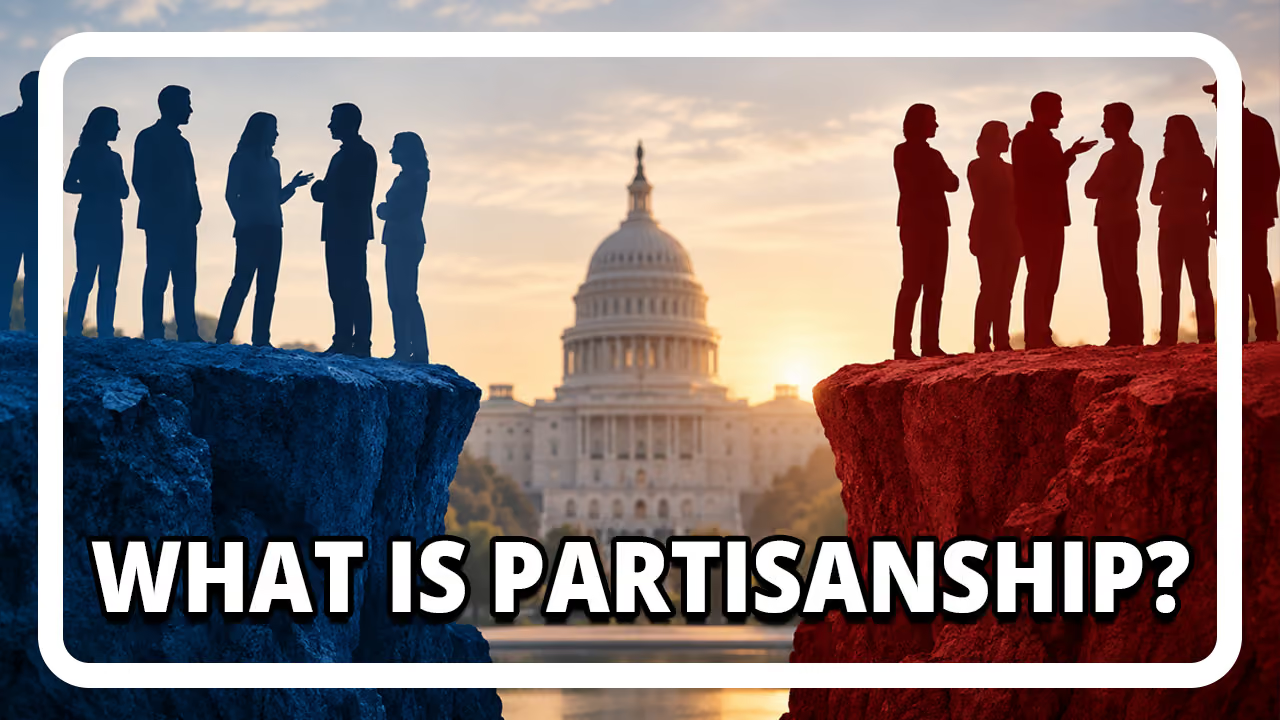
What is partisanship, and why does it divide us? Learn the psychology, consequences, and ways Americans can bridge the partisan divide.
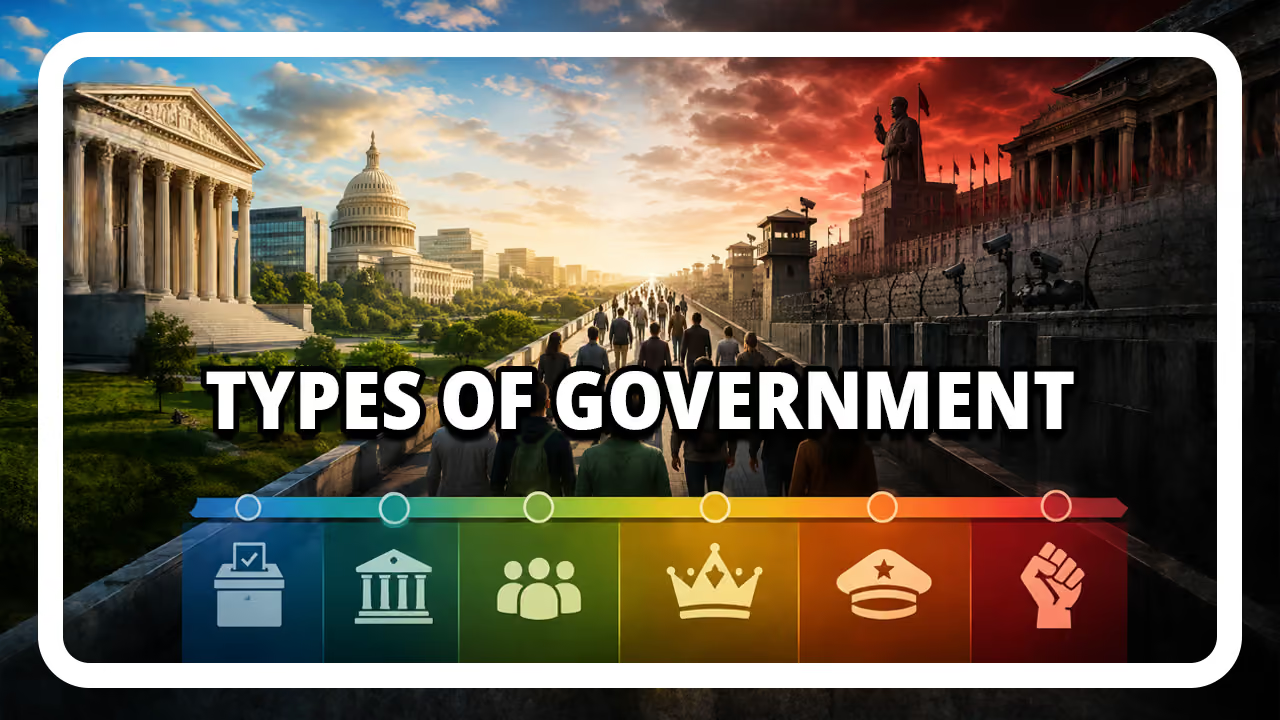
What are the main types of government, and where does your country fall on the democracy-to-authoritarian spectrum? Learn the differences between democracy, republics, monarchies, oligarchies, anocracies, authoritarianism, and totalitarianism through expert insights from political scientists, historians, and democracy advocates featured across The Democracy Group podcast network.
Engaging in civil discourse. Inspiring civic engagement. Exploring the future of our democracy.
Join our community and never miss your favorite episodes from the Democracy Group.
Subscribe to our Newsletter