

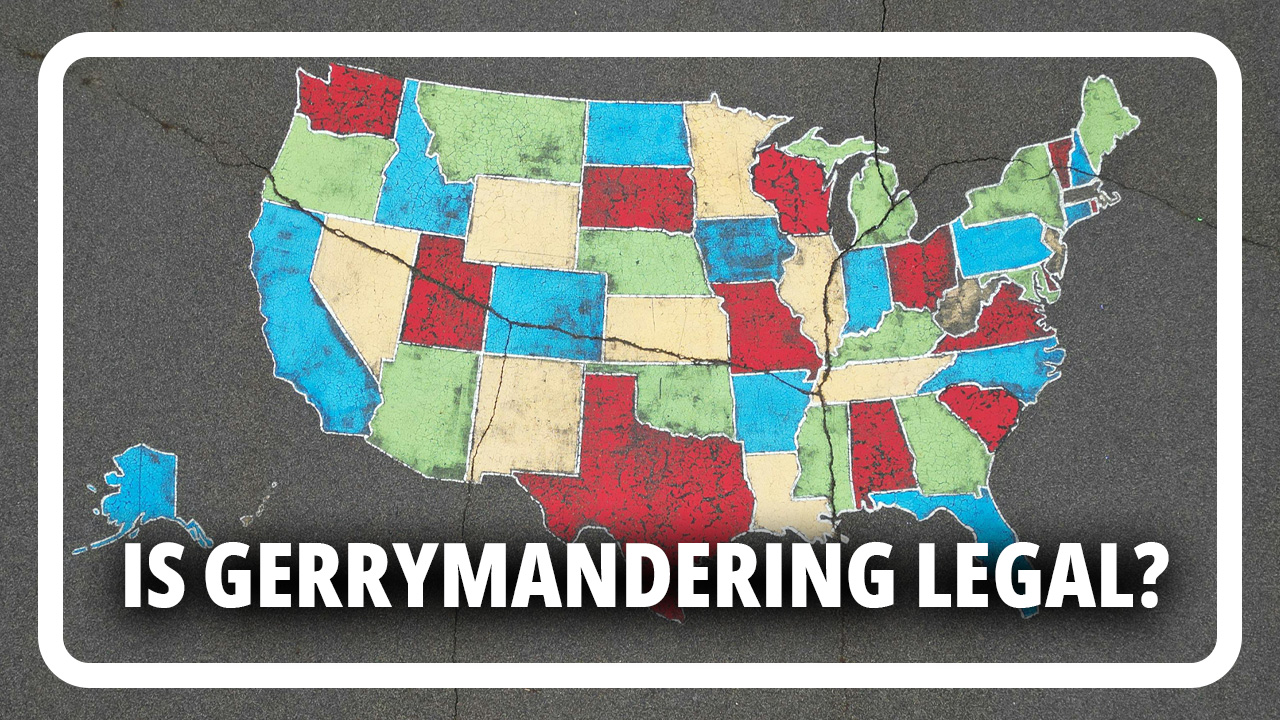
The promise of democracy rests on a simple idea: voters choose their representatives. But what happens when representatives choose their voters instead?
Gerrymandering is the practice of drawing electoral district lines in ways that advantage certain political interests—often by weakening the voting power of particular communities or political groups. While redistricting itself is a necessary and constitutionally required process, gerrymandering exploits that process for partisan or racial gain. It raises a fundamental question at the heart of American democracy: If elections are shaped before a single ballot is cast, how democratic are they really?
The legality of gerrymandering sits in an uneasy gray area. Some forms—particularly racial gerrymandering—are explicitly illegal. Others persist despite repeated court challenges, protected by political incentives and constitutional loopholes. The result is a system that can comply with the letter of the law while undermining its democratic spirit.
In this article, we’ll explore what gerrymandering is, why it distorts representation and erodes voter trust, and how it affects people not just in theory, but in their everyday experience as citizens. Drawing from expert interviews and conversations featured across multiple podcasts, you’ll hear from historians, legal scholars, journalists, and reform advocates who explain how gerrymandering works, why it has endured for centuries, and what can be done to end it.
From packing and cracking to independent redistricting commissions and citizen-led ballot initiatives, these voices illuminate both the dangers gerrymandering poses—and the growing movement to reclaim fair representation in American democracy.
Related: If you teach political science, our free syllabus guide curates the best democracy podcasts on topics just like this—ready to assign.
Subscribe to receive a biweekly collection of the hottest podcast episodes from the network, upcoming special events, expert features, and news from your favorite shows.
Subscribe to our NewsletterLet’s start with a bit of Gerrymandering 101.
Alex Lovit—senior program officer and historian at the Kettering Foundation and host of The Context—explains the foundational practice of gerrymandering and its primary forms. Then Simone Leeper, host of Democracy Decoded, and Mark Gaber, CLC’s senior director of redistricting, walk us through packing and cracking, two of the most common tactics used in gerrymandering.
Alex Lovit:
“Almost all elected officials in the U.S. represent a specific geographic district. Since populations shift over time, those districts need to shift as well to ensure everyone has equal representation. So if one region’s population grows while another shrinks, we have to redraw the lines to make sure that each state legislative and U.S. House district has approximately the same population.
Normally, states do this every ten years after each national census. The problem is that it’s possible to draw district lines in ways that minimize or maximize the voting power of particular groups or benefit one of our two major political parties. That’s what we call gerrymandering.
The basic strategy of gerrymandering is to force your opponents to waste votes—so they win some districts by much larger margins than necessary, while other districts remain out of reach.
Gerrymandering distorts representation, leading to legislatures whose partisan breakdown doesn’t align with the parties’ popular support among voters. Because it insulates elected officials from cross-party competition, it also leads to more extreme representatives. And for voters in districts designed to be noncompetitive, it’s frustrating and alienating.
In short, gerrymandering is bad for democracy.
There’s racial gerrymandering, which involves drawing district lines with race as the predominant factor. There’s also partisan gerrymandering, which is drawing district lines to benefit one political party over another—or one incumbent over another.”
Listen to the full episode on The Context: Citizens Can End Gerrymandering
Simone Leeper and Mark Gaber then explain how gerrymandering works in practice through the concepts of packing and cracking.
Simone Leeper: “The second concept is the difference between packing and cracking. This is gerrymandering 101. Packing is how a gerrymander blunts a voting group’s power by concentrating certain voters together.”
Mark Gaber: “Packing means putting them into as few districts as possible.”
Simone Leeper: “That dilutes their influence in surrounding districts. By contrast, cracking draws lines that disperse a particular group of voters into as many districts as possible.”
Mark Gaber: “Splitting them apart so they’re not able to elect their preferred candidate in any single district.”
Simone Leeper: “These motivations for and methods of gerrymandering are hundreds of years old. Back then, the process was much clumsier. But today, software and big data give officials unprecedented ability to draw districts that are either fair—or deeply unfair.”
Mark Gaber: “Technology has made gerrymandering far more precise. When Elbridge Gerry was engaging in gerrymandering, they may have had a paper map and printed election results. Today, we can see and visualize data at a granular level, and we can use computers to draw and redraw maps with specific goals in mind.
You can test versions of a map to find the one that most maximizes your party’s electoral outcome—or one that is most harmful to Black, Latino, or Native American voters.”
Listen to the full episode on Democracy Decoded: How Gerrymandering Undermines Fair Representation
Now that we understand what gerrymandering is, let’s examine why it is so harmful to democracy. Simone Leeper and Mark Gaber place the practice in historical context and connect it to modern political examples, illustrating how gerrymandering undermines fair representation and voter trust.
Simone Leeper:
“Gerrymandering—the practice of manipulating the map-drawing process to tilt elections—is as old as American democracy itself. But in this current moment, the already contentious practice of drawing district maps is, to say the least, stretching the bounds of the law.
The president has encouraged gerrymandering to an alarming degree, kicking off a nationwide redistricting arms race. He has been very vocal about the motivation: he and his partisan allies want to lock in a congressional majority for their party in the 2026 midterm elections before a single voter casts a ballot.
This past summer, Republicans in Texas announced an aggressive redistricting plan that would effectively disenfranchise millions of voters in an effort that amounts to blatant racial discrimination.
Democrats in California, seeing a political opening, announced the possibility of redistricting of their own. Soon, more states—both red and blue—jumped into the fray. When Republicans in Missouri announced that they, too, would gerrymander their state’s congressional map, President Trump cheered on social media, saying, ‘The great state of Missouri is now in.’
For Americans who believe elections should be fair and representative of the voters’ will, this has been a stormy year.”
Mark Gaber:
“The Constitution set up a process in which states are responsible for drawing congressional districts. Given that one of the major problems that drove people to flee the power of the throne in England was the ‘rotten borough’ system, which prevented fair representation, I suspect the framers believed they were creating a constitutional republic that wouldn’t suffer from the same flaw.
Unfortunately, it turns out they were largely wrong.
Throughout American history, drawing district lines to thwart the will of the voters has been an endemic problem. Instead of accountability, politicians have often used redistricting to insulate themselves from electoral consequences. The result is unfair representation in government and, consequently, public policies that don’t reflect the views of the voters.
The Constitution’s requirement that districts be equally populated means that states and their political subdivisions—cities, school boards, and other governing bodies—must engage in redistricting, which simply means redrawing district boundaries so populations remain equal.
Gerrymandering occurs when the people drawing those lines—often politicians with clear conflicts of interest—design districts to protect themselves. Instead of respecting communities of interest or existing city and county boundaries, they pick their voters by drawing lines with a single goal in mind: benefiting themselves.”
Simone Leeper: “Gerrymandering undermines the very foundation of our democracy by unfairly silencing voters and depriving them of representation. At the end of the day, elections should be determined by voters—not by politicians who manipulate voting maps.
When districts are drawn fairly, all voters have an equal opportunity to make their voices heard and to elect leaders who will best serve their communities.”
Listen to the full episode on Democracy Decoded: How Gerrymandering Undermines Fair Representation
Next, Professor Sam Wang, who oversees the Princeton Gerrymandering Project, explains how gerrymandering affects voters on a personal level.
Sam Wang:
“Anytime one group has the power to draw district lines without meaningful checks—from the other party, the courts, or uniform standards—human nature takes over. When one party is in charge, it will do what it can to benefit itself and advance its own priorities.
That’s true whether it’s Democrats in Illinois or New York, or Republicans in North Carolina or Ohio. Legislators are human, and today they have access to extraordinarily detailed data on voter behavior in an era of deep polarization.
Power, when left unchecked, tends to be used.
Add to that the fact that creative line-drawing eliminates what little competition remains in elections. Combined with systems like the Electoral College—where all of a state’s electors can go to the majority winner—this contributes to a growing sense that individual votes don’t matter.
That feeling has been shown to reduce voter turnout and shift attention away from general elections toward party primaries. It creates a system in which the pathways for votes to count become increasingly narrow.
That is a very bad place for a democracy to end up. If you care about democracy, you should want people’s votes to count in as many ways as possible.”
Listen to the full episode on How Do We Fix It?: Gerrymandering: Why It's So Bad For Democracy. Sam Wang
So how do we stop gerrymandering?
To begin, it’s important to clarify what not to do. Corey Nathan, host of Talkin’ Politics & Religion Without Killin’ Each Other, argues that responding to gerrymandering with anti-democratic tactics of our own only deepens the problem rather than solving it.
Corey Nathan:
“One of the biggest reasons I have a problem with this approach is that it dilutes certain voices in certain districts, and once you proceed in that direction, there’s no going back.
There’s an assumption that if we move toward anti-democratic tactics in response to what we see as anti-democratic actions—whether by another state or even by a federal administration—we can later just snap back to perfect democratic representation, to the ideal democratic republic. I don’t believe that’s true.
I don’t believe the way to fight anti-democratic tactics is through reciprocal anti-democratic tactics.
California’s independent redistricting commission, while not perfect, represents a democratic renovation—it was a step in the right direction toward more representative democracy. It wasn’t perfect, but it was progress.
Submitting to districts where majorities can gerrymander themselves into supermajorities, however, is a major step backward. That’s one of the reasons I’m not in favor of it.”
Listen to the full episode on Talkin‘ Politics & Religion Without Killin‘ Each Other: Drawing the Line: When Gerrymandering Becomes Political Warfare
Simone Leeper argues that lasting solutions require clear federal standards that remove partisan incentives from the redistricting process altogether.
Simone Leeper:
“We need Congress to pass federal legislation that bans partisan gerrymandering and mandates independent redistricting commissions in every state.
We also need to strengthen protections against racial discrimination in redistricting, which would ensure that the already illegal practice of racial gerrymandering is more effectively policed.
As we play gerrymandering whack-a-mole at the state level, we continue to urge lawmakers in Washington, D.C., to pass the Freedom to Vote Act and the John Lewis Voting Rights Advancement Act—measures that would help bring order to a districting process that is currently devolving into chaos.”
Listen to the full episode on Democracy Decoded: How Gerrymandering Undermines Fair Representation
Professor Sam Wang of the Princeton Gerrymandering Project highlights a different avenue for reform: using the same data and technology that have enabled gerrymandering to expose and challenge it.
Sam Wang:
“Today, data can amplify all of our efforts. Voters are more predictable in their behavior than they’ve been in decades, largely because of polarization.
We now have election data that’s freely available through sources like Dave’s Redistricting App, the Princeton Gerrymandering Project, and the Redistricting Data Hub. Until recently, this data—and the software used to draw district lines—was private and proprietary. Over the last decade, though, there’s been an explosion of free data and open-source software.
As a result, a community of election experts has been building tools that make it possible—more than ever before—for regular citizens with technical skills to analyze and diagnose a redistricting plan the moment it’s released.
At Princeton, we do this using a scoring and report-card system that grades proposed maps. The public can now give feedback on draft plans in real time, and watchdogs, whistleblowers, and reformers can see what’s happening almost immediately.
The goal is to shine sunlight on the process. And that sunlight can help make the system work better.
If you visit gerrymander.princeton.edu, you’ll find legal resources, information on redistricting processes in all 50 states, and our Redistricting Report Card. This tool makes the mathematical analysis we use freely available to the public. We developed it with input from civic-minded groups like RepresentUs, so people everywhere can better understand—and challenge—unfair maps.”
Listen to the full episode on How Do We Fix It?: Gerrymandering: Why It's So Bad For Democracy. Sam Wang
Maureen O’Connor, the first female Chief Justice of Ohio, is leading an effort to pass an Ohio constitutional amendment that would create an independent redistricting commission—one that empowers citizens, not politicians, to draw district lines.
Maureen O’Connor:
“It can be fixed. We can have a solution here. That’s what the constitutional amendment we’re working on is designed to do. Right now, signatures are being gathered to place it on the ballot in November 2024.
How will this change things? It begins with reconfiguring what the Redistricting Commission looks like. Our group is called Citizens Not Politicians—and the beauty of this approach is that the power lies with citizens. This constitutional amendment recognizes that and brings citizens into the process of how the districts are drawn.
The big distinction is that the new Redistricting Commission would consist of 15 members, instead of the seven members we have now. All seven current members are elected political actors—both Democrat and Republican: five Republicans and two Democrats. Whether they have a D or R next to their name doesn’t matter; they’re all political actors.
Under the new proposal, the commission would have 15 members: five registered Democrats, five registered Republicans, and five voters who are registered but affiliated with neither party. They would be considered the independents. Together, these 15 members would be responsible for drawing the maps.
The new constitutional amendment also lays out the factors that must be taken into consideration when drawing those maps.
For citizens, the important thing to understand is that the commission will hold public hearings throughout the state before the maps are drawn. They will listen to the public in all five regions of Ohio—northeast, southeast, southwest, northwest, and central. Citizens can explain why they believe a district should look a certain way or why their community should be kept together.
One of the factors in the amendment is to keep communities of interest together whenever possible. People who believe they are part of a community of interest will be able to make their case to the commission about why it is important not to divide their community and dilute their vote.
And that is essentially what gerrymandering does: it dilutes votes. They take a concentration of—just as an example—urban voters who tend to vote for Democratic candidates and divide them so their vote is weakened. The districts are drawn with a majority of very conservative voters and only a small portion of the urban community. That becomes one district where progressive voters are consistently outnumbered.
When that happens, those voters will never prevail. They will never have a member of the legislature who reflects their needs, their interests, or their community.
So again, it’s important to keep communities of interest together. And that doesn’t only apply to urban areas—there are many kinds of communities of interest. One example we included in the amendment is school districts. School districts can be considered communities of interest, and whenever possible, they should be kept intact within a single House or Senate district for practical and representational reasons.
That, in a nutshell, is why we need this constitutional amendment.”
Listen to the full episode on The Context: Citizens Can End Gerrymandering
Don’t assume that addressing gerrymandering is beyond the reach of everyday citizens. Katie Fahey, executive director of The People, was also the founder of Voters Not Politicians—an organization that successfully organized and passed a ballot initiative to end gerrymandering in Michigan in 2018.
Katie Fahey:
“As I started researching, I realized that Michigan is one of about 26 states with a citizen-led ballot initiative process. That means citizens can come together, write their own law—or, in our case, constitutional language—and if they gather enough signatures, the proposal can be placed on the ballot.
We had to collect more than 315,654 signatures from registered Michigan voters within 180 days. If we succeeded, the proposal would go directly to the people to vote on in the general election.
What that meant was that the politicians who were currently benefiting from gerrymandered districts couldn’t interfere with our proposal. The people of Michigan got to vote on it directly, instead of it going through the traditional legislative process.
Once we realized we had access to a citizen-led ballot initiative, that’s when we got to work—figuring out how to gather that many signatures, how to write constitutional language, and how we were going to convince roughly two and a half million people to vote yes on ending gerrymandering and replacing it with something better.”
Listen to the full episode on Future Hindsight: End Gerrymandering with Ballot Initiatives: Katie Fahey
Fahey goes on to describe how the process—while daunting—was still within the reach of determined citizens.
Katie Fahey: “I made a Facebook post that said, ‘Hey, I want to end gerrymandering in Michigan. Do you want to help? Let me know.’ Smiley face.
It was early—around seven in the morning. I went off to work and didn’t think much about it. I make plenty of Facebook posts.
By lunchtime, I started noticing a lot of comments and private messages from people saying, ‘I’ve cared about this issue for a long time. Sign me up. I’m ready to help.’”
“Kelly was in the office with me, and I said, ‘Oh my gosh, this is real.’ I asked, ‘Should we do something about this?’ And she said, ‘We have to do something.’
That’s when the panic set in. I remember thinking, ‘I don’t actually know how to end gerrymandering.’”
Jenna Spinelle : “Katie basically Googled how to do ballot initiatives in Michigan. It’s one thing to identify a problem, but it’s something else entirely to create a solution—and that’s what an initiative campaign requires.
She turned her Facebook post into a Facebook group, which became an organization called Voters Not Politicians. Their pitch was simple: voters should pick their politicians, not the other way around.
After extensive research and public surveying, Voters Not Politicians crafted a proposal to establish an independent commission to draw voting districts in Michigan.
Fahey recalls needing frequent reminders that this work was not only possible—but her right as a citizen.
Citizens in Michigan are constitutionally empowered to propose legislation, invoke referendums, and amend the state constitution through ballot initiatives.”
Katie Fahey: “One of the things that really stuck with me was how little help there was in figuring out how to do this. There were clearly many people with strong passion who wanted to make change, but we had to figure everything out from scratch—where to start, what steps to take.
There were so many small details that could have completely derailed us. If we had missed a filing deadline or misunderstood campaign finance compliance laws—even accidentally—we could have been fined huge sums of money. Not because we were trying to break the law, but because we didn’t know what we were doing.”
Fahey also points out that the process itself can be prohibitively expensive—well beyond the means of many ordinary citizens.
Jenna Spinelle: “You shouldn’t need millions of dollars or thousands of people just to hold your government accountable.
If we hadn’t been fortunate enough to have a few wealthy donors find us and contribute several million dollars, we would have lost—not because people didn’t support the idea, but because we were either drowned out by opposition spending or because not enough people would have even known what the proposal was.
We had more than 33 times as many individual small-dollar donors as any other campaign in the state, yet that only amounted to about $2 million. In the end, we needed $17 million to win.
And because we were just everyday people—and Katie wasn’t a secret millionaire—our odds were stacked against us from the beginning.”
Listen to the full episode on When the People Decide: What happens when the people decide?
Gerrymandering is not a political abstraction or a procedural footnote—it is a structural force that shapes who has power, whose voices are heard, and whether elections truly reflect the will of the people. As we’ve seen, the practice twists a constitutional necessity into a partisan weapon, distorting representation, insulating politicians from accountability, and leaving many voters with the sense that their participation no longer matters.
Through the voices of historians, legal experts, journalists, and civic reformers, this article has traced gerrymandering’s origins, exposed how tactics like packing and cracking operate in the modern era, and examined why courts and lawmakers have struggled to rein it in. Just as importantly, it has shown that gerrymandering is not inevitable. Independent redistricting commissions, transparent standards, and citizen-led ballot initiatives offer real, proven pathways toward fairer maps and more representative government.
Democracy does not erode all at once—it weakens quietly when systems are bent, norms are stretched, and public attention fades. Gerrymandering thrives in those moments of inattention. Paying attention—learning how district lines are drawn, who draws them, and how decisions are justified—is itself a democratic act.
The stories and solutions explored here make one thing clear: democracy works best when citizens are engaged not only on Election Day, but in the rules that shape elections long before votes are cast. Protecting fair representation requires vigilance, participation, and a willingness to demand transparency and accountability. The maps that define our democracy are drawn by people—and they can be redrawn by the people as well.
Subscribe to receive a biweekly collection of the hottest podcast episodes from the network, upcoming special events, expert features, and news from your favorite shows.
Subscribe to our NewsletterBrandon Stover is the Network Manager for The Democracy Group and a Digital Content Specialist at the McCourtney Institute for Democracy. He leads partnerships and collaborations across the podcast network, oversees educational content strategy, and produces written, audio, and video content while managing the network's digital marketing efforts. Before joining the McCourtney Institute for Democracy, Brandon founded and led a nonprofit organization dedicated to creating free educational content on global issues. He holds a master's degree in Architecture from Washington State University.
What is partisanship, and why does it divide us? Learn the psychology, consequences, and ways Americans can bridge the partisan divide.

What are the main types of government, and where does your country fall on the democracy-to-authoritarian spectrum? Learn the differences between democracy, republics, monarchies, oligarchies, anocracies, authoritarianism, and totalitarianism through expert insights from political scientists, historians, and democracy advocates featured across The Democracy Group podcast network.
Lindsey Cormack discussed civic education, common misconceptions about government and what to expect from her new podcast "Government That Doesn't Suck."

Engaging in civil discourse. Inspiring civic engagement. Exploring the future of our democracy.
Join our community and never miss your favorite episodes from the Democracy Group.
Subscribe to our Newsletter