

The legislative branch, made up of the U.S. House of Representatives and Senate, plays a central role in the system of checks and balances by making laws and overseeing the other branches of the federal government. Congress can check the executive branch by controlling government spending, overriding presidential vetoes, confirming certain presidential appointments, ratifying treaties, investigating executive actions, and using the impeachment process. It can check the judicial branch by creating lower federal courts, confirming federal judges and Supreme Court justices, impeaching federal judges, revising laws in response to court decisions, and proposing constitutional amendments that can overturn certain judicial interpretations. At the same time, Congress is checked by the president's veto power and by the courts' ability to declare laws unconstitutional.
Congress has several important powers that limit the executive branch. Most importantly, Congress passes the laws that the president is responsible for enforcing and controls federal funding through what is often called the power of the purse. Congress can approve, deny, or restrict government spending, giving it significant influence over how executive agencies operate.
Congress can also override a presidential veto with a two-thirds vote in both chambers. The Senate confirms many presidential appointments, including Cabinet officials, ambassadors, federal judges, and Supreme Court justices, and it has the power to ratify treaties. Congress can also investigate executive actions through hearings and subpoenas.
Congress possesses the power of impeachment, which provides an important constitutional check on presidents and other federal officials. The House of Representatives can impeach an official by bringing charges, while the Senate conducts the impeachment trial and can vote to remove the official from office.
Congress also has several ways to check the judicial branch. It creates lower federal courts, and the Senate confirms the federal judges and Supreme Court justices nominated by the president. Congress can also impeach federal judges.
When courts interpret laws, Congress can sometimes respond by passing revised legislation. Congress can also propose amendments to the Constitution that, if ratified, can overturn certain constitutional interpretations made by the courts.
Checks and balances also limit Congress. The president can veto bills passed by Congress, preventing them from becoming law unless Congress has enough votes to override the veto.
The judicial branch provides another check. Federal courts can use judicial review to determine whether laws comply with the Constitution and can declare laws unconstitutional.
Congress was intentionally designed as a place where competing interests must negotiate and reach agreement. Even within the legislative branch, power is divided between the House and Senate, meaning a bill generally must pass both chambers before it can become law. This makes the legislative process more difficult, but it also creates another safeguard against power being exercised too quickly or without sufficient agreement.
The legislative branch therefore serves as both a check on presidential and judicial power and an institution whose own authority is limited by the other branches. This balance helps prevent any single part of the federal government from governing alone.
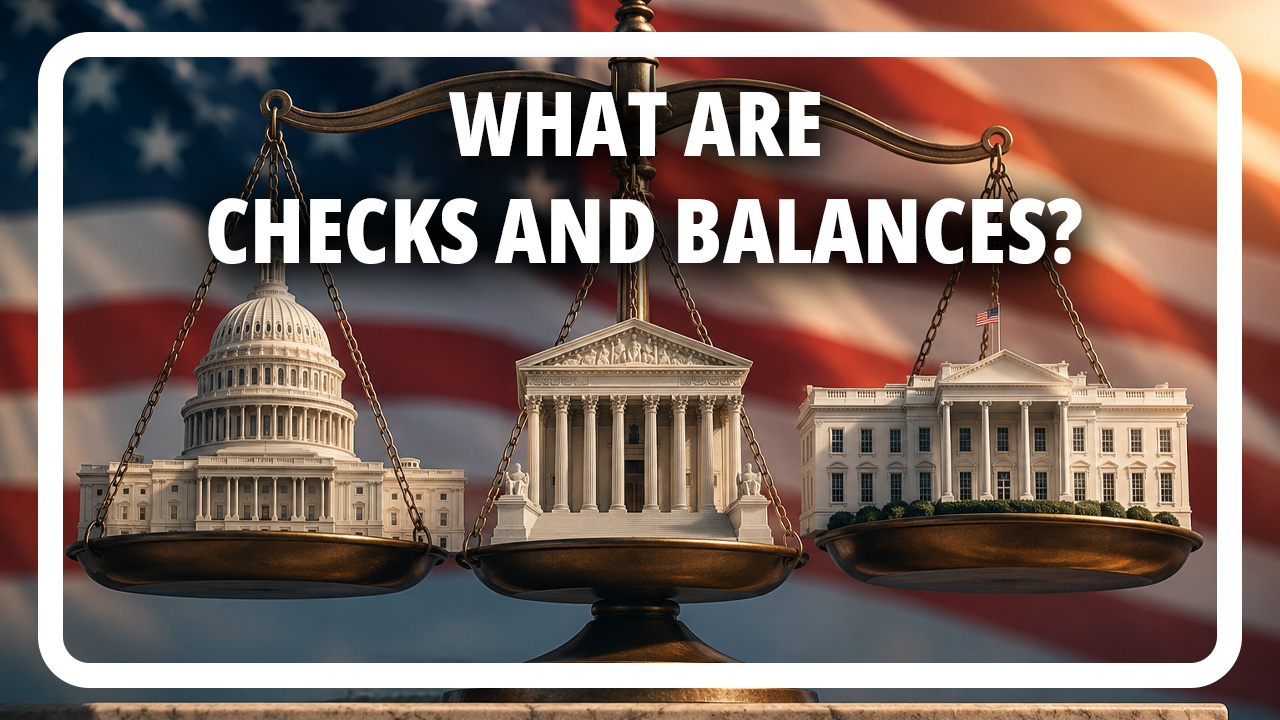
What are checks and balances, and why do they matter? Learn how the legislative, executive, and judicial branches limit one another's power, what happens when those safeguards weaken, and how citizens can help protect American democracy. Featuring insights from experts across The Democracy Group podcast network.
Read PostSubscribe to receive a biweekly collection of the hottest podcast episodes from the network, upcoming special events, expert features and news from your favorite shows.
Subscribe to our NewsletterChecks and balances are a system of government in which different branches have powers that allow them to limit or oversee one another, helping prevent any single person or institution from accumulating excessive authority. In the United States, this system operates through three co-equal branches: the legislative branch, which makes laws; the executive branch, which carries out and enforces laws; and the judicial branch, which interprets laws and the Constitution. Each branch has enough authority to fulfill its responsibilities but also possesses specific powers that can check the actions of the others. These formal constitutional safeguards are reinforced by informal checks, including ethical norms and expectations that public officials respect the limits of their offices.
The judicial branch is one of the three co-equal branches of the U.S. federal government and plays a central role in the system of checks and balances by interpreting laws and the Constitution. Federal courts can check the legislative branch by declaring laws unconstitutional through judicial review, and they can check the executive branch by ruling that executive actions, regulations, or executive orders are unlawful or unconstitutional and by requiring executive officials to follow the law. At the same time, the judiciary is itself checked by the other branches: the president nominates federal judges and Supreme Court justices, while the Senate confirms them; Congress can create lower federal courts, impeach federal judges, revise legislation in response to court decisions, and propose constitutional amendments that can overturn certain constitutional interpretations.
The executive branch, headed by the president, carries out and enforces federal laws while participating in the U.S. system of checks and balances. The president can check the legislative branch by vetoing bills passed by Congress and can check the judicial branch by nominating federal judges and Supreme Court justices and exercising clemency powers, including pardons and commutations for federal crimes. At the same time, executive power is limited by Congress, which controls federal spending, can override presidential vetoes, confirms many presidential appointments, conducts oversight, and can use the impeachment process. Federal courts provide another check by reviewing executive actions and ruling them unlawful or unconstitutional.
Brandon Stover is the Network Manager for The Democracy Group and a Digital Content Specialist at the McCourtney Institute for Democracy. He leads partnerships and collaborations across the podcast network, oversees educational content strategy, and produces written, audio, and video content while managing the network's digital marketing efforts. Before joining the McCourtney Institute for Democracy, Brandon founded and led a nonprofit organization dedicated to creating free educational content on global issues. He holds a master's degree in Architecture from Washington State University.
Engaging in civil discourse. Inspiring civic engagement. Exploring the future of our democracy.
Join our community and never miss your favorite episodes from the Democracy Group.
Subscribe to our Newsletter