

Misinformation spreads when people share false or misleading information they mistakenly believe is true. It can travel through social media, news outlets, podcasts, messaging apps, and everyday conversations. Social media algorithms can amplify misinformation by recommending engaging content to more users, while emotionally charged claims and trusted personal relationships can encourage people to share information without verifying it. Artificial intelligence can also accelerate the spread by making convincing fake images, videos, and articles easier to create. Together, these factors allow false information to reach large audiences quickly, sometimes before anyone has checked whether it is accurate.
One of the simplest ways misinformation spreads is through ordinary people sharing information with friends, family, or followers.
Pauline Hoffman, an infodemiologist and author of Fake News, Witch Hunts, and Conspiracy Theories, explains that misinformation often spreads because people genuinely believe what they're sharing.
Imagine seeing a social media post claiming that a new law has passed. Your friend shared it, and you trust their judgment. Without checking the original source, you share it with your followers.
Unfortunately, the law never passed.
You've now spread misinformation, even though you had no intention of deceiving anyone.
This is what distinguishes misinformation from disinformation. Disinformation is deliberately spread to deceive, while misinformation is shared without that intention. The same false claim can begin as deliberate disinformation and then spread as misinformation when people unknowingly pass it along.
Social media has dramatically changed how quickly information can reach large audiences.
Platforms such as Facebook, TikTok, YouTube, and Instagram use recommendation algorithms to determine which content users are likely to engage with. These systems can amplify misleading content, particularly when it generates strong reactions.
Angelo Carusone, president of Media Matters for America, describes how recommendation algorithms can gradually expose users to increasingly extreme content.
For example, someone watching a political video might subsequently receive recommendations for conspiracy theories or misleading political commentary. If they engage with that content, the algorithm may recommend more of it.
Over time, users can find themselves consuming increasingly narrow or misleading information without intentionally seeking it out.
Importantly, social media doesn't necessarily create the misinformation. It often amplifies information that already exists, allowing false claims to spread far beyond their original audience.
Misinformation can also spread because it appeals to people's emotions.
Content that provokes fear, anger, outrage, or excitement may encourage people to react immediately rather than stop and evaluate whether a claim is accurate.
Samuel C. Spitale, author of How to Win the War on Truth, emphasizes the importance of examining the emotions a message is designed to provoke.
For example, a sensational headline might claim that a politician has secretly enacted an outrageous policy. Someone who already distrusts that politician may be more inclined to believe and share the claim without verifying it.
This connects to confirmation bias, our tendency to favor information that reinforces our existing beliefs.
When misinformation tells us something we already suspect or want to believe, we may be less motivated to question it.
Although social media receives considerable attention, misinformation also spreads through influential public figures and traditional media.
Jonathan Rauch, author of The Constitution of Knowledge, argues that politicians and cable news can play major roles in spreading false narratives.
When a prominent political figure makes a misleading claim, journalists may report on it because the statement itself is newsworthy. The claim can then circulate through television, podcasts, social media, and conversations.
Even when journalists challenge or correct the statement, repeated exposure can make the original claim more familiar.
Rauch also describes a strategy called the firehose of falsehood, in which large quantities of false claims, exaggerations, and conspiracy theories are circulated through multiple channels.
The resulting information overload can make it difficult for audiences to determine which claims are credible.
Generative artificial intelligence introduces another challenge.
AI tools can create realistic-looking photographs, convincing audio recordings, fabricated videos, and entire news articles describing events that never occurred.
Simone Leeper, senior legal counsel at the Campaign Legal Center, explains that AI-generated content can provide seemingly convincing evidence for claims that are entirely false.
For example, someone might encounter an AI-generated recording of a politician appearing to make a controversial statement. Believing the recording is authentic, they share it with others.
The technology doesn't necessarily change why people believe misinformation, but it can make false claims easier to produce and harder to recognize.
Fortunately, everyone can help slow the spread of misinformation.
Jason Reifler, a political scientist who studies misinformation, recommends checking questionable claims against credible sources and established fact-checking organizations such as PolitiFact, FactCheck.org, and Snopes.
Before sharing something, consider where the information originated, whether independent sources confirm it, and whether it might be designed to provoke an emotional reaction.
Hoffman offers a particularly simple reminder: "Care before you share."
Ultimately, misinformation spreads because false claims move through the same networks of trust, communication, and technology as accurate information.
We may not be able to control everything we encounter online, but we can control what we pass along to others. Taking a few moments to verify a claim before sharing it can help prevent misinformation from reaching the next person.
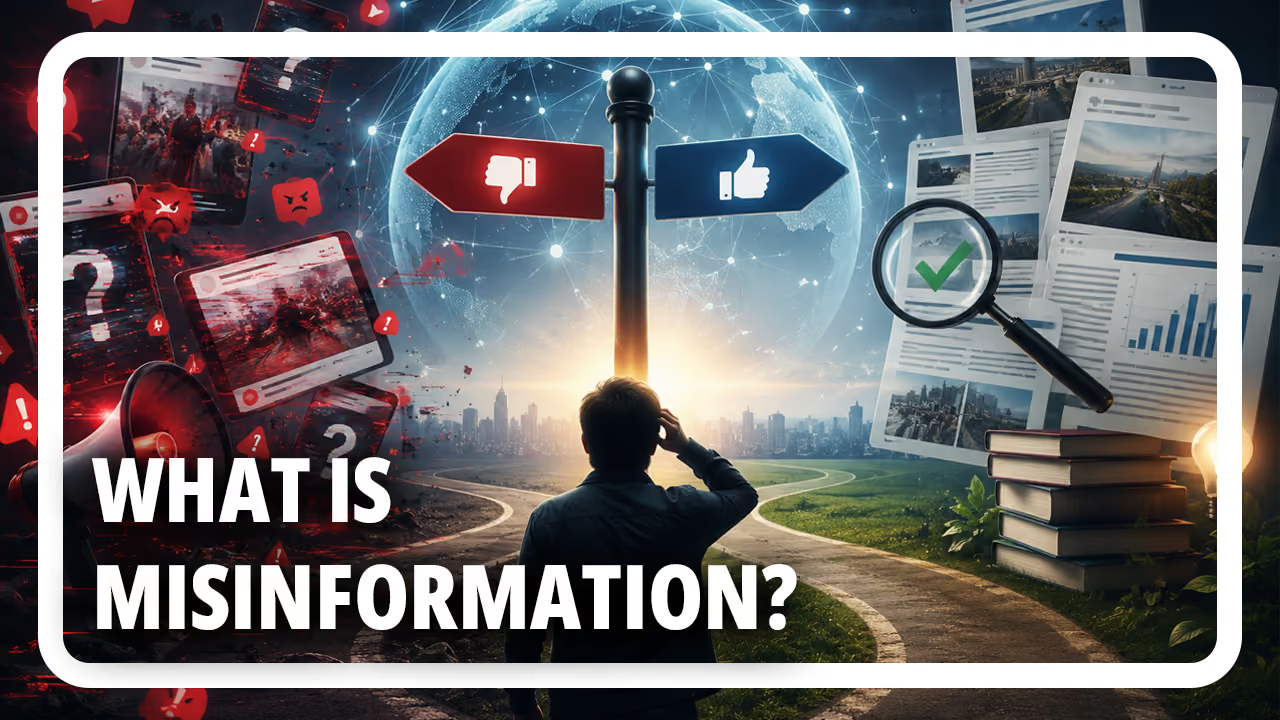
What is misinformation, and how does it spread so quickly online? Learn the difference between misinformation and disinformation, how social media and AI amplify false narratives, and what experts say you can do to protect yourself and strengthen democracy.
Read PostSubscribe to receive a biweekly collection of the hottest podcast episodes from the network, upcoming special events, expert features and news from your favorite shows.
Subscribe to our NewsletterMisinformation is false, inaccurate, or misleading information that is shared without the intention to deceive. It occurs when someone believes something is true and passes it along to others, even though the information is incorrect. Misinformation can take many forms, including false news stories, misleading social media posts, inaccurate statistics, and rumors. Unlike disinformation, which is deliberately created or spread to deceive people, misinformation is generally shared in good faith. However, both can influence public opinion, create confusion, and undermine trust in reliable information.
Misinformation is bad because false or misleading information can cause people to make decisions based on things that aren't true. It can harm public health, influence elections, damage reputations, increase political polarization, and undermine trust in reliable sources of information. Even when misinformation is shared without malicious intent, its consequences can be serious. In a democracy, widespread misinformation is particularly dangerous because citizens need accurate information to evaluate political leaders, debate public policies, and make informed voting decisions. When people cannot agree on basic facts, solving shared problems becomes much more difficult.
Misinformation affects democracy by making it harder for citizens to make informed decisions, participate in elections, and hold political leaders accountable. False or misleading information can distort voters' understanding of candidates and policies, discourage electoral participation, increase political polarization, and undermine trust in democratic institutions. When misinformation becomes widespread, people may struggle to agree on basic facts, making productive debate and compromise more difficult. Because democracy depends on an informed public, the spread of misinformation can weaken the foundations of democratic governance, even when false information is shared without malicious intent.
The main difference between misinformation and disinformation is intent. Misinformation is false or misleading information shared by someone who believes it is true, while disinformation is false or misleading information deliberately spread to deceive or manipulate others. For example, someone who knowingly creates a fake news story to influence an election is spreading disinformation. However, someone who believes that story and shares it with friends is spreading misinformation. Both can cause harm by misleading the public, influencing decisions, and undermining trust in reliable information, but only disinformation necessarily involves intentional deception.
To combat misinformation, verify information before sharing it, evaluate the credibility of sources, check claims against reliable evidence, and develop strong media literacy skills. Be especially cautious of sensational headlines, emotionally charged messages, and suspicious images or videos. Fact-checking organizations such as PolitiFact, FactCheck.org, and Snopes can help identify false claims. Combating misinformation also requires educating others, correcting falsehoods respectfully, and supporting trustworthy journalism and institutions. While misinformation cannot be eliminated entirely, individuals and organizations can reduce its spread by promoting accurate information and encouraging critical thinking.
Brandon Stover is the Network Manager for The Democracy Group and a Digital Content Specialist at the McCourtney Institute for Democracy. He leads partnerships and collaborations across the podcast network, oversees educational content strategy, and produces written, audio, and video content while managing the network's digital marketing efforts. Before joining the McCourtney Institute for Democracy, Brandon founded and led a nonprofit organization dedicated to creating free educational content on global issues. He holds a master's degree in Architecture from Washington State University.
Engaging in civil discourse. Inspiring civic engagement. Exploring the future of our democracy.
Join our community and never miss your favorite episodes from the Democracy Group.
Subscribe to our Newsletter