

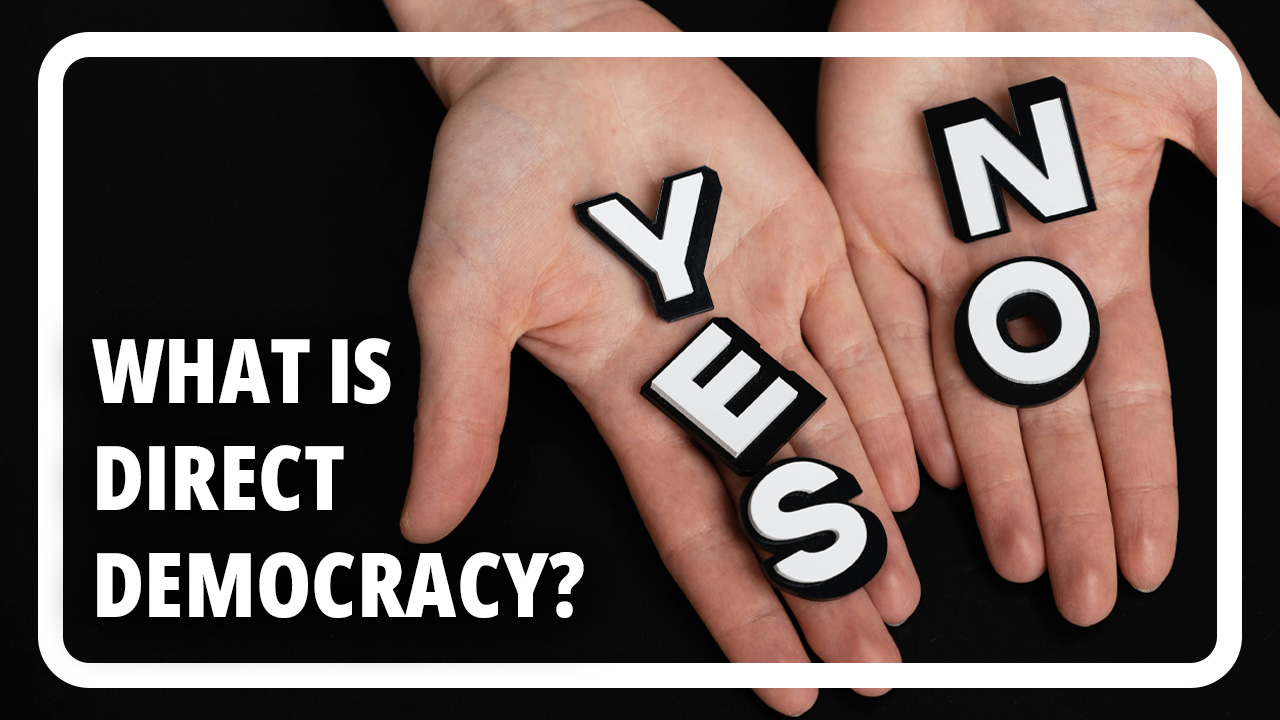
“Democracy” is a broad term that refers to a system of government in which supreme power is vested in the people and exercised by them either directly or indirectly. This system branches into two main types: indirect democracies and direct democracies.
An indirect democracy, also known as a representative democracy, is a system in which elected officials vote on laws and policies on behalf of the people.
Direct democracy is a system of government in which citizens make policy decisions and pass laws directly, rather than through elected representatives, typically using majority rule. It empowers voters to directly influence governance by bypassing legislative bodies through mechanisms such as referendums, initiatives, and recalls. These mechanisms often operate at the state or local level.
A well-known historical example is Ancient Athens. While direct democracy is rare at the national level, many countries use it for specific issues. Switzerland is a prominent modern example of incorporating direct democracy at the national level.
Proponents argue that direct democracy increases civic engagement, strengthens accountability, and makes government more representative of the public’s will. Critics, however, suggest it can lead to voter fatigue, increase the risk that minority rights may be overlooked, and require voters to decide on complex issues without sufficient knowledge.
The key mechanisms through which direct democracy is enacted include:
In the following podcast excerpts, we’ll unpack two of these three mechanisms.
Related: If you teach political science, our free syllabus guide curates the best democracy podcasts on topics just like this—ready to assign.
Subscribe to receive a biweekly collection of the hottest podcast episodes from the network, upcoming special events, expert features, and news from your favorite shows.
Subscribe to our NewsletterFrancesco Veri, Senior Researcher at the Centre for Democracy Studies at the University of Zurich and an associate at the Centre for Deliberative Democracy and Global Governance at the University of Canberra, explains how referendums function as a tool of direct democracy within representative systems.
Francesco Veri:
“I’ve done some work on what we call indirect democracy — democracy through referendums.
When people go to vote in Switzerland, we have a very strong referendum system. We vote on probably 20 to 25 issues a year at different levels — local, regional, and national. One of the specific features of the Swiss system is that it’s very bottom-up.
If people don’t like a law, they can collect signatures to oppose it. If they collect enough signatures, the law is put to a vote. Likewise, if they want to propose a new law, they can collect signatures to bring that proposal to a vote. That’s how the popular initiative and what we call the optional referendum work.
We’ve studied these dynamics and how referendums can improve democracy. In Switzerland, referendums are very effective because they allow people to participate directly in democratic governance. This is linked to high levels of trust. Switzerland probably has one of the highest levels of institutional trust in the world.
Participation and trust are deeply connected. And because we vote so many times each year, it forces political leaders to clearly present and explain their political agendas.”
Listen to the full episode on The True Representation Movement: Direct Democracy vs. Representative Democracy
Next, we’ll explore ballot initiatives.
Chris Melody Fields Figueredo is the Executive Director of the Ballot Initiative Strategy Center, an organization that seeks to strengthen democracy by building a national progressive strategy for ballot measures. She explains how ballot initiatives put issues directly into the hands of voters — outside the traditional two-party legislative process.
Chris Melody Fields Figueredo:
“You can think about ballot measures as the people’s tool — a form of direct democracy. What that means is it enables us, as citizens in about half the country, plus D.C. to take critical issues facing our communities, gather signatures, and put those issues directly before voters.
We go out into our communities, have conversations, collect signatures, and then place something on the ballot that we think is important — something our city council or state legislature may not have addressed.
Now, only about half the country has a citizen-initiated process. In other states, the legislature can refer something to the ballot. For example, on abortion, many state legislatures referred constitutional amendments to voters — either to impose abortion bans, like we saw in Kentucky and Kansas in 2022, or to affirmatively protect reproductive rights, like we saw in Vermont, Michigan, and California.
That’s why we call it the people’s tool. It gives us power in a different way than going before Congress, talking to legislators, writing letters, or marching in the streets. It engages us more deeply in shaping policy and making changes for our communities.”
Listen to the full episode on Future Hindsight: Ballot Initiatives For Direct Democracy
Fields Figueredo also shares how ballot initiatives can serve underrepresented communities within a nation.
Fields Figueredo:
“I saw an opportunity, as a queer woman of color, to lead an organization at a time when voices like mine were really important — important in steering the direction of what we want this country to be.
In all honesty, this country and this democracy were not built for me. They were not built for a queer Latinx immigrant. And so it felt like what I was supposed to do — to ensure that my people, yes, queer Latinx people, but also my broader community and the people I love from all walks of life — had a voice and a choice in the direction our country would take.
For me, ballot measures are one of the purest forms of democracy. What’s more direct than putting issues before voters themselves and letting them have a say?”
Spinelle:
“We’re really wrestling with the question: Do ballot initiatives serve the many or the few?”
Fields Figueredo:
“I think they can serve the many. Right now, a lot of people don’t believe government and politics serve the many — they believe it serves the few. Most people don’t see themselves represented, reflected, heard, or listened to. And that’s a problem, because democracy is supposed to be a forum by the people. Many folks don’t feel that right now, especially in this moment.
I think ballot initiatives can serve the many if they’re rooted in people and community — if we take a coalition-based approach. If it’s just one wealthy individual trying to push something through, that’s limited. But if we return to what ballot measures were originally intended to be — citizen-led and driven by us, the people — then yes, I believe they can serve the many.
And listen, in a democracy, not everyone is going to be happy. We’re all different. We all want different and sometimes opposing things. But if love and belonging are at the core, then you ultimately serve far more people.”
Listen to the full episode on When the people decide: For the many or the few?
Jenna Spinelle, host of When the People Decide, and John Matsusaka, Director of the Initiative and Referendum Institute at the University of Southern California, discuss common criticisms of ballot initiatives. These critiques are important to consider when designing measures and campaigns that are truly democratic and serve the many, not the few.
Matsusaka:
“It turns out that voters are actually very good at navigating what political scientists call ‘cues’ — what most people would call endorsements or advice. As long as there are enough cues available, research suggests that people can find their way to vote in an informed and intelligent manner.”
Spinelle:
“I’ll admit that throughout the series we heard a lot of rosy language about the power of initiatives, but I do want to address some of the cons.
From my research, the objections to initiatives often include, first, that they increase polarization by forcing voters to choose one position or another, eliminating opportunities for compromise.
Second, that the process can erode trust in government. If voters are asked to weigh in on an issue, they might wonder, ‘Why haven’t my elected officials fixed this problem?’ Many initiative campaigns answer that question by vilifying legislators as corrupt or untrustworthy. That might earn votes, but it’s not necessarily good for long-term trust in government.
And third, that all of this takes a lot of money and time — especially when someone wants to oppose an initiative they disagree with. A regular citizen can lobby the legislature, though as we’ve heard in previous episodes, citizens often resort to ballot initiatives because the legislature wasn’t taking action on an issue they cared about. They can try to place a countermeasure on the ballot, like we heard about with California’s Three Strikes law in Episode Two, but that requires significant work, funding, and strategic planning. They can also challenge an initiative in court, which happens frequently.
It’s also worth noting that ballot initiatives are more likely to be overturned by courts than traditional legislation. But all of these pathways take time and money, which can restrict access to direct democracy.”
Spinelle notes, however, that direct democracy is common around the world. As Matsusaka explained in their interview, people do not look at places with direct democracy — internationally in countries like Germany and the United Kingdom, or here in the United States in states like California, Florida, and Massachusetts — and conclude that they are undesirable or undemocratic places to live.
Matsusaka:
“People don’t say, ‘Oh, those are terrible places to live. Nobody wants to go there. Those are undemocratic places. They don’t protect people’s liberties and rights.’”
Spinelle:
“Quite the contrary. John said the U.S. is a ‘weird outlier on the international stage for not letting citizens vote on national issues.’”
She suggests that the United States is out of step with how democracy functions in many other countries and proposes that we imagine incorporating national referendums — perhaps beginning with nonbinding versions that allow citizens to express their views on major issues.
Matsusaka:
“When people say they’re frustrated with American democracy, a lot of that frustration is focused on the federal government. People tend to be much happier with their state and local governments, where there’s more direct participation in decisions. It’s at the federal level where people feel they have no control.”
Spinelle adds that ballot initiatives could be a way to update American institutions so they better reflect today’s realities and operate more democratically.
Matsusaka:
“I think we need to maintain a spirit of innovation and experimentation. At the federal level, we’re in what I would call a democracy-deprived state, and people don’t even realize how deprived we are. Part of the challenge is helping people see that it doesn’t have to be this way. It’s not like this in much of the rest of the world.”
Listen to the full episode on When the people decide: For the many or the few?
Although John Matsusaka may have high hopes for direct democracy initiatives, others take a more cautious view. Ted Lascher and Joshua Dyck, authors of Initiatives Without Engagement: A Realistic Appraisal of Direct Democracy’s Secondary Effects, argue that the ballot initiative process fails to deliver many of the civic benefits commonly attributed to it — including increased political engagement. Ultimately, they contend that one of the core effects of direct democracy, as currently practiced, is to intensify political conflict.
Joshua Dyck:
“I think what I want people to understand about the way democracy works in the United States is that these forms of direct democracy we’ve developed aren’t necessarily what they appear to be. In their ideal form, they may represent a kind of pure democracy. That’s certainly how most people describe reforms like the ballot initiative, referendum, and recall — as direct democracy in America.
But I don’t really think that’s how the process functions in practice.
When we look at how voters behave, how initiative entrepreneurs operate, and how money influences politics, this isn’t truly direct democracy. There’s no real deliberation over these policies once they’re put forward. They’re presented in a simple yes-or-no format, and enormous sums of money are spent on campaigns surrounding them.
When we examine voting behavior after the fact, we find that decisions are heavily constrained by partisanship, ideology, and levels of trust in government. So when people vote on these issues, the implications extend beyond the specific policy. Our contribution to this conversation is pointing out that the level of conflict and rancor in society right now is already quite high.
Ballot initiatives have become a battlefield where that conflict expands — where we intensify polarization and grow to dislike each other even more. And we’re concerned about that. We don’t think that’s healthy for democracy or for democratic society’s long-term survival.
We still have a democracy — a representative democracy. There may be ways to lower the temperature around some of these ballot initiative elections. But as the system currently operates, it’s creating more conflict. Given the level of polarization that already exists, I have serious concerns about an institution that claims to support democracy while also reinforcing that polarization.”
Ted Lascher:
“The main thing I would add is that I hope voters approach the ballot box with a healthy skepticism — not necessarily about the legislature, but about the claims that direct democracy advocates often make regarding the failures of representative government. Those claims are frequently misleading, highly partisan, and sometimes extreme.”
Listen to the full episode on Democracy Works: Direct democracy's dark side
Direct democracy is neither a cure-all nor a catastrophe. As the voices in this article demonstrate, it is a powerful tool — one that can expand participation, elevate underrepresented communities, and give citizens a more direct hand in shaping policy. At its best, it can strengthen accountability, increase transparency, and foster a sense that government truly belongs to the people.
But power, especially political power, is never neutral. The same mechanisms that allow citizens to bypass gridlocked legislatures can also amplify polarization, attract large sums of money, and reduce complex policy debates to simple yes-or-no choices. Without deliberation, coalition-building, and thoughtful design, ballot measures can become arenas of conflict rather than forums for collective problem-solving.
The question, then, is not simply whether direct democracy is good or bad. The more important question is how it is structured, who has access to it, and whether it is rooted in broad civic participation or narrow interests.
In the United States — where frustration with national institutions runs high — direct democracy represents both an opportunity and a warning. It offers a way for citizens to feel heard when traditional representative channels seem unresponsive. At the same time, it challenges us to guard against reducing democracy to a series of expensive campaigns and polarized votes.
If democracy is, at its core, government by the people, then direct democracy asks something more of us than simply casting a ballot. It asks for informed engagement, a willingness to deliberate across differences, and a commitment to protecting both majority rule and minority rights.
Ultimately, direct democracy does not replace representative government — it interacts with it. Whether it strengthens or strains democratic society depends less on the mechanism itself and more on the civic culture surrounding it.
The tools are available. The responsibility for how they are used belongs to the public.
Subscribe to receive a biweekly collection of the hottest podcast episodes from the network, upcoming special events, expert features, and news from your favorite shows.
Subscribe to our NewsletterBrandon Stover is the Network Manager for The Democracy Group and a Digital Content Specialist at the McCourtney Institute for Democracy. He leads partnerships and collaborations across the podcast network, oversees educational content strategy, and produces written, audio, and video content while managing the network's digital marketing efforts. Before joining the McCourtney Institute for Democracy, Brandon founded and led a nonprofit organization dedicated to creating free educational content on global issues. He holds a master's degree in Architecture from Washington State University.
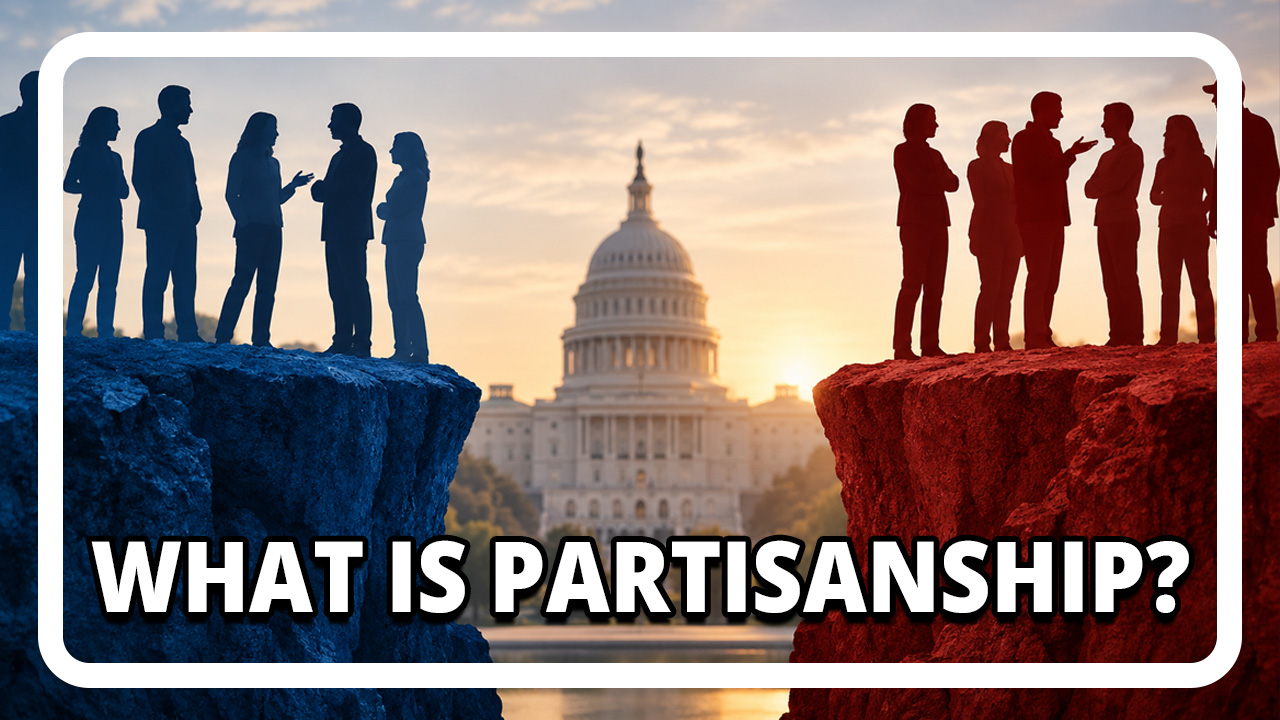
What is partisanship, and why does it divide us? Learn the psychology, consequences, and ways Americans can bridge the partisan divide.

What are the main types of government, and where does your country fall on the democracy-to-authoritarian spectrum? Learn the differences between democracy, republics, monarchies, oligarchies, anocracies, authoritarianism, and totalitarianism through expert insights from political scientists, historians, and democracy advocates featured across The Democracy Group podcast network.
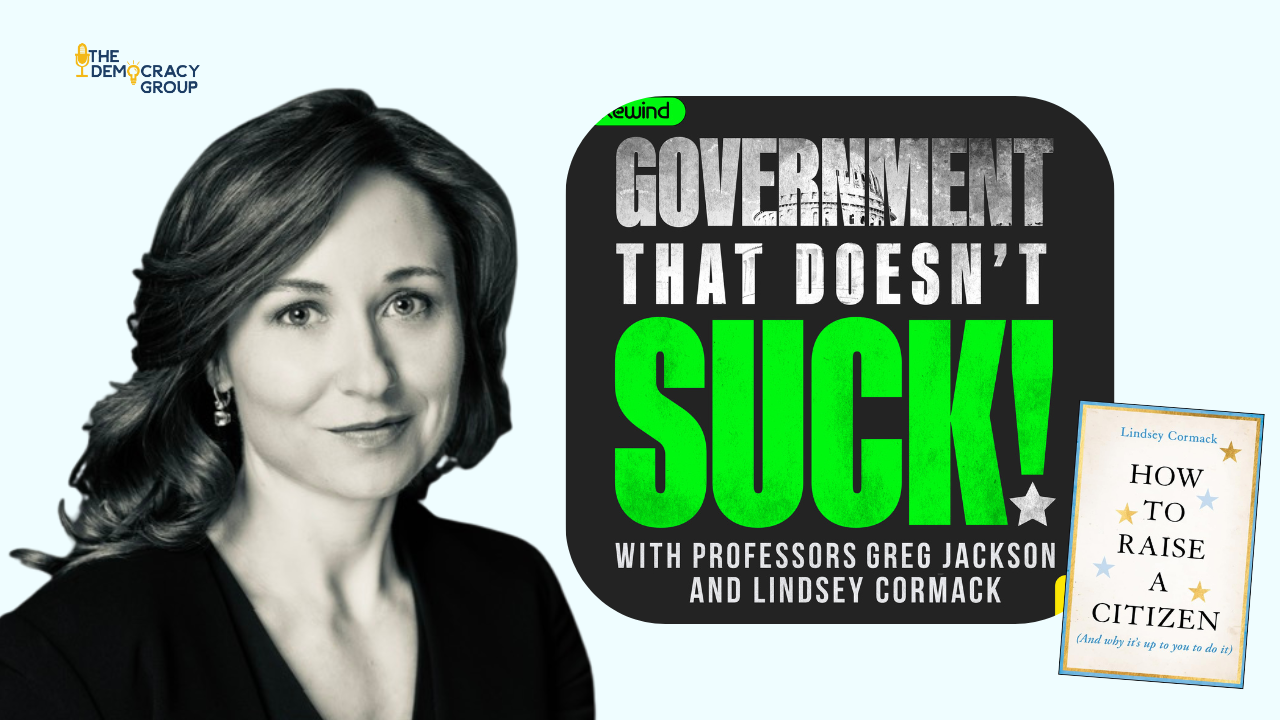
Lindsey Cormack discussed civic education, common misconceptions about government and what to expect from her new podcast "Government That Doesn't Suck."

Engaging in civil discourse. Inspiring civic engagement. Exploring the future of our democracy.
Join our community and never miss your favorite episodes from the Democracy Group.
Subscribe to our Newsletter